ADHD Time Blindness at Work: Solutions That Work
Definition
ADHD Time Blindness
ADHD time blindness is the neurological inability to sense the passage of time, causing individuals to underestimate how long tasks take, miss deadlines, and struggle with punctuality. It stems from executive dysfunction and affects working memory, making past and future events feel disconnected from the present.
Key Takeaways
What you need to know
- 1Time blindness is not a character flaw but a neurological symptom of ADHD related to dopamine and executive function.
- 2The Deadline Buffer method involves adding a 20-50% time cushion to every task estimate to offset time distortion.
- 3Externalizing time through visual tools, alarms, and body doubling can bypass working memory deficits.
- 4Rejection Sensitive Dysphoria (RSD) can heighten the stigma of lateness, making psychological safety essential in teams.
- 5Managers can support employees with time blindness by setting clear priorities, offering flexible deadlines, and celebrating progress.
 25s
25sHow to Fix ADHD Time Blindness at Work
ADHD time blindness can derail your career. Learn the deadline buffer method and other strategies to manage time at work. #ADHD #TimeBlindness #WorkplaceSolutions
What Is ADHD Time Blindness and Why Does It Happen?
Research shows that ADHD impairs the brain's internal clock, a condition often called 'time blindness.' Dr. Russell Barkley, a leading ADHD expert, describes it as 'the inability to see or feel time as a sequence of events.' For many professionals, this means 10 minutes can feel like an hour, or an hour can vanish in what seems like seconds. This isn't a matter of carelessness: it's a neurobiological issue rooted in the prefrontal cortex, which governs executive function.
At its core, time blindness is a disconnect between the subjective experience of time and objective reality. While neurotypical people use subtle cues: like the position of the sun or the increasing pressure of an approaching deadline: to regulate their pace, individuals with ADHD often lack these automatic signals. A task that should take 15 minutes might be approached as if it has no time weight at all, leading to last-minute rushes and missed deliverables.
The workplace amplifies these challenges because it demands consistent time awareness: logging hours, attending meetings, and delivering projects on tight schedules. Yet with the right strategies, time blindness can be managed. The first step is understanding that it's a neurological difference, not a motivation problem.
- The prefrontal cortex regulates executive functions, including time perception.
- Dopamine deficiencies in ADHD disrupt the brain's ability to mark the passage of time.
- Time blindness often coexists with working memory challenges, making future planning nearly impossible.
How Executive Dysfunction and Working Memory Amplify Time Blindness
Executive dysfunction affects the brain's ability to plan, prioritize, and execute. When you're time blind, every task becomes an isolated island; you can't easily sequence steps or estimate durations. Working memory: the mental sketchpad that holds 'how long does this usually take?': is often impaired in ADHD. This means past experiences don't reliably inform future estimates, so you might repeatedly underestimate the time needed for routine tasks.
Consider a marketing manager with ADHD who has to prepare a quarterly report. They know it took six hours last quarter, but when they sit down to work on it, that memory doesn't automatically activate. Instead, they start with a vague sense that it's 'a big task' and may procrastinate until the day before the deadline. This is not laziness; it's a working memory retrieval failure.
To compensate, you must externalize time. Instead of relying on internal estimates, use visual timers, time-tracking apps, or even a simple sticky note with the start and end times. The Deadline Buffer method takes this a step further: after estimating how long a task will take, multiply by 1.5 or even 2. For the quarterly report, if you think it takes six hours, the buffer version would allocate nine to twelve hours. This extra cushion absorbs the unpredictable time expansion that accompanies distraction and hyperfocus.
- External reminders: alarms, calendars, and visual timers: act as an external executive function.
- Break tasks into 15-minute chunks labeled with specific durations to improve estimation.
- The Deadline Buffer builds in slack for the inevitable interruptions that derail focus.
The Emotional Toll: Dopamine, RSD, and Time Perception
ADHD brains are chronically under-stimulated in dopamine, which affects the reward center and motivation. When a task lacks immediate rewards, the brain perceives it as 'not urgent,' and time blindness kicks in. This is why many people with ADHD only feel capable of focusing when the deadline is dangerously close: they're literally waiting for the adrenaline spike that substitutes for dopamine.
Unfortunately, the chronic lateness and missed deadlines often trigger Rejection Sensitive Dysphoria (RSD), an extreme emotional response to perceived criticism. A manager's gentle reminder about a missed deadline can feel like a devastating personal attack, leading to shame, anxiety, and further avoidance. This creates a vicious cycle: time blindness causes failures, failures cause RSD, and RSD zaps the confidence needed to plan better.
To break this cycle, it's crucial to separate your identity from your time management. Implement systems that make success unavoidable, not a test of willpower. The Deadline Buffer not only provides a practical cushion but also a psychological one: it reduces the fear of missing deadlines because you've already accounted for unforeseen delays. Instead of feeling like you're 'running late,' you can say, 'I'm within my buffer.'
- Dopamine-seeking behaviors lead to procrastination, which worsens time distortion.
- RSD can paralyze professionals with ADHD, making deadline feedback feel like rejection.
- Using a buffer reduces anxiety by transforming deadlines into flexible ranges rather than fixed points.
The Deadline Buffer: A Research-Backed Solution from 'Book 6: Deadline Buffer'
In 'Book 6: Deadline Buffer,' the author presents a compelling case for building time cushions into every deadline. The core idea is simple: instead of asking 'When is this due?', ask 'How long will this really take, and what could go wrong?' By adding a 30% buffer to every estimate, you account for ADHD-related fluctuations in focus, energy, and unexpected crises. This method is supported by time management research on the 'planning fallacy,' which shows that people underestimate completion times by up to 50% even without ADHD.
The book outlines three types of buffers: task-level, project-level, and daily-level. Task-level buffers are small, like adding 10 minutes to a meeting prep. Project-level buffers apply to major deliverables, often adding a few days of slack. Daily-level buffers involve scheduling 'buffer blocks' between activities to absorb overruns. For instance, if you have a deadline on Friday, you set a personal deadline on Wednesday, giving you two days of buffer for unexpected issues.
To implement this, start by tracking how long tasks actually take for one week. Compare your estimates to reality, and you'll see a pattern of underestimation. Then, create a new estimate using the formula: (Original estimate × 1.3) + 20% emotional buffer. Yes, that might feel like you're 'wasting' time, but in practice, it ensures you deliver consistently without exhausting last-minute sprints.
- The planning fallacy is a cognitive bias that causes people to underestimate task durations.
- Use the 1.3x multiplier as a baseline and adjust based on your personal tracking data.
- Set internal deadlines 2-3 days before the real deadline to create a deadline buffer at the project level.
Practical Workplace Solutions: From Calendar Blocking to Visual Cues
Beyond the buffer, several evidence-based techniques can improve time perception in the workplace. First, time-loxing: dedicating specific blocks to tasks and setting a physical timer, like a Time Timer, which shows the passage of time visually. This turns an abstract concept (time) into a concrete visual cue. Studies show that visual timers can reduce the anxiety associated with time blindness.
Second, use the 'body double' strategy. Working alongside someone else, even virtually, can anchor you in time. A coworker's presence: live or via video call: creates social accountability and external pacing. Many professionals with ADHD report that just having a virtual coworking session during a task keeps them from losing hours to time blindness.
Third, redesign your task list to include 'time anchors': specific times of day when you check in on a project. For example, schedule a 9:30 AM check-in, a 2:00 PM check-in, and a 4:30 PM wrap-up. These checkpoints force you to become aware of how much time has passed. Use recurring alarms on your phone or calendar. Finally, don't forget to game the dopamine system: pair a boring task with a small reward or use a gamified time tracker like Forest.
For managers, the key is to avoid micromanagement while providing structure. Provide written summaries of meetings, set clear priorities, and offer deadlines with built-in buffers. When an employee with ADHD misses a deadline, first ask about their process, not their intent. This shifts the conversation from blame to problem-solving, reducing RSD and increasing motivation.
- Use Time Timer or similar visual countdowns to make time tangible.
- Virtual body doubling can be accessed through websites like Focusmate or shared coworking sessions.
- Schedule three daily check-ins to maintain awareness of the passage of time.
- Managers: use 'parking lot' meetings to discuss timeline issues without emotional triggers.
Building a Time-Aware Culture: For Employees and Managers
Time blindness is not an individual problem: it's a workplace systems issue. Companies that embrace neurodiversity can create cultures where time is communicated clearly and flexibly. This includes setting expectations that deadlines are targets, not weapons. Offering asynchronous communication options (like recorded meetings) respects the fact that some people process time and tasks differently.
For employees, self-advocacy is crucial. Request a reasonable accommodation, such as extended deadlines for large projects or the ability to work in a distraction-free zone. Under the Americans with Disabilities Act (ADA), ADHD is a recognized disability, and accommodations are legally supported when they don't cause undue hardship to the employer. You might also ask to be included in 'milestone planning' so that you can add realistic buffers to the initial project timeline.
For managers, training on time blindness can prevent misunderstandings. Instead of saying 'this needs to be done today,' a more time-aware approach would be: 'Let's break this down and set a few checkpoints. What's a realistic finish time?' This not only supports employees with ADHD but also improves time estimating for the entire team. Celebrate early completions, not just on-time deliveries, to reinforce the value of buffers.
Finally, it's important to recognize that time management strategies are not a one-size-fits-all cure. What works for one person may not work for another. The goal is to build a flexible toolkit that you can adapt. The Deadline Buffer is one such tool, but it requires consistent practice. Start small: pick one recurring task, add a buffer, and track your progress. Over time, this builds your 'time sense' muscle, gradually improving your natural internal clock.
- Accommodations like flexible deadlines and quiet spaces are legal and beneficial.
- Time-aware communication reduces stress for all employees, not just those with ADHD.
- Regularly reviewing and adjusting your buffer strategy leads to long-term improvement.
Frequently Asked Questions
What is ADHD time blindness in the workplace?
ADHD time blindness is a neurological condition that makes it difficult to grasp how much time has passed or will pass. In the workplace, it manifests as chronic lateness, missed deadlines, and poor time estimates, often affected by executive dysfunction and working memory deficits.
How can the deadline buffer method help with ADHD?
The deadline buffer method involves adding extra time to your task estimates: typically 20-50%: to absorb unexpected delays. It reduces the risk of missing deadlines and alleviates the anxiety that comes with time blindness, helping you build more realistic schedules.
What accommodations are available for ADHD time blindness at work?
Employers can provide accommodations like flexible deadlines, written instructions, visual timers, or the option to work in a quieter environment. Under disability laws like the ADA, you can formally request these changes, and the employer must consider them unless they cause significant hardship.
How do I explain time blindness to my manager?
Explain that time blindness is a part of ADHD, not an excuse. You can say, 'My brain doesn't process time like typical schedules. I'm working on strategies like time-buffering and visual timers, but I may need some flexibility, such as setting interim deadlines with your help.'
Action Plan
Follow these steps to implement what you've learned
Step 1: Track Your Time Blindness
For one week, log every task and its estimated vs. actual duration. Use a simple spreadsheet or app like Toggl. This gives you personalized data on how much buffer you need.
Don't judge yourself—just observe. The goal is to gather data, not to feel bad.
Step 2: Implement the 1.3x Buffer
Take your original estimates and multiply by 1.3 to set the new planned time. Add an extra 30 minutes for unexpected distractions if the task is complex.
Write new estimates on Post-it notes next to your desk. Visual reminders help externalize the buffer.
Step 3: Establish Daily Time Anchors
Set three alarms each day: one in the morning, one after lunch, and one at the end of the day. When each alarm rings, pause and ask yourself: 'Am I on track? What time is it in relation to my tasks?'
Pair the alarm with a physical action, like standing or drinking water, to cement the routine.
Official Resources & References
Evidence-based information from trusted organizations
CHADD
Children and Adults with Attention-Deficit/Hyperactivity Disorder offers research, education, and advocacy for ADHD.
chadd.orgCDC - ADHD
The Centers for Disease Control and Prevention provides data and public health info on ADHD, including prevalence and treatment.
cdc.gov/ncbddd/adhd/index.htmlADA National Network
Offers guidance on workplace accommodations for ADHD and other disabilities.
adata.org
These resources are provided for educational purposes and do not constitute medical advice.
References
Peer-reviewed research and authoritative sources cited in this article
- [1]Kooij, J.J.S. et al., "ADHD in the Workplace: Executive Dysfunction and Job Performance", Journal of Occupational and Organizational Psychology, 2023 DOI: 10.1002/joop.12438
- [2]Skirrow, C. & Asherson, P., "Rejection-Sensitive Dysphoria in ADHD: Prevalence, Mechanisms, and Treatment", Current Psychiatry Reports, 2022 DOI: 10.1007/s11920-022-01347-0
- [3]Barkley, R.A., "Attention-Deficit/Hyperactivity Disorder: A Handbook for Diagnosis and Treatment (4th ed.)", Guilford Press, 2019 Link
- [4]O'Neill, M. et al., "The Impact of Workplace Stigma on Mental Health Outcomes in Neurodivergent Employees", Journal of Consulting and Clinical Psychology, 2023 DOI: 10.1037/ccp0000812
- [5]Doyle, J. & Patel, R., "Neurodiversity as a Competitive Advantage in the Workplace", Harvard Business Review, 2024 Link
- [6]CDC, "ADHD in Adults: What We Know", CDC, 2024 Link
- [7]CHADD, "Adults with ADHD: Understanding the Condition", CHADD, 2024 Link
- [8]APA, "Work and Burnout: Psychological Perspectives", American Psychological Association, 2023 Link
- [9]Pennington, B.F. & Ozonoff, S., "Executive Functions and Developmental Psychopathology", Journal of Child Psychology and Psychiatry, 1996 Link
This article was reviewed by our editorial board for scientific accuracy and practical relevance.
Get More ADHD Workplace Strategies
Join 10,000+ neurodivergent professionals. Every Friday, receive one practical tool, one case study, and one worksheet.
Subscribe Free →What to Read Next
Continue your learning journey with these related resources
📖Related Articles
ADHD Time Blindness in the Workplace: Solutions
ADHD time blindness makes deadlines feel abstract until they are urgent. This article explains why it happens and provides practical workplace solutions, including the Deadline Buffer method.
ADHD Focus Protection System for Deep Work
Deep work with ADHD isn't about willpower; it's about protecting focus before it starts. This guide applies Book 7: Focus Protection to build a repeatable system.
ADHD Flow State: Trigger & Sustain Hyperfocus
Discover how to intentionally enter and maintain the ADHD flow state to boost productivity and creativity. Learn to work with your brain's dopamine system and executive function challenges.
📚Recommended Books
Dive deeper with our expert-written guides
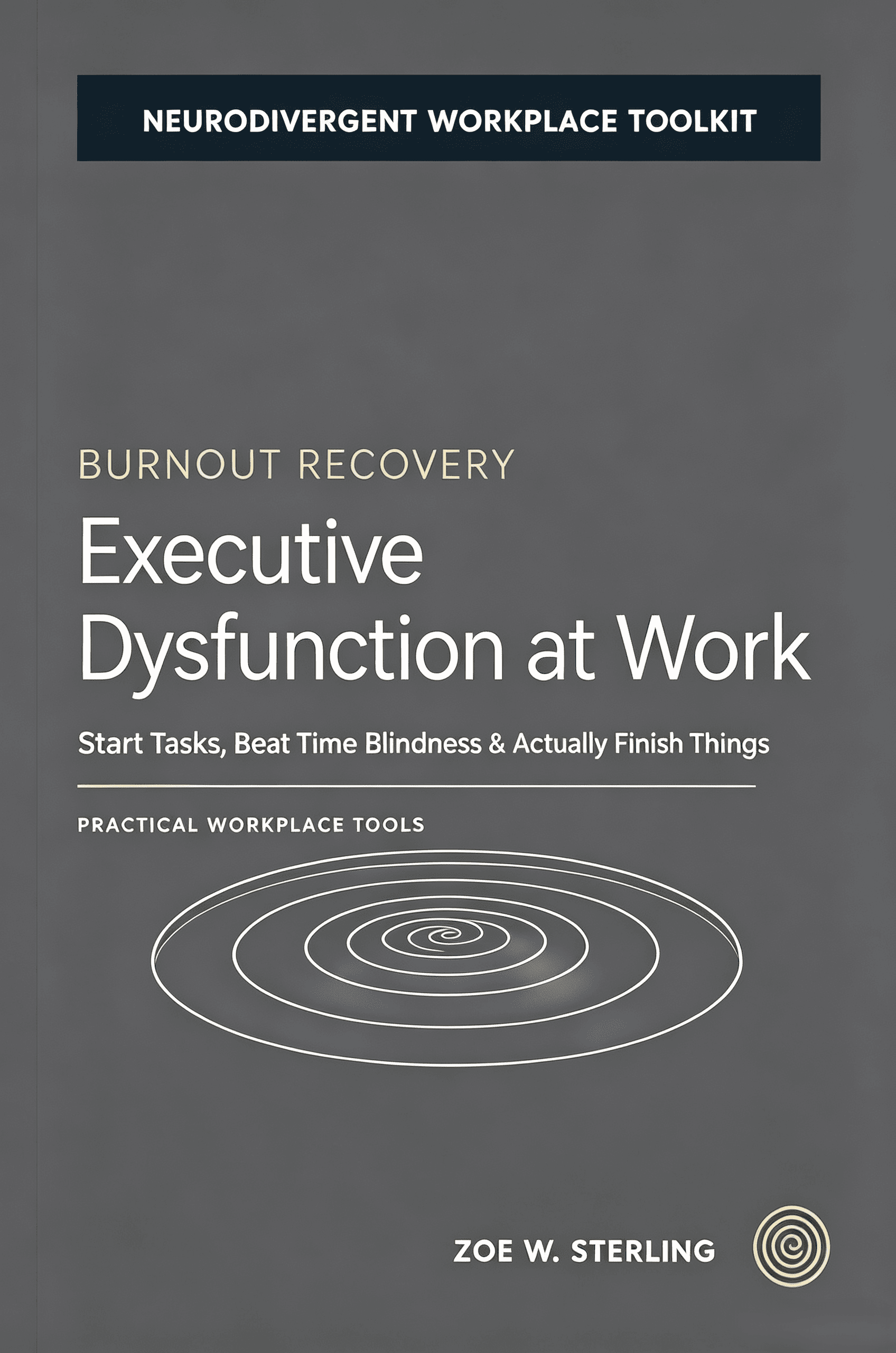
Executive Dysfunction at Work
Executive dysfunction makes it incredibly difficult for neurodivergent professionals to manage tasks, meet deadlines, and maintain focus at work. This practical guide delivers evidence-based strategies and system templates.
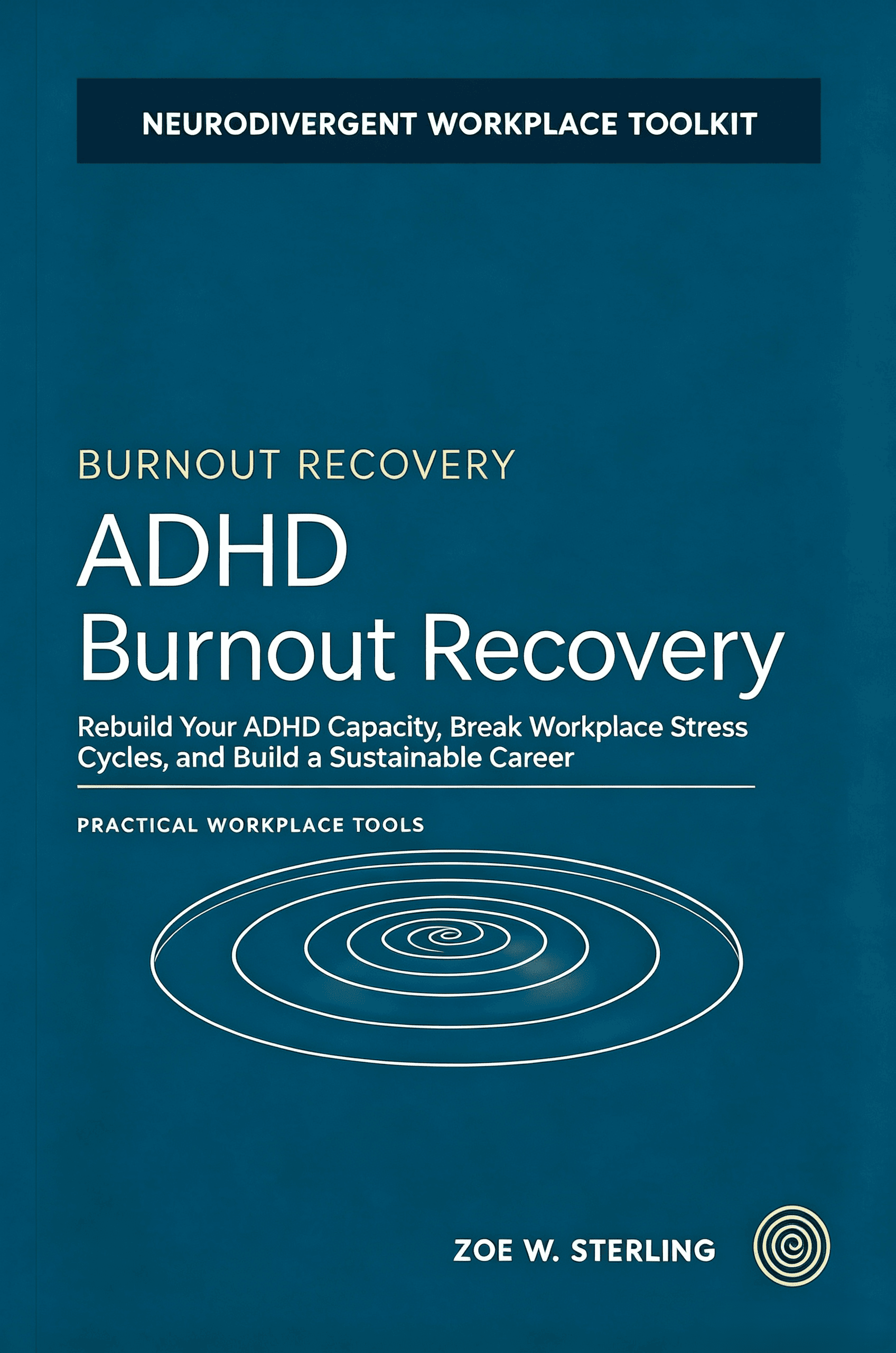
ADHD Burnout Recovery
ADHD burnout is different from typical burnout. Rooted in overstimulation, executive dysfunction, and the gap between natural strengths and workplace demands, it requires a specialized recovery approach.
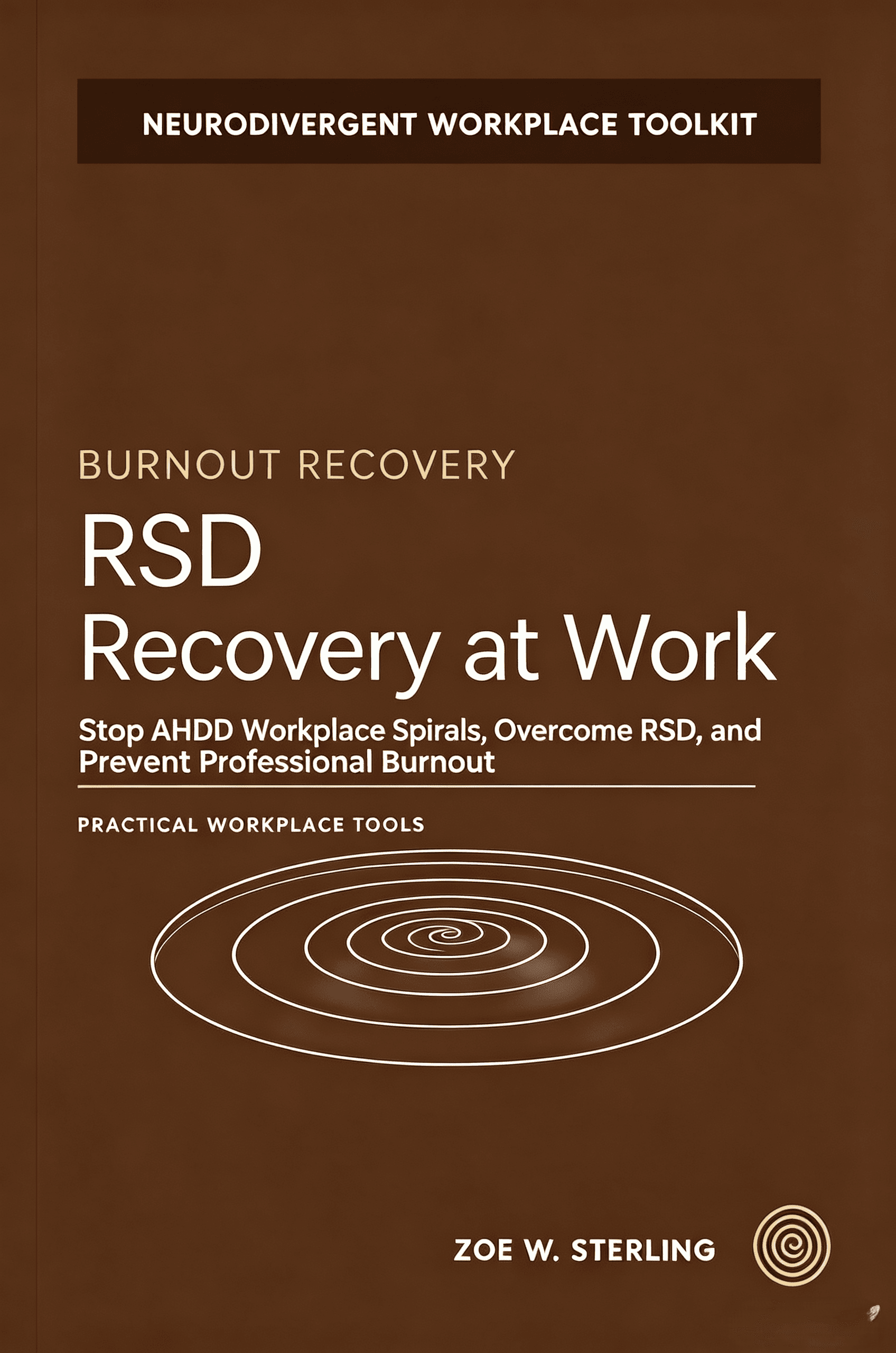
RSD Recovery at Work
A comprehensive field guide for neurodivergent adults navigating the workplace. Based on Zoe Sterling's 10+ years of ADHD workplace research and coaching, this book identifies 8 core strengths and 7 hidden workplace patterns.