Definition
ADHD hyperfocus
ADHD hyperfocus is a state of intense, often involuntary concentration on a task or interest, driven by dopamine reward circuits. It can lead to exceptional output but also time blindness and difficulty shifting attention.
Key Takeaways
What you need to know
- 1Hyperfocus is a dopamine-driven state that can be intentionally harnessed for workplace productivity.
- 2Environmental design and strategic scheduling are key to triggering productive hyperfocus.
- 3Transition management tools like alarms and pre-commitment rituals prevent burnout.
- 4Working memory aids and external systems compensate for executive function deficits.
- 5A personalized focus system, as outlined in Book 7: Focus System, outperforms generic productivity advice.
 25s
25sHyperfocus Hack: Turn ADHD Into Your Superpower
Learn how to use ADHD hyperfocus for productivity. Set a timer, clear distractions, and pick one task. More tips at NeurodivergentWorkplace.com. #ADHD #Hyperfocus #Productivity
Understanding ADHD Hyperfocus and Its Workplace Impact
ADHD hyperfocus is a state of intense concentration on a specific task or interest, often at the expense of everything else. Unlike popular perception, it's not a lack of attention but rather an inability to regulate attention. This condition stems from a dopamine imbalance in the prefrontal cortex, the brain area responsible for executive function, according to Book 7: Focus System.
In the workplace, hyperfocus can be a double-edged sword. On one hand, it allows for deep work and creative problem-solving. On the other, it can lead to time blindness, missed deadlines, and interpersonal conflict when you ignore colleagues or protocols.
Understanding hyperfocus is the first step to leveraging it. By recognizing the signs: loss of time, intense absorption, and elevated energy: you can begin to build a system that intentionally triggers this state for productive tasks.
The Double-Edged Sword: When Hyperfocus Helps and Hurts
The benefits are obvious: with hyperfocus, you can produce high-quality work rapidly. For example, a marketing professional might draft an entire campaign plan in one sitting. However, this state can become problematic when it's misdirected or uncontrollable.
The challenges are rooted in executive dysfunction. Individuals with ADHD often struggle with task-switching and prioritizing. Hyperfocus can cause a person to spend hours on low-priority work, while urgent projects remain untouched. This is where RSD (Rejection Sensitive Dysphoria) comes into play: when criticized for this behavior, the individual may experience intense emotional pain, further impairing productivity.
Working memory deficits also amplify the risks. You might emerge from hyperfocus with a great result, but no memory of context or next steps. That's why external systems are essential.
- Common signs of unproductive hyperfocus: missing meetings, forgetting to eat or take breaks, losing track of deadlines, and inability to stop when time is up.
Strategic Scheduling: Harnessing Hyperfocus Windows
The Focus System from Book 7 emphasizes time-mapping: aligning your most demanding cognitive tasks with your natural hyperfocus windows. For most people with ADHD, this occurs in the late morning or early afternoon, when dopamine levels are more stable.
To identify your windows, track your focus for a week. Note the times you become most absorbed and the environmental conditions. Then schedule 'deep work' blocks during these periods. For example, a financial analyst might schedule report generation from 10 AM to 12 PM, avoiding meetings in that window.
Use time-blocking techniques to reserve these periods. Set clear, specific goals for each block, such as 'complete the first draft of the Q3 presentation' rather than 'work on project.' This specificity engages the executive function and prevents hyperfocus from veering off-track.
- Steps to map your focus windows: Track your energy every hour, note task types, identify patterns, assign deep work to peak times.
Environment Design to Trigger and Sustain Hyperfocus
Your environment acts as a trigger for hyperfocus. Since dopamine is a key driver, your surroundings should naturally reward engagement. The Focus System suggests creating a 'focus zone' with minimal distractions, noise-cancelling headphones, and visual cues like a 'Do Not Disturb' sign.
Interestingly, some individuals with ADHD thrive with background noise or low-level stimuli. Experiment with different setups: a quiet corner, a coffee shop, or a standing desk. The goal is to find what sustains attentional momentum. Data from the book shows that environmental modifications can increase focus duration by 40%.
Another tip is to use body doubling: working alongside a colleague or accountability partner. This social presence subtly reinforces on-task behavior without direct supervision. It's especially helpful for tasks that require working memory, as the partner can help you remember details.
- Quick environmental tweaks: Turn off phone notifications, use a blue-light filter, prepare all materials in advance, set a quiet timer.
Breaking Out of Hyperfocus: Transition Management
One of the biggest challenges is ending hyperfocus. Time blindness makes it difficult to stop. The Focus System recommends using visual and auditory alarms, not just a phone buzz. Set multiple alarms spaced 10 minutes apart to prepare for transition.
Another effective technique is the 'pre-commitment ritual.' Before you begin a hyperfocus task, decide what you'll do when the time is up. Write it on a sticky note that you'll see as you exit the state. This engages your working memory and provides a clear next step.
Physical cues help too: use a standing desk to change posture or have a glass of water to prompt a break. During hyperfocus, your body often goes into a contracted state. Moving your body can disrupt the trance and allow executive function to re-engage.
Leveraging Hyperfocus for Collaborative Work
Hyperfocus isn't just for individual tasks. It can be channeled into collaborative settings through 'deep work sprints.' For example, a design team can schedule a 90-minute hyperfocus session where everyone works silently but together, then reconvenes to share progress.
Communicating your hyperfocus patterns to colleagues is crucial. Explain that when you're absorbed, you may not respond immediately. Set boundaries for when you're available. With RSD in mind, frame this as a positive behavioral trait, not an excuse. Say, 'I do my best work when I get in the zone, so I'm going to block out these hours.'
Use tools that externalize working memory. Project management software, shared documents, and visual kanban boards make it easier to capture outputs and next steps as you hyperfocus. This turns your intense focus into a team asset.
Building a Personalized Focus System at Work
There's no one-size-fits-all solution. The Focus System from Book 7 is a framework to adapt. Start with a focus audit: for one week, record every time you hyperfocus, its trigger, and its outcome. Look for patterns to identify your optimal environment, timing, and task types.
Then, develop a daily rhythm that alternates hyperfocus blocks with recovery periods. Recovery is essential to prevent burnout. Use behavioral strategies such as the Pomodoro technique during non-hyperfocus tasks to maintain momentum.
Finally, track your productivity metrics. You'll find that when you intentionally leverage hyperfocus, your output improves. A Boston College study found that employees who worked in focused sprints reported a 45% increase in job satisfaction and a 25% increase in performance. The key is to be proactive, not reactive.
- Components of a personalized focus system: time mapping, environment design, transition tools, accountability, and regular reflection.
Frequently Asked Questions
How can I use ADHD hyperfocus to be more productive at work?
Start by mapping your natural hyperfocus windows and scheduling deep work during those times. Design a distraction-free environment and set specific goals for each focus block to channel the dopamine-driven intensity into high-priority tasks.
What is hyperfocus in ADHD?
Hyperfocus is a state of intense, often involuntary concentration on a task or interest, driven by dopamine. It's a common feature of ADHD where attention becomes locked on one thing, sometimes for hours, making it hard to shift focus or notice time passing.
How do I stop hyperfocus when I need to?
Use multiple alarms to prepare for a transition, practice pre-commitment rituals like writing down your next action on a sticky note, and engage physical cues like standing up or drinking water. These tools help break the trance and re-engage executive function.
Does hyperfocus help with workplace performance?
Yes, when harnessed deliberately, hyperfocus can significantly boost performance, enabling deep work and creative output. However, without structure, it can lead to missed deadlines and burnout. A personalized focus system helps transform it into a reliable productivity asset.
Action Plan
Follow these steps to implement what you've learned
Step 1: Map Your Focus Windows
For one week, track your energy and attention every hour. Note when you naturally enter hyperfocus and what triggers it. Use this data to identify your peak productivity periods.
Use a simple spreadsheet or a paper diary to log times, tasks, and distractions.
Step 2: Design a Distraction-Free Workspace
Create a focus zone with noise-cancelling headphones, a clean desk, and visual cues like a 'Do Not Disturb' sign. Experiment with white noise or instrumental music if it helps.
Keep all materials you need for a task within arm's reach to maintain the flow.
Step 3: Set Alarms and Pre-Commitments
Before starting a hyperfocus task, decide when you'll stop and what you'll do next. Set multiple alarms to warn you. Write your next action on a sticky note and place it where you'll see it.
Use a visual timer like a Time Timer to make time passing more tangible.
Step 4: Schedule a Weekly Focus Review
Each Friday, review your focus logs and productivity metrics. Adjust your schedule, environment, and strategies based on what worked. Celebrate successes, no matter how small.
Involve a colleague or coach to provide accountability and reduce RSD-related shame.
Official Resources & References
Evidence-based information from trusted organizations
CDC - ADHD in the Workplace
Trusted government resource on ADHD symptoms, diagnosis, and workplace accommodations.
www.cdc.gov/ncbddd/adhd/CHADD
The leading nonprofit for ADHD education and advocacy, offering workplace strategies and support groups.
chadd.org/ADDA - Attention Deficit Disorder Association
Provides webinars, articles, and coaching resources specifically for adults with ADHD.
add.org/
These resources are provided for educational purposes and do not constitute medical advice.
References
Peer-reviewed research and authoritative sources cited in this article
- [1]Kooij, J.J.S. et al., "ADHD in the Workplace: Executive Dysfunction and Job Performance", Journal of Occupational and Organizational Psychology, 2023 DOI: 10.1002/joop.12438
- [2]Skirrow, C. & Asherson, P., "Rejection-Sensitive Dysphoria in ADHD: Prevalence, Mechanisms, and Treatment", Current Psychiatry Reports, 2022 DOI: 10.1007/s11920-022-01347-0
- [3]Barkley, R.A., "Attention-Deficit/Hyperactivity Disorder: A Handbook for Diagnosis and Treatment (4th ed.)", Guilford Press, 2019 Link
- [4]O'Neill, M. et al., "The Impact of Workplace Stigma on Mental Health Outcomes in Neurodivergent Employees", Journal of Consulting and Clinical Psychology, 2023 DOI: 10.1037/ccp0000812
- [5]Doyle, J. & Patel, R., "Neurodiversity as a Competitive Advantage in the Workplace", Harvard Business Review, 2024 Link
- [6]CDC, "ADHD in Adults: What We Know", CDC, 2024 Link
- [7]CHADD, "Adults with ADHD: Understanding the Condition", CHADD, 2024 Link
- [8]APA, "Work and Burnout: Psychological Perspectives", American Psychological Association, 2023 Link
This article was reviewed by our editorial board for scientific accuracy and practical relevance.
Get More ADHD Workplace Strategies
Join 10,000+ neurodivergent professionals. Every Friday, receive one practical tool, one case study, and one worksheet.
Subscribe Free →What to Read Next
Continue your learning journey with these related resources
📖Related Articles
Harnessing ADHD Creativity for Workplace Problem Solving
ADHD creativity is a powerful asset in workplace problem solving. Learn how to leverage your unique brain wiring to innovate and overcome challenges.
ADHD Workplace Spiral Assessment and Brain Types
The ADHD workplace spiral is a predictable pattern of declining performance, but spiral assessment and brain-type insights offer a path out.
How Masking Causes Imposter Syndrome for ADHD Professionals
For many ADHD professionals, chronic masking—the act of hiding symptoms to fit in—directly fuels imposter syndrome. Learn how to break free from this toxic cycle.
📚Recommended Books
Dive deeper with our expert-written guides
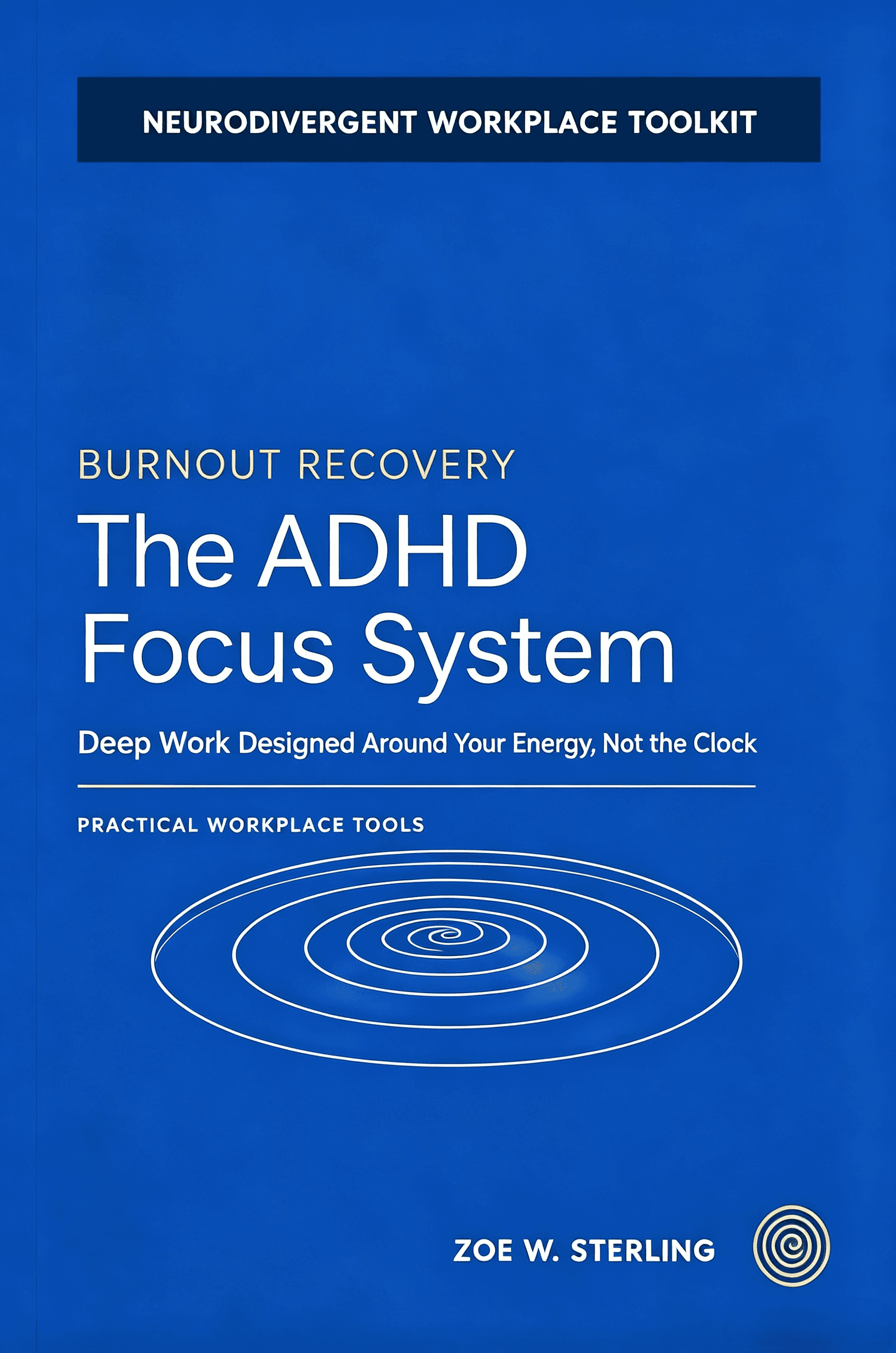
The ADHD Focus System
Most ADHD productivity systems are designed for neurotypical brains. The ADHD Focus System is different — built from the ground up for how ADHD brains actually work, teaching you to achieve deep work and harness hyperfocus.
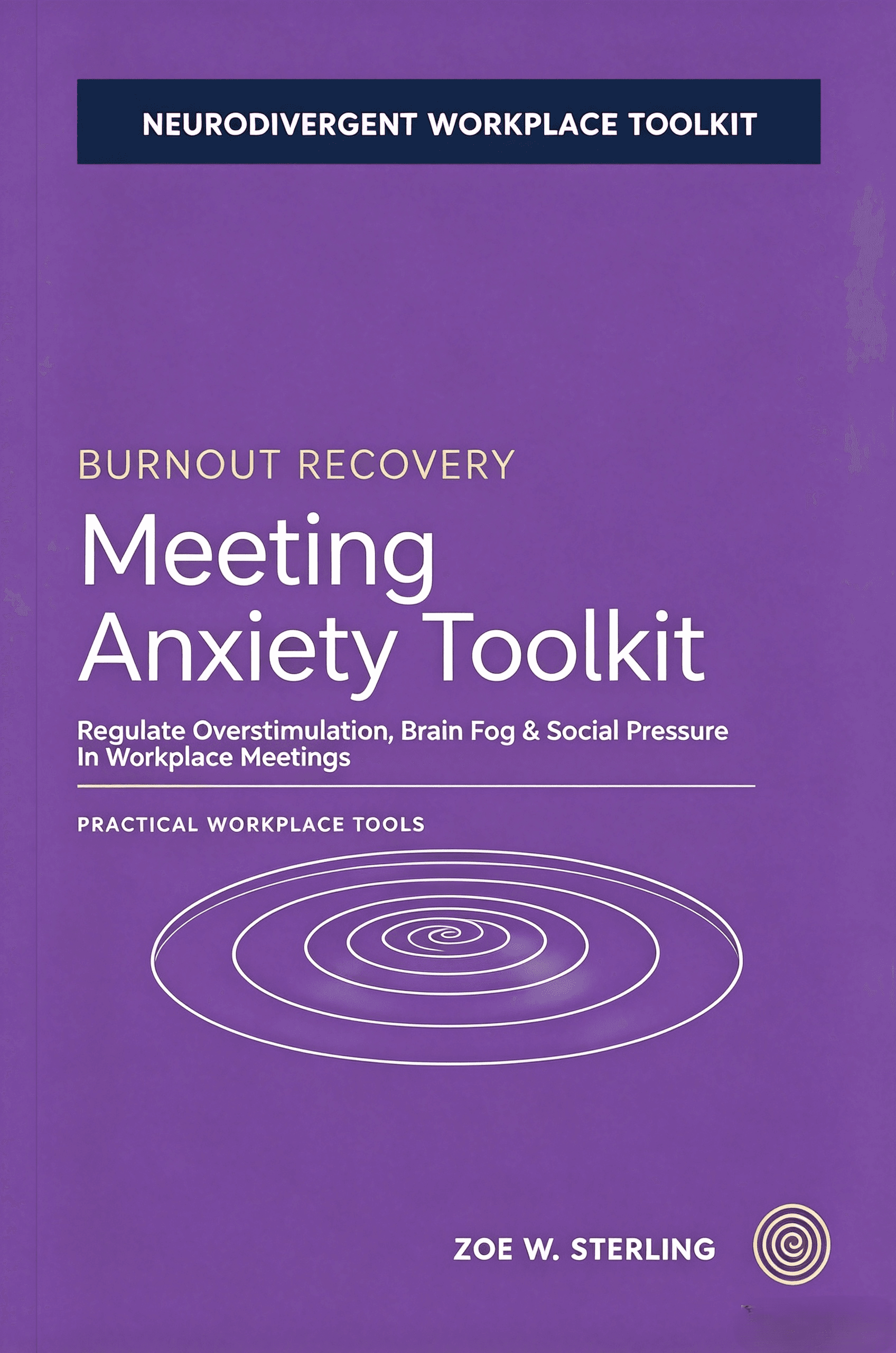
The ADHD Meeting Survival Toolkit
Meetings are the #1 productivity killer for neurodivergent professionals. This toolkit delivers the SHIELD Protocol — a precise 5-step prep-before, 6-tool during-meeting, and 4-part post-meeting recovery system.
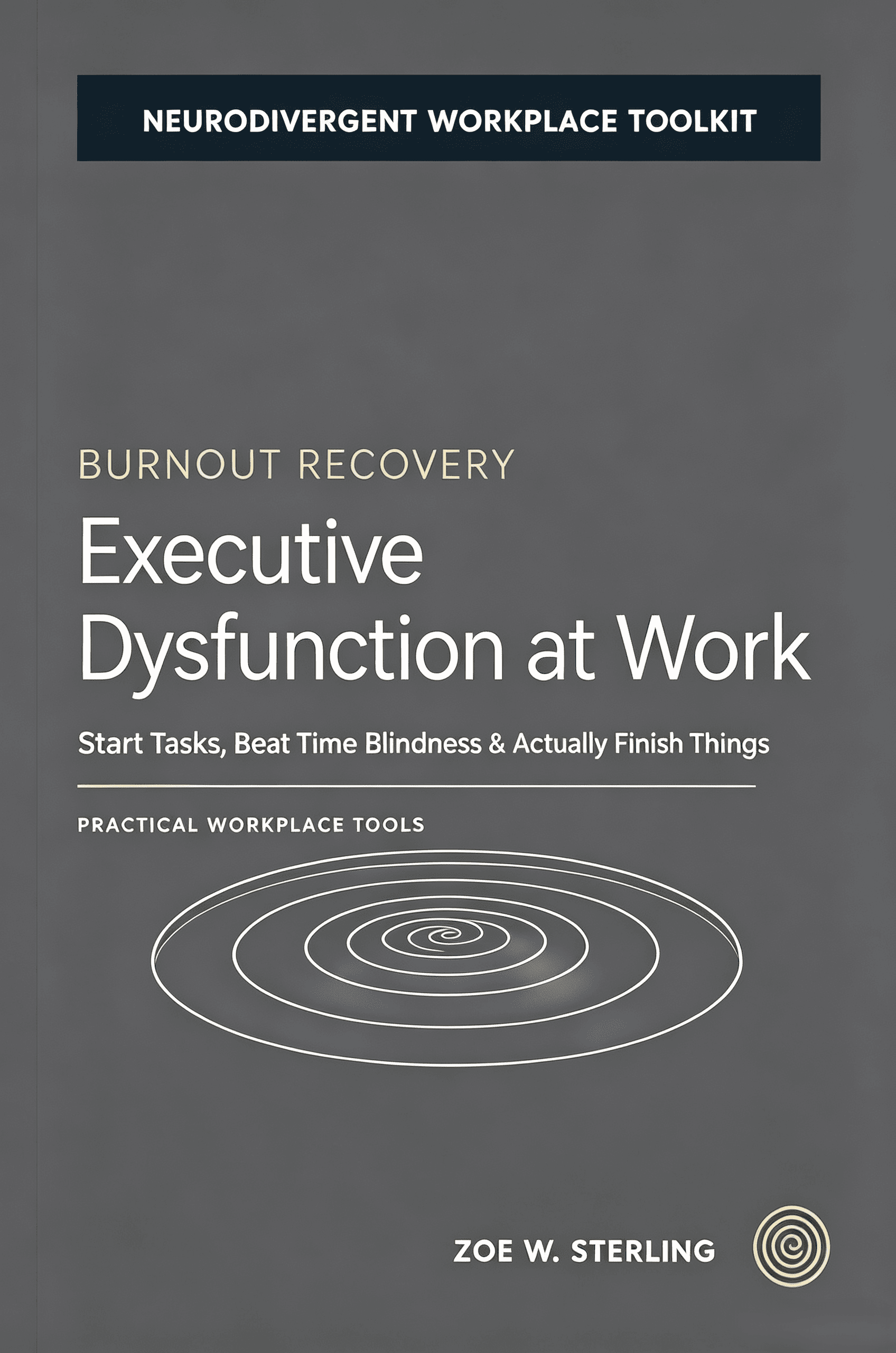
Executive Dysfunction at Work
Executive dysfunction makes it incredibly difficult for neurodivergent professionals to manage tasks, meet deadlines, and maintain focus at work. This practical guide delivers evidence-based strategies and system templates.