How Masking Causes Imposter Syndrome for ADHD Professionals
Definition
ADHD masking
Masking refers to the conscious or subconscious effort to hide ADHD-related symptoms (e.g., inattention, impulsivity, disorganization) in order to appear 'normal' or competent. For professionals, this might mean overpreparing for meetings, suppressing hyperactive urges, or forcing intense eye contact, which consumes massive cognitive energy.
Key Takeaways
What you need to know
- 1Masking depletes working memory and executive function, leaving ADHD professionals mentally exhausted and prone to self-doubt.
- 2The constant gap between the 'masked self' and the 'true self' internalizes the belief that competence is fake, feeding imposter syndrome.
- 3Rejection sensitive dysphoria (RSD) amplifies imposter feelings, making constructive criticism feel like proof of inadequacy.
- 4Strategic unmasking—not full disclosure—helps rebuild authentic confidence and sustainable productivity.
 30s
30sIs ADHD Masking Causing Your Imposter Syndrome?
Discover the link between ADHD masking and imposter syndrome. Learn strategic unmasking for ADHD professionals. #ADHD #ImposterSyndrome
What Is Masking—and Why Do ADHD Professionals Do It?
Masking is a survival strategy. For adults with Attention Deficit Hyperactivity Disorder (ADHD), it often starts in childhood as a way to avoid punishment or social rejection. By the time you reach the professional world, masking has become an automatic, reflexive response to workplace expectations: hide the fidgeting, memorize the agenda, never forget a deadline, and always appear 'put together.' Research suggests that masking is a common but extremely taxing behavior, with many adults reporting they exhaust themselves trying to pass as neurotypical (Journal of Attention Disorders, 2020).
In the modern workplace, strength is often equated with consistency and ease. An ADHD brain, however, thrives on novelty, interest, and urgency—not on routine. So you craft elaborate systems: color-coded calendars, endless checklists, and even facial expressions that broadcast calm. But every pretence costs something. The cognitive load of monitoring your behavior, suppressing internal motor activity, and forcing your working memory to hold additional 'acting scripts' leaves less bandwidth for actual work. Over time, this performance starts to feel like your only version of success—while the authentic, messy, capable self remains hidden.
- Common masking behaviors: grinning when overwhelmed, asking 'dumb questions' to seem engaged, writing verbose notes to prove attention.
- Masking can be so deeply habitual that you may not realize when you're doing it; it feels like your 'work mode.'
The Energy Tax of Masking: A Direct Hit to Executive Function
Executive function is the brain's CEO—the set of cognitive processes that help you plan, prioritize, and regulate emotion. ADHD directly impairs these functions, and masking imposes an additional, relentless burden. A 2019 meta-analysis found that individuals with ADHD who reported high levels of 'camouflaging' also experienced significantly lower executive functioning in daily life, even after controlling for symptom severity (Clinical Psychology Review). This is not weak willpower; it's the natural consequence of running mental dual-processes: one for the actual task and one for maintaining the mask.
When you are masking, you are constantly using a 'cover story' in your head. You may replay conversations to ensure you didn't miss a cue, rehearse questions you already know the answer to, or physically restrain your impulses until breaks. This robs your working memory of its limited capacity. Working memory is your mental scratchpad—the ability to retain and manipulate information in the moment. When it becomes cluttered with masking tactics, you lose track of your own thoughts, forget key points in a meeting, and then berate yourself for 'failing.' The cycle intensifies your belief that you are barely competent, setting the stage for imposter syndrome.
- Double capacity demand: Masking uses working memory to monitor self, while the task itself is secondary.
- Aftermasking 'shutdowns'—when you crash at home—are the body's way of saying the executive load was too high.
How Masking Plants the Seeds of Imposter Syndrome
Imposter syndrome is the gnawing feeling of being a fraud, despite clear evidence of success. For ADHD professionals, this isn't purely psychological—it's a logical response to living a lie. If you consistently hide your most authentic self (including genuine symptoms, your need for structure, or your occasional brilliance), you naturally attribute your achievements to luck, timing, or the 'mask' rather than to your own intelligence or skills.
Psychologists call this 'self-verification theory': we want others to see us as we see ourselves. When you've spent years convincing everyone you're organized and calm, you never receive external validation of your real capacities. Every promotion feels like the empty reward for a performance, not a true acknowledgment of your worth. A 2021 study in 'ADHD in Adults' revealed that higher self-reported masking behaviors were positively correlated with imposter phenomenon scores, suggesting that the more you hide, the more you doubt your intellectual legitimacy.
- The 'Fraud Loop': mask → get positive feedback → attribute it to the mask → feel like a fraud → mask more.
- Perfectionism and masking feed each other; you demand invisible effort, which is impossible to sustain.
Working Memory Overload: The Invisible Driver of Self-Doubt
Your working memory is not just about remembering numbers—it's the tool you use to compare what you know with what is happening. It allows you to see, 'Ah, I have experience with this problem, so I can solve it.' When you're constantly masking, your working memory is occupied with self-monitoring, leaving less space to access your own knowledge and past successes. Consequently, you may feel like you 'don't know anything' even when you're an expert.
Let's use a concrete example. In a design review, you have an excellent intuition that a proposed plan won't resonate with the client. But your working memory is busy suppressing your physical urge to stand up, planning your neutral facial expressions, and remembering to pause before you speak. By the time you form a sentence, you've lost the why behind your idea. Later, you see the project fail—and you think, 'I knew it, why didn't I say something?' The real answer isn't lack of knowledge; it's that masking hijacked the cognitive resources needed for reflection.
This creates a subtle but devastating habit: you start second-guessing yourself before you ever speak. Your inner monologue reminds you that you've 'been wrong before' (you weren't wrong—you were busy) and that you 'can't trust your brain.' The imposter syndrome becomes a self-fulfilling prophecy as you speak less, contribute with hedging language, and minimize your potential—reinforcing the false belief that you don't belong.
- Masking and ADHD both 'steal' working memory capacity; the combination effectively disables your ability to access expertise in high-pressure moments.
- Try 'thought dumps' before meetings to externalize your ideas, freeing your working memory to engage without self-monitoring.
RSD and the Criticism Loop: Why Mistakes Feel Devastating
Many ADHD professionals experience Rejection Sensitive Dysphoria (RSD)—an intense emotional pain in response to perceived or actual criticism. RSD is not a formal diagnosis but is recognized as a common emotional feature of ADHD, rooted in neurological differences in emotional regulation and significantly worsened by a history of failure and negative feedback. When you've masked for years, you are also extremely sensitive to any gap between your mask and the expectations of others.
Even mild workplace criticism—like a manager suggesting you use a new software tool—can be internally interpreted as 'I am a fraud and they are finally catching me.' RSD amplifies the impact of any perceived failure, and the shame that follows pushes you further into masking. You think, 'If I just try harder to appear normal, this won't happen again.' But this coping strategy is fragile; it requires constant positive reassurance, which you rarely give yourself. The imposter syndrome thrives here, because your own internal barometer of 'acceptable behavior' is set impossibly high.
Empathy matters: you are not being dramatic—your brain's alarm system is overactive due to a lifetime of masking and rejection. Understanding RSD as a neurological reaction, not a character flaw, is the first step toward breaking the loop.
- RSD can cause you to ruminate on a single piece of negative feedback for days—long after it was meant to be constructive.
- Self-compassion training has been shown to reduce the impact of RSD, yet many ADHD professionals consider it 'weakness.'
From Masking to Self-Advocacy: Practical, Evidence-Based to Rebuild Authentic Confidence
The alternative to masking isn't 'letting it all hang out'—it's strategic unmasking. You don't need to disclose your ADHD to every colleague. Start by identifying one or two controllable environments (e.g., a trusted mentor relationship or a weekly team meeting) where you can experiment with small shifts. For instance, if you have a backlog of ideas in your head, you might say, 'I need a moment to organize my thoughts' instead of forcing immediate answers. This version of 'unmasking' removes the load of always performing fluidity.
Studies on authentic self-expression in the workplace show that individuals who practice selective vulnerability report higher job satisfaction and lower burnout (HBR, 2020). For ADHD professionals, this often means renegotiating how you work—not just hiding your struggles. Ask for your desired work style: Could you have an agenda in advance? Are you allowed to take visual to-do notes rather than linear ones? These are reasonable accommodations that address the real problem of ADHD symptoms, not a personal defect.
Another central strategy is to separate your ADHD from your core identity. You are not 'a problem'; you are a problem-solver with a unique executive function profile. When you accomplish something, practice claiming credit: have a ‘brag folder’ of positive emails and successful projects. Review it the first Monday of every month. This tangible evidence counters your working memory's tendency to overfocus on perceived failures.
- Micro-unmasking challenge: pick one 'safe person' at work and tell them one thing about how you work best.
- Structural independence: set separate physical spaces for work vs. rest—dopamine cues help your brain switch between 'performance' and 'true self.'
Frequently Asked Questions
Can ADHD masking cause imposter syndrome in high-performing professionals?
Yes. The very effort you invest in hiding ADHD traits—like constant reminders to stay organized or forcing yourself to appear 'always in control'—creates a disconnect between external success and internal self-assessment. Every achievement is chalked up to the mask, not to your real capability, which directly leads to imposter syndrome.
How is working memory related to ADHD and imposter syndrome?
Working memory is your brain's temporary holding space for thoughts and plans. ADHD typically weakens working memory, and when you mask, you squeeze even more load onto it by trying to remember your own 'acting scripts.' This makes it harder to recall evidence of your competence when you need it most, reinforcing self-doubt.
What is RSD in ADHD and how does it affect work performance?
Rejection Sensitive Dysphoria (RSD) is an intense, emotionally painful reaction to any perceived rejection or criticism. It's common in ADHD and can cause professionals to spiral into harsh self-judgment after even neutral feedback. RSD can lead to over-preparation (more masking) and reluctance to share ideas—ultimately harming career growth.
What are healthy alternatives to masking at work for ADHD professionals?
Healthy alternatives include 'strategic unmasking'—disclosing a preference or accommodation when relevant, using assistive tools (like digital reminders and voice memos) instead of relying on your memory, and building a daily habit of reviewing your accomplishments to rebuild self-esteem. Seeking a coach or therapist knowledgeable about adult ADHD can also help you tailor these strategies.
Action Plan
Follow these steps to implement what you've learned
Step 1: Track Your Masking Triggers
For one week, keep a small notebook or note document. Each time you notice yourself 'acting' at work (suppressing a fidget, forcing eye contact, over-energetic agreeing), write down the situational trigger.
Don't try to stop the behavior yet—just observe it. Awareness reduces automaticity.
Step 2: Schedule Working Memory Resets
Block 5-10 minutes after every hour of high-demand work to step away and do something low-cognitive (e.g., stretching or water) to clear mental scratchpad.
Set a smartwatch or desktop timer; your ADHD brain appreciates an alarm over internal time-monitoring.
Step 3: Conduct a Weekly Evidence Review
Every Friday, open your 'accomplishment folder' and write three concrete ways you contributed to projects that week, no matter how small. Include feedback from others.
Store folder in cloud service so it's always accessible; add screenshots of positive emails immediately, not later.
Step 4: Practice Micro-Unmasking with a Trusted Colleague
Identify one low-risk colleague and try one gentle unmasking revelation, e.g., 'I process better when I have 10 minutes to write my thoughts first.' Observe their response.
Start with a request or a work preference, not an ADHD diagnosis. This tests safe waters without over-exposing.
Official Resources & References
Evidence-based information from trusted organizations
CHADD (Children and Adults with Attention-Deficit/Hyperactivity Disorder)
Leading non-profit organization providing education, support, and evidence-based information on ADHD for adults and children.
chadd.org/Attention Deficit Disorder Association (ADDA)
ADDA provides virtual support groups, webinars, and resources specifically designed for adults with ADHD.
add.org/National Institute of Mental Health (NIMH)
NIMH offers factual, government-backed information about ADHD symptoms, treatments, and latest strategic plans.
www.nimh.nih.gov/health/topics/attention-deficit-hyperactivity-disorder-adhd
These resources are provided for educational purposes and do not constitute medical advice.
This article was reviewed by our editorial board for scientific accuracy and practical relevance.
Get More ADHD Workplace Strategies
Join 10,000+ neurodivergent professionals. Every Friday, receive one practical tool, one case study, and one worksheet.
Subscribe Free →What to Read Next
Continue your learning journey with these related resources
📖Related Articles
Harnessing ADHD Creativity for Workplace Problem Solving
ADHD creativity is a powerful asset in workplace problem solving. Learn how to leverage your unique brain wiring to innovate and overcome challenges.
ADHD Workplace Spiral Assessment and Brain Types
The ADHD workplace spiral is a predictable pattern of declining performance, but spiral assessment and brain-type insights offer a path out.
ADHD Big Picture Thinking: Career Advantage
ADHD big picture thinking is a powerful career advantage when harnessed strategically. Learn how to leverage your unique cognitive style for professional success.
📚Recommended Books
Dive deeper with our expert-written guides
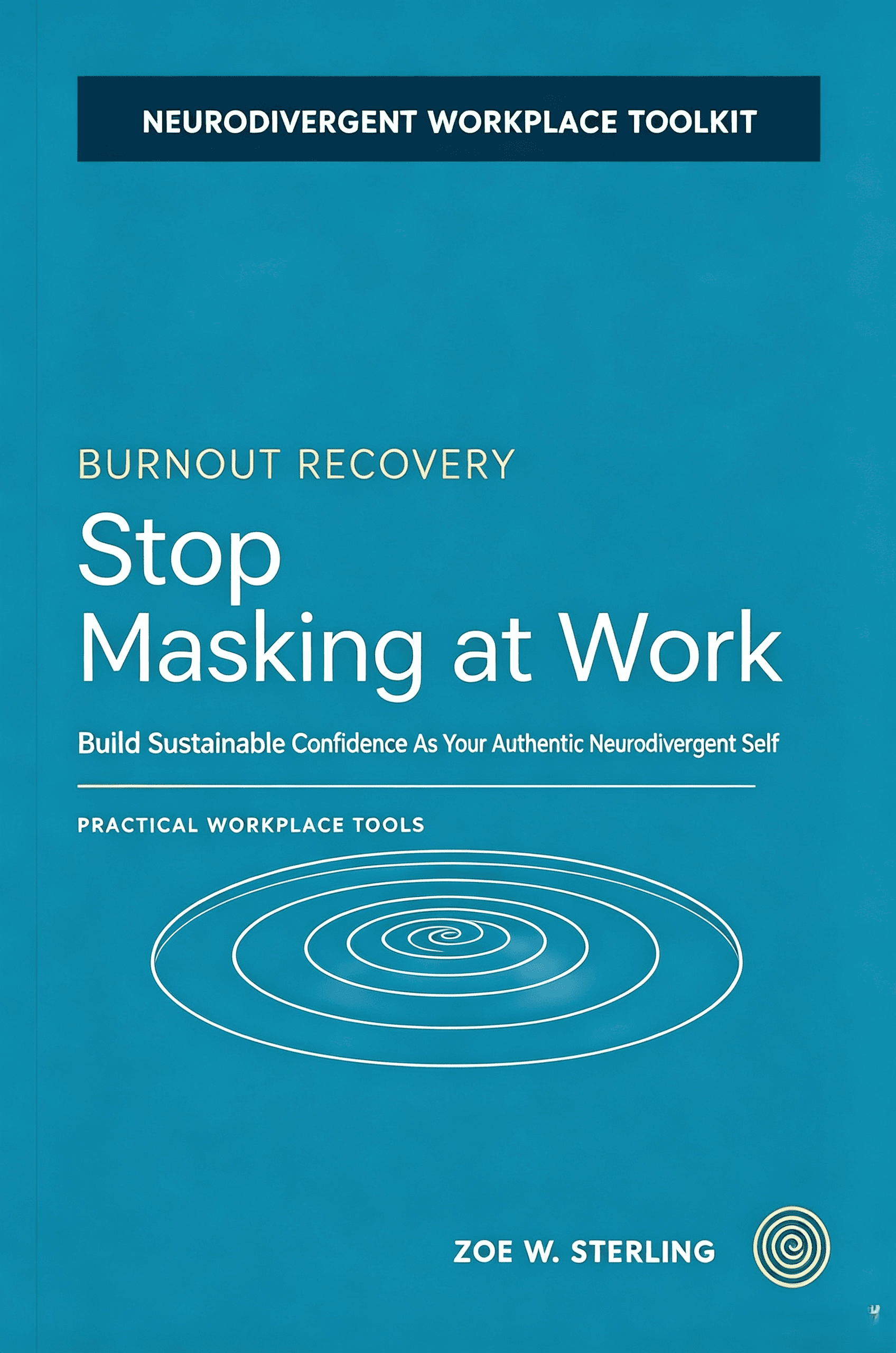
Stop Masking at Work
Masking — the exhausting practice of hiding your neurodivergent traits to appear neurotypical — is one of the biggest drains on neurodivergent professionals' well-being. This book provides a 6-step framework for unmasking.
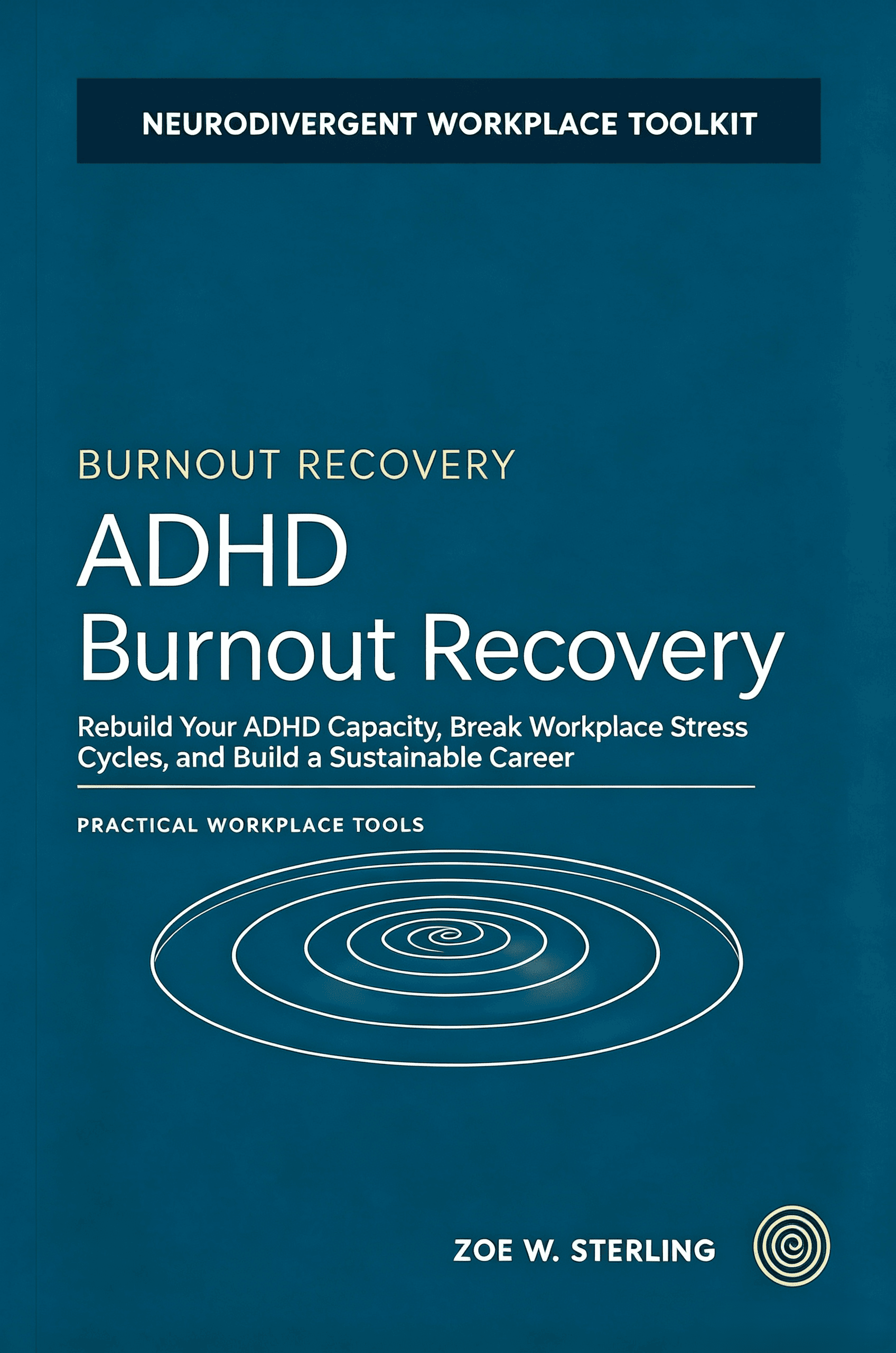
ADHD Burnout Recovery
ADHD burnout is different from typical burnout. Rooted in overstimulation, executive dysfunction, and the gap between natural strengths and workplace demands, it requires a specialized recovery approach.
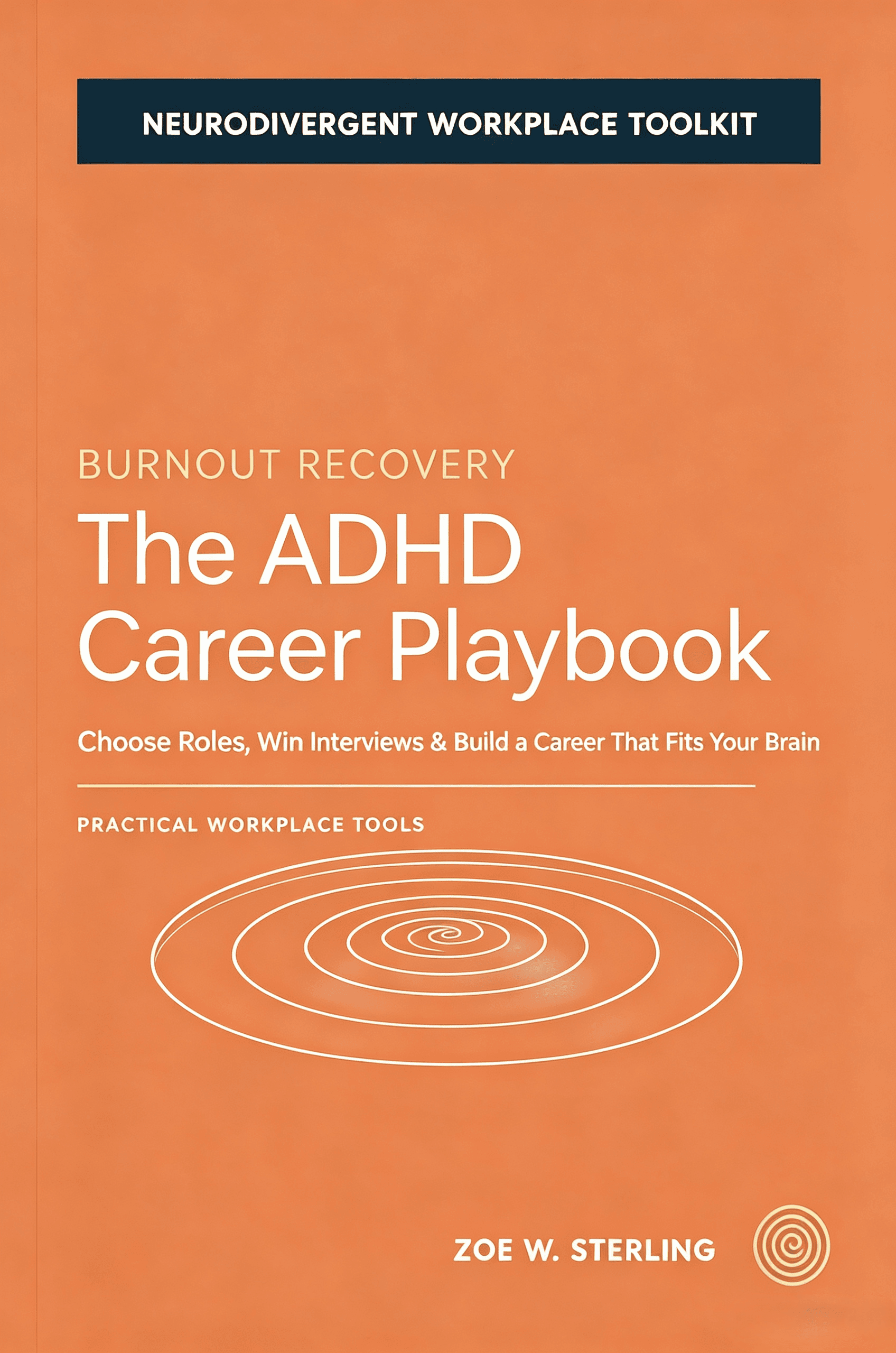
The ADHD Career Playbook
Career advancement is challenging for everyone, but neurodivergent professionals face unique obstacles — from job interview anxiety to promotion bias. This career playbook delivers a strategic guide for finding the right role.