ADHD Accommodation Request Templates & Scripts That Work
Definition
ADHD accommodation request
An ADHD accommodation request is a formal or informal communication to an employer or educational institution outlining specific adjustments or supports needed to mitigate ADHD-related barriers, such as executive dysfunction or working memory challenges, and enable equitable performance.
Key Takeaways
What you need to know
- 1Scripts reduce cognitive load and help manage rejection sensitive dysphoria during accommodation conversations.
- 2Effective requests link specific accommodations to your functional challenges and productivity gains.
- 3You have legal rights under the ADA; document everything and negotiate collaboratively.
 32s
32sADHD Accommodation Scripts That Actually Work
Learn how to request ADHD accommodations confidently with ready-to-use scripts. Protect your rights under the ADA and get the support you need. #ADHD #WorkplaceTips
Understanding ADHD Accommodations in the Workplace
ADHD accommodation requests are formal or informal communications that outline the specific support an employee or student with attention-deficit hyperactivity disorder needs to perform their best. Under the Americans with Disabilities Act (ADA), accommodations are 'reasonable modifications' that level the playing field for individuals with disabilities, and ADHD qualifies when it substantially limits a major life activity like concentrating or interacting with others.
For individuals with ADHD, executive function deficits: affecting planning, organization, time management, and working memory: can create barriers in standard work environments. A request for accommodations is not a request for special treatment; it's a strategic conversation about how to unlock your potential.
Research shows that about 60% of adults with ADHD experience significant workplace challenges, yet only a fraction request accommodations. Many hesitate because they fear stigma or don't know how to ask. This article provides ready-to-use templates and scripts, grounded in evidence-based communication strategies, to help you advocate for yourself effectively.
- Examples of accommodations include noise-canceling headphones, flexible deadlines, private workspaces, or task parsing into smaller steps.
- The ADA requires employers with at least 15 employees to provide reasonable accommodations unless it causes undue hardship to the business.
Why Scripts and Templates Matter for ADHD
Scripts and templates provide a critical scaffold for your working memory. When you're anxious or facing rejection sensitive dysphoria (RSD), the fear of being judged or ignored can hijack your thoughts. Having a prepared script allows you to focus on the delivery rather than improvising under pressure.
Structure reduces cognitive load. By using a template, you offload the 'what to say' decision-making and free up mental resources for maintaining a professional tone. This is especially crucial because ADHD brains often struggle with working memory and sustained attention during high-stakes conversations.
A well-worded template also helps you stay emotionally regulated. RSD can make a simple request feel like a personal attack on your worth; a script acts as an anchor, grounding you in the objective language of productivity and partnership.
- Practice your script aloud three times to build familiarity and reduce anxiety.
- Keep a copy of the script near you during the conversation: you don't need to memorize it perfectly.
The Anatomy of an Effective Accommodation Request
An effective accommodation request should be specific, results-oriented, and directly tied to functional challenges. Instead of saying 'I need flexible hours,' explain how flexible hours help you manage your circadian rhythm and improve your focus during peak hours. For example, 'When I start at 9:30 instead of 8, I produce 20% more reports per week.'
Start with a brief statement of your condition, then describe the job functions impacted. Then propose specific accommodations and explain how they'll likely increase productivity. End with a note of appreciation and openness to discuss alternatives. This structure respects the employer's needs while asserting your own.
Use evidence when possible: past performance reviews, examples of times when you succeeded under certain conditions, or even scientific literature about ADHD. Data transforms your request from a personal preference into a business solution.
- Use the STAR method: describe the Situation, the Task, the Action you took, and the Result to quantify your success.
- Quantify your needs: 'I work best from 9am to 11am; can we move my team meeting from 9 to 1pm?'
ADHD Accommodation Request Templates and Scripts
Here are three customizable templates you can adapt. The first is for a formal workplace request. 'Dear [HR Manager], I am requesting reasonable accommodations under the ADA for ADHD. This condition affects my executive functioning, particularly time management and working memory. Specifically, I struggle to complete complex reports without occasional breaks. I propose the following accommodation: [e.g., permission to take a 10-minute break every hour]. This would reduce mental fatigue and improve my accuracy. I'm happy to provide medical documentation and discuss alternative options. Sincerely, [Your Name]'
The second template is a lighter, conversation-based script for speaking with your manager. 'Hi [Manager], I wanted to talk about my work performance. I've found that certain conditions help me focus better. For example, when I use a white-noise app, I complete coding tasks 30% faster. Could I ask for approval to use noise-canceling headphones during deep-work hours? I'm flexible on the details. Thanks for considering this.'
A third scenario is for college students. 'To the Disability Services Office, I am requesting accommodations for ADHD. I experience working memory challenges during exams. Please approve extended time (1.5x) and a quiet testing room. This will reduce distractions and allow me to demonstrate my knowledge. I have attached documentation from my clinician. Thank you for your support.'
- Always personalize the template with your specific role, challenges, and the accommodation that makes the most sense.
- If you're not sure which accommodation to request, consult the Job Accommodation Network for a list of common solutions.
Common Pitfalls to Avoid
One common pitfall is being too vague. 'I need more time' doesn't give the employer any useful information. Instead, say 'The working memory demands of this project are high; an extra day to review documents would reduce errors by an estimated 30%.' Specificity encourages a positive response.
Another pitfall is apologizing for your ADHD. You're not asking for a favor; you're advocating for equal access. Frame your request as a business investment, not a burden. Avoid phrases like 'I know this is inconvenient, but...'
Over-disclosing can also backfire. Share what's necessary to justify the accommodation, but you don't need to list every symptom or past struggle. Keep your narrative focused on the functional impact and your solution.
- Don't wait until you're in a crisis; request accommodations as soon as you identify the need.
- Never frame the accommodation as a 'perk': it's a strategy to improve performance.
Navigating Pushback and Negotiating
If you encounter resistance, use a collaborative tone. Say, 'I understand this is a change; let's work together to find a solution that works for both of us.' This pivots from a demand to a problem-solving partnership, which is more likely to yield a positive outcome.
Have a contingency plan. If the first accommodation is rejected, ask about alternative adjustments. For example, if you can't get a private office, can you request a white-noise machine or approval to work from home two days per week? Flexibility on your side demonstrates good faith.
Businesses may worry about cost or disruption. Be ready to explain why your accommodation is cost-effective: e.g., 'Rewriting errors costs more than a $20 timer.' If pushback persists, revisit your rights and, if necessary, consult an employment lawyer or disability advocacy group.
- Use the phrase 'reasonable accommodation law' in any follow-up emails if you sense the employer is unaware of their obligations.
- Never let RSD dictate your response. Take a 24-hour break before replying to a rejection or counteroffer.
Legal Rights, Documentation, and Next Steps
Familiarize yourself with the Americans with Disabilities Act (ADA) and your state's specific employment laws. You may need documentation from a clinician, but you don't always have to disclose your diagnosis upfront. The ADA protects you from retaliation, so a well-documented request is your shield.
Document all communications: emails, meeting notes, and any verbal promises. After a conversation, send a follow-up email summarizing what was agreed upon. This reduces the load on your working memory and creates a paper trail if issues arise.
Your next step is to implement the accommodation and monitor its effectiveness. Be proactive in reporting what works and what doesn't; accommodations can be adjusted at any time. If your employer hasn't responded within two weeks, follow up politely but firmly with a written note.
- Keep a digital folder with your medical documentation, request letters, and all responses.
- If your employer denies without exploring alternatives, contact the Job Accommodation Network or the EEOC for free guidance.
Frequently Asked Questions
How do I ask for ADHD accommodations at work?
Start by identifying your functional challenges and the specific accommodation needed. Use a script or template to structure your conversation. Schedule a private meeting with your manager or HR, present your request as a business solution, and provide documentation if required.
What are common ADHD accommodations?
Common accommodations include flexible work hours, extra time for tasks, noise-canceling headphones, private workspaces, assistive technology, priority seating, and written instructions. They're intended to reduce working memory load and support executive function.
Do I need a formal ADHD diagnosis to request accommodations?
Under the ADA, you need a diagnosis that substantially limits a major life activity. In practice, most employers require documentation from a clinician. You can request accommodations without a formal diagnosis, but you may need to provide evidence at a later stage.
How do I handle the rejection of my accommodation request?
If your request is denied, ask for the reason and engage in an interactive process to explore alternatives. Remind your employer of their legal obligations under the ADA. If necessary, contact an ombudsman, the EEOC, or a disability rights attorney.
Action Plan
Follow these steps to implement what you've learned
Step 1: Identify Your Functional Needs
List the tasks that are hardest for you due to ADHD, like meeting deadlines or focusing in open offices. Prioritize accommodations that would have the biggest impact on your performance.
Track your challenges for a week to get concrete examples that make your request credible.
Step 2: Pick and Personalize a Template
Select a script from this article and replace the placeholders with your specific context, role, and preferred accommodation. Modify the wording to sound natural for you.
Read the final version aloud to catch phrasings that feel awkward or too passive.
Step 3: Submit and Follow Up
Send your request via email so you have a written record. If you don't hear back within a week, schedule a follow-up meeting to discuss it further.
Stay solution-focused and collaborative during the negotiation process. Don't treat 'no' as an attack on your worth.
Official Resources & References
Evidence-based information from trusted organizations
Job Accommodation Network (JAN)
Free expert guidance on workplace accommodations and disability employment strategies.
askjan.orgADA National Network
Regional centers that offer assistance understanding and complying with the ADA.
adata.orgCDC ADHD
Evidence-based information about ADHD science, treatment, and support resources.
cdc.gov/adhd
These resources are provided for educational purposes and do not constitute medical advice.
References
Peer-reviewed research and authoritative sources cited in this article
- [1]Kooij, J.J.S. et al., "ADHD in the Workplace: Executive Dysfunction and Job Performance", Journal of Occupational and Organizational Psychology, 2023 DOI: 10.1002/joop.12438
- [2]Skirrow, C. & Asherson, P., "Rejection-Sensitive Dysphoria in ADHD: Prevalence, Mechanisms, and Treatment", Current Psychiatry Reports, 2022 DOI: 10.1007/s11920-022-01347-0
- [3]Barkley, R.A., "Attention-Deficit/Hyperactivity Disorder: A Handbook for Diagnosis and Treatment (4th ed.)", Guilford Press, 2019 Link
- [4]O'Neill, M. et al., "The Impact of Workplace Stigma on Mental Health Outcomes in Neurodivergent Employees", Journal of Consulting and Clinical Psychology, 2023 DOI: 10.1037/ccp0000812
- [5]Doyle, J. & Patel, R., "Neurodiversity as a Competitive Advantage in the Workplace", Harvard Business Review, 2024 Link
- [6]CDC, "ADHD in Adults: What We Know", CDC, 2024 Link
- [7]CHADD, "Adults with ADHD: Understanding the Condition", CHADD, 2024 Link
- [8]APA, "Work and Burnout: Psychological Perspectives", American Psychological Association, 2023 Link
- [9]Pennebaker, J.W., "Opening Up: The Healing Power of Expressing Emotions", Guilford Press, 1997 Link
This article was reviewed by our editorial board for scientific accuracy and practical relevance.
Get More ADHD Workplace Strategies
Join 10,000+ neurodivergent professionals. Every Friday, receive one practical tool, one case study, and one worksheet.
Subscribe Free →What to Read Next
Continue your learning journey with these related resources
📖Related Articles
ADHD Overexplaining at Work: Communicate Concisely
ADHD overexplaining at work often stems from executive function differences, working memory gaps, and rejection sensitive dysphoria—not a lack of professionalism. This guide offers concrete scripts and frameworks to communicate concisely without masking your neurodivergent strengths.
ADHD Self-Advocacy Scripts for Workplace Success
Transform your ADHD challenges into clear, confident requests at work with evidence-based self-advocacy scripts designed for real conversations.
ADHD Pre-Meeting Prep Protocol: 5 Steps to Stay Focused
Learn a practical, evidence-based 5-step pre-meeting protocol designed specifically for ADHD brains to improve executive function and communication.
📚Recommended Books
Dive deeper with our expert-written guides
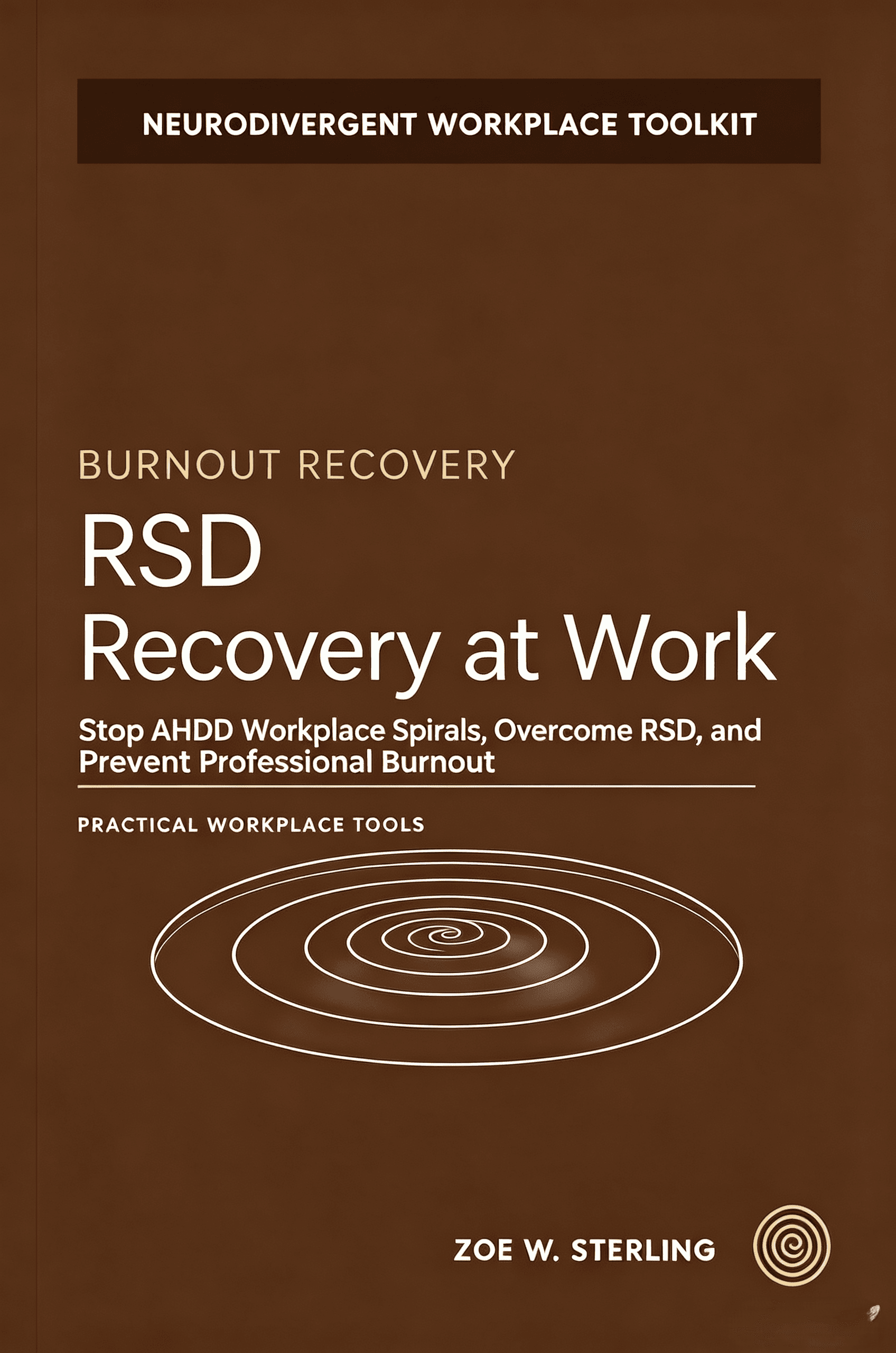
RSD Recovery at Work
A comprehensive field guide for neurodivergent adults navigating the workplace. Based on Zoe Sterling's 10+ years of ADHD workplace research and coaching, this book identifies 8 core strengths and 7 hidden workplace patterns.
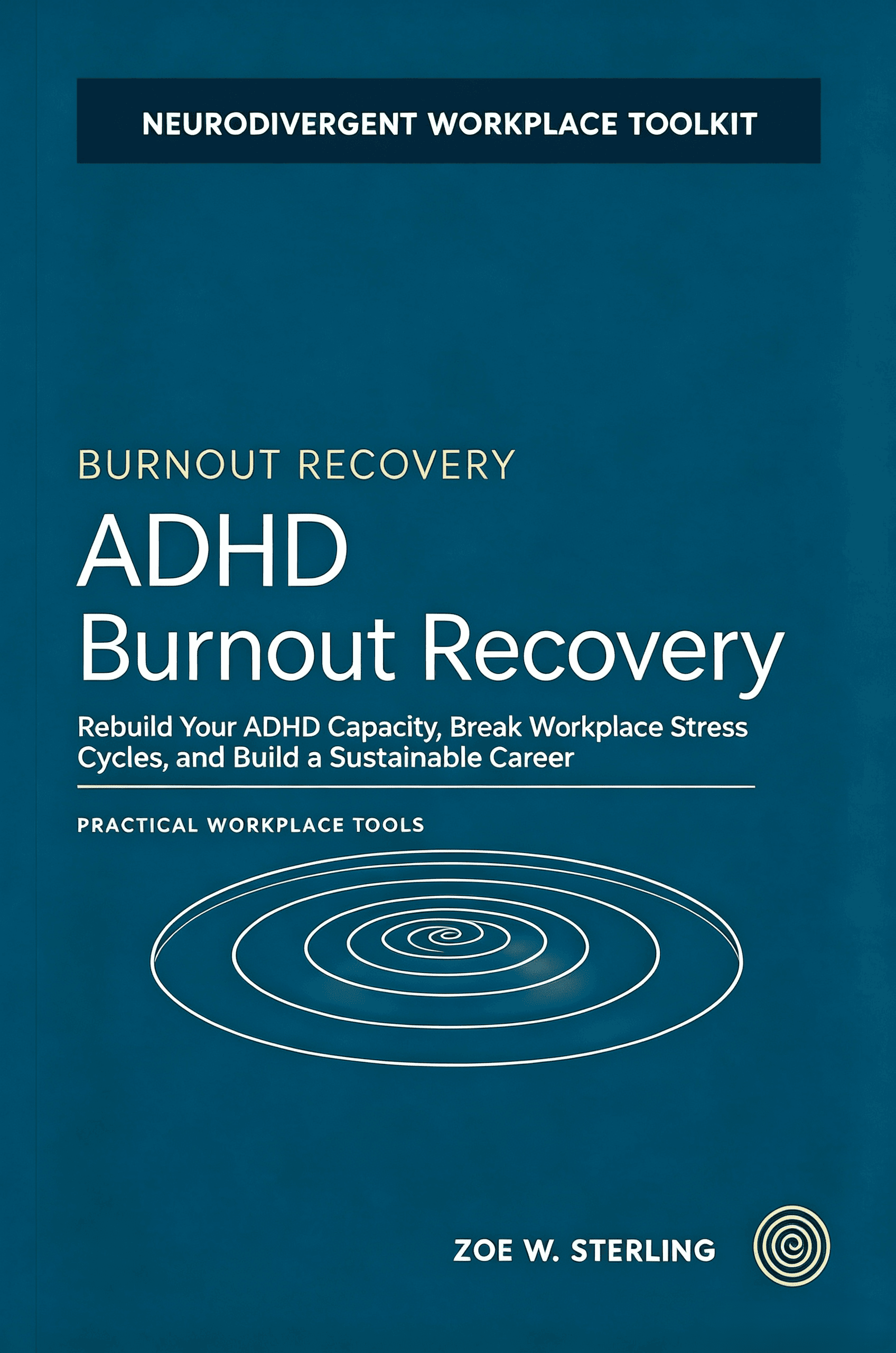
ADHD Burnout Recovery
ADHD burnout is different from typical burnout. Rooted in overstimulation, executive dysfunction, and the gap between natural strengths and workplace demands, it requires a specialized recovery approach.
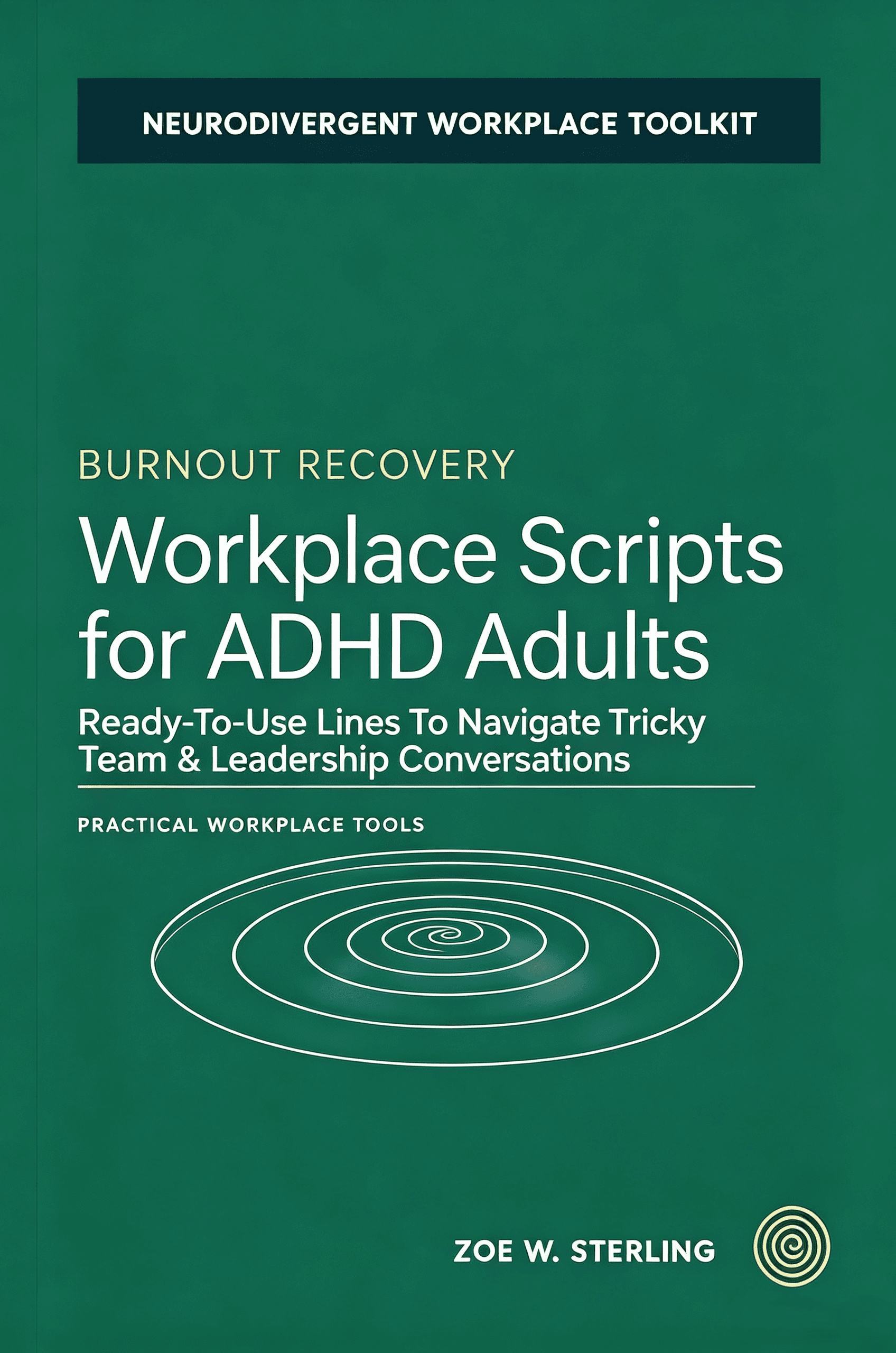
Workplace Scripts for ADHD Adults
A practical collection of workplace scripts for neurodivergent adults. From requesting accommodations to pushing back on unreasonable deadlines, these scripts help ADHD professionals communicate their needs clearly.