Definition
ADHD overexplaining at work
ADHD overexplaining at work is the tendency to provide excessive context, detail, or justification when speaking or writing, driven by differences in executive function, working memory, and dopamine regulation. Research shows that ADHD adults often overexplain to compensate for anticipated misunderstanding, forgetfulness, or criticism, which can reduce perceived clarity and efficiency in professional settings.
Key Takeaways
What you need to know
- 1ADHD overexplaining is a neurological compensation, not a character flaw; it links to executive function, working memory, dopamine, and rejection sensitive dysphoria (RSD).
- 2Use the 3-Sentence Rule and BLUF (Bottom Line Up Front) to deliver concise updates without losing essential context.
- 3Offload working memory with pre-meeting templates, bullet notes, and a 'parking lot' for tangents.
- 4Manage RSD by scripting neutral follow-ups and separating feedback from identity.
- 5Practice concise communication in low-stakes settings before high-stakes meetings to build automaticity.
 42s
ADHD Overexplaining at Work? Try This 3-Sentence Rule
Stop overexplaining in meetings with ADHD. Learn the 3-sentence rule, BLUF, and parking lot method to communicate concisely and manage RSD. Scripts included.
Why ADHD Brains Overexplain at Work
ADHD overexplaining at work is not random verbosity. It reflects differences in executive function—the brain's command center for planning, organizing, and self-monitoring. When working memory holds fewer pieces of information at once, you may add extra details to avoid losing an important point or to help the listener follow your non-linear path.
Dopamine, a neurotransmitter tied to motivation and reward, also plays a role. ADHD brains often seek immediate feedback and certainty. Overexplaining can be an attempt to secure a nod, a 'got it,' or a written confirmation that the message landed—micro-rewards that regulate attention and anxiety.
Rejection sensitive dysphoria (RSD) intensifies this pattern. If you have ever been interrupted, corrected, or ignored, your brain may preemptively defend against criticism by front-loading evidence and caveats. A simple status update becomes a legal brief because part of you is preparing for cross-examination.
- Executive function: planning and self-monitoring differences
- Working memory: holding fewer items, so you add context
- Dopamine: seeking certainty and immediate feedback
- RSD: preemptive defense against real or imagined criticism
The Hidden Costs of Overexplaining in Professional Settings
In fast-paced workplaces, overexplaining can erode perceived competence even when your ideas are strong. Research on communication efficiency shows that listeners process information in chunks; when a message exceeds working memory limits, retention drops. You may be talking more but communicating less.
Consider a 45-second project update that becomes a 4-minute monologue. Colleagues may interrupt, disengage, or ask 'So what's the ask?' That reaction can trigger RSD, leading to more overexplaining next time—a cycle that reinforces the very behavior you want to change.
Over time, this pattern can affect performance reviews and leadership opportunities. A 2023 survey by ADDitude found that 62% of adults with ADHD reported difficulty with concise communication at work, and 48% said it negatively affected career advancement. The goal is not to shrink your personality but to align your delivery with listener needs.
- Interruptions and disengagement from colleagues
- RSD spiral after negative reactions
- Career advancement and leadership perception
- Meeting fatigue for you and your team
The Concise Communication Framework from Book 3: Communication Scripts
Book 3: Communication Scripts provides a structured way to organize thoughts before speaking. Its core premise is that concise communication is a skill, not a trait. The framework uses three elements: Headline (the main point), Heart (why it matters), and Handoff (the ask or next step).
The BLUF (Bottom Line Up Front) method, adapted from military and business communication, aligns with this. Instead of building to a conclusion, you state it first. Then you add only the context needed for the listener to act. This reduces cognitive load for both of you.
The book also offers scripts for common workplace moments: status updates, disagreeing with a manager, asking for accommodations, and responding to feedback. For example, a status update script: 'Headline: The launch is on track for Friday. Heart: We resolved the vendor delay. Handoff: I need your approval on the revised budget by Wednesday.'
- Headline: one-sentence main point
- Heart: one-sentence relevance
- Handoff: one-sentence request
- BLUF: state conclusion first, then context
Strategy 1: Use the 3-Sentence Rule and BLUF
The 3-Sentence Rule is a practical constraint: deliver your main point, the most critical context, and the next step in three sentences or fewer. This forces prioritization, which supports executive function by reducing the number of decisions you make in the moment.
At work, replace 'I just wanted to follow up because I was thinking about the client email and I remember they mentioned the deadline, and also the design team had a question, so I wasn't sure if...' with 'The client needs the revised deck by Thursday. Design has one question about the chart. Can we review it at 2 p.m. today?'
Practice this in low-stakes messages first: Slack replies, calendar invites, quick emails. Set a timer for 30 seconds and speak your update aloud using the three-sentence structure. Record it and listen back. This builds automaticity and reduces reliance on working memory during high-pressure meetings.
- Sentence 1: Main point
- Sentence 2: Critical context
- Sentence 3: Ask or next step
- Timer practice: 30 seconds in low-stakes settings
Strategy 2: Offload Working Memory with Pre-Meeting Templates
Working memory is the mental scratchpad that holds information during a task. ADHD working memory differences mean that holding a multi-part update in your head while also reading the room is a recipe for tangents. The solution is to externalize the structure before the meeting.
Create a simple template: Topic, Bottom Line, Two Supporting Points, Ask. Fill it in 5 minutes before the meeting. During the meeting, you can glance at it and deliver the bottom line first. If you feel a tangent coming, write it in a 'parking lot' section and return to it only if time allows.
Script: 'That's an important point—let me park it so we can stay on track, and I'll follow up after.' This validates the thought without derailing the conversation. It also gives your dopamine-seeking brain a reward: the thought is captured, not lost.
- Template: Topic, Bottom Line, 2 Points, Ask
- Parking lot for tangents
- Follow-up script for parking lot
- Prep 5 minutes before meeting
Strategy 3: Manage RSD Triggers with Neutral Follow-Up Scripts
RSD can make neutral questions feel like attacks. When a manager asks 'Can you clarify?' your brain may hear 'You are confusing and incompetent.' The urge to overexplain is a defense. But a defensive wall of words often confirms the listener's impression that you are scattered.
Use scripts that separate feedback from identity. Instead of explaining every decision, say: 'Thanks for asking—here's the headline: X. I can send a one-page summary if that helps.' Or: 'I hear your concern about Y. My recommendation is Z because of one key reason. Want me to detail that?'
The pause-and-pin technique: when you feel the RSD heat rising, pause for two seconds, pin the emotion ('This is RSD, not an emergency'), and choose a script. This engages executive function and gives you a moment to select a concise response rather than react.
- Pause 2 seconds
- Pin the emotion: 'This is RSD'
- Use headline + offer summary
- Separate feedback from identity
How to Build a Concise Communication Habit (and When to Ask for Accommodations)
Concise communication is a muscle. Start with one meeting per day where you commit to BLUF. Afterward, note what worked and what felt uncomfortable. Celebrate the discomfort—it often means you are practicing a new skill, not failing.
If overexplaining stems from processing differences, you may benefit from workplace accommodations: written agendas, extra time to prepare, or permission to submit written updates instead of speaking off the cuff. Under the ADA in the U.S., ADHD can qualify as a disability, and reasonable accommodations are available.
Book 3: Communication Scripts offers a full library of templates for asking for accommodations, setting meeting norms, and repairing conversations after overexplaining. Use them as a starting point, then adapt the language to your voice.
- Practice BLUF once daily
- Request written agendas
- Ask for prep time
- Use scripts for accommodation requests
Frequently Asked Questions
Why do people with ADHD overexplain at work?
ADHD overexplaining at work is linked to executive function differences, working memory limits, dopamine-seeking, and rejection sensitive dysphoria. It is often a compensation strategy to prevent misunderstanding or criticism, not a lack of professionalism.
How can I stop overexplaining in meetings?
Use the 3-Sentence Rule and BLUF: state your main point, one critical context, and your ask. Prepare a written template before the meeting and use a 'parking lot' for tangents so your working memory is not overloaded.
What is the 3-sentence rule for ADHD communication?
The 3-Sentence Rule is a concise communication constraint from Book 3: Communication Scripts. It asks you to deliver your headline, the most important context, and the next step in three sentences or fewer, which reduces working memory load and listener confusion.
Can ADHD overexplaining affect my career?
Yes. Research and surveys suggest that difficulty with concise communication can affect performance reviews, promotions, and leadership opportunities. However, with scripts, practice, and accommodations, you can communicate concisely while preserving your strengths.
Action Plan
Follow these steps to implement what you've learned
Step 1: Map Your Overexplaining Triggers
For one week, note when you overexplain: meetings, Slack, email, or feedback. Record the situation, your emotion, and the outcome.
Look for RSD triggers like criticism or ambiguity.
Step 2: Create Your BLUF Template
Build a reusable note: Topic, Bottom Line, Two Supporting Points, Ask. Fill it before every meeting.
Keep it to five lines maximum.
Step 3: Practice the 3-Sentence Rule
Set a 30-second timer and deliver updates in three sentences. Do this in low-stakes conversations first.
Record yourself to hear progress.
Step 4: Use the Parking Lot Script
When a tangent arises, say: 'Let me park that so we stay on track, and I'll follow up.'
Keep a visible parking lot note during meetings.
Step 5: Request One Accommodation
Ask for written agendas, prep time, or written updates. Use a script from Book 3: Communication Scripts.
Frame it as a productivity tool, not a limitation.
Official Resources & References
Evidence-based information from trusted organizations
CDC ADHD
Centers for Disease Control and Prevention overview of ADHD symptoms, diagnosis, and treatment.
www.cdc.gov/adhd/CHADD
Children and Adults with Attention-Deficit/Hyperactivity Disorder provides support, education, and advocacy.
chadd.org/ADDitude
Evidence-based articles and strategies for living well with ADHD and related conditions.
www.additudemag.com/NIMH ADHD
National Institute of Mental Health resource on ADHD research, statistics, and clinical guidance.
www.nimh.nih.gov/health/topics/attention-deficit-hyperactivity-disorder-adhd
These resources are provided for educational purposes and do not constitute medical advice.
This article was reviewed by our editorial board for scientific accuracy and practical relevance.
Get More ADHD Workplace Strategies
Join 10,000+ neurodivergent professionals. Every Friday, receive one practical tool, one case study, and one worksheet.
Subscribe Free →What to Read Next
Continue your learning journey with these related resources
📖Related Articles
ADHD Self-Advocacy Scripts for Workplace Success
Transform your ADHD challenges into clear, confident requests at work with evidence-based self-advocacy scripts designed for real conversations.
ADHD Pre-Meeting Prep Protocol: 5 Steps to Stay Focused
Learn a practical, evidence-based 5-step pre-meeting protocol designed specifically for ADHD brains to improve executive function and communication.
ADHD Overexplaining at Work: How to Communicate Concisely
ADHD overexplaining is a common but manageable workplace challenge. Using structured communication scripts can help you get to the point while honoring your brain's unique wiring.
📚Recommended Books
Dive deeper with our expert-written guides
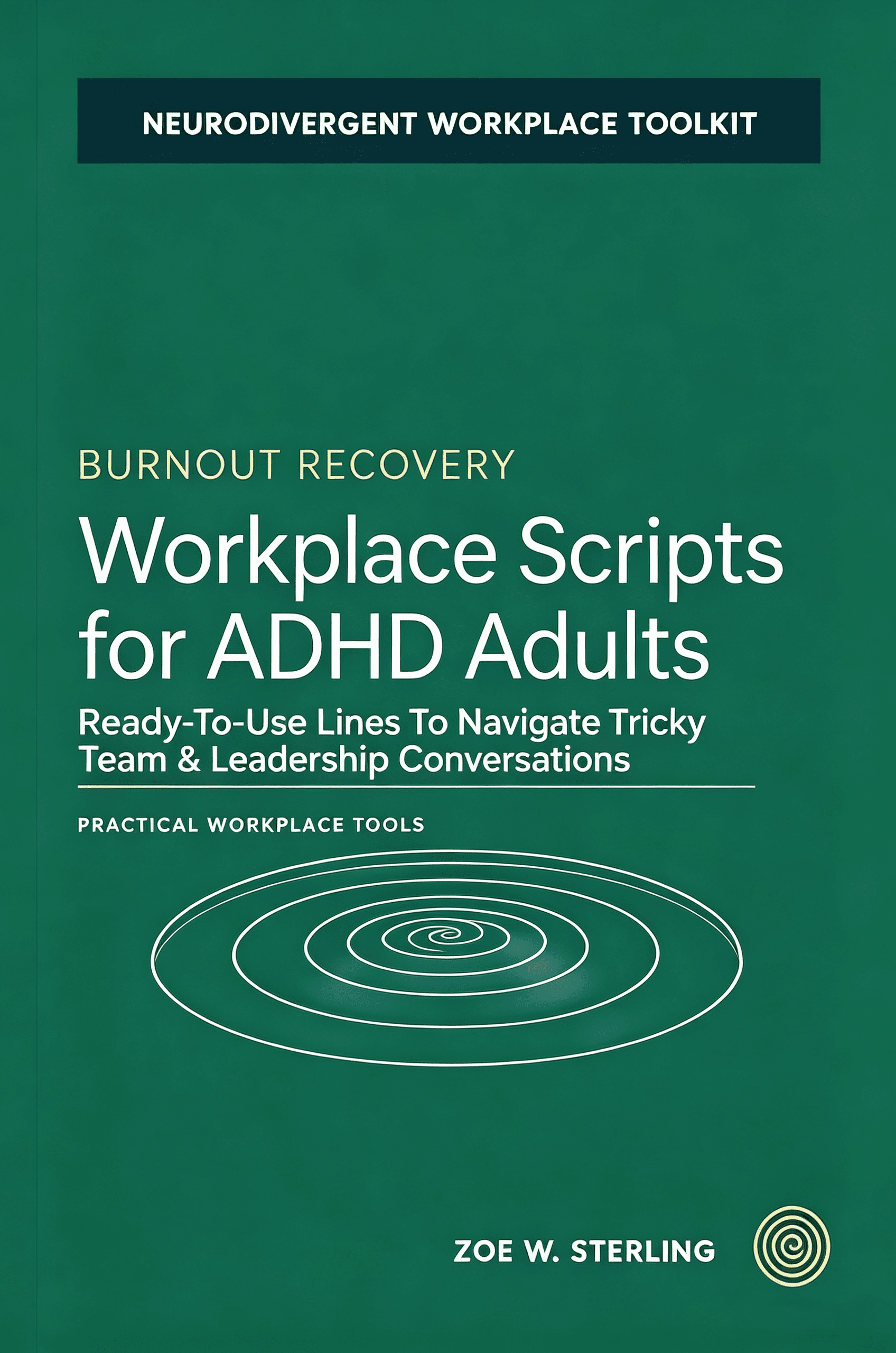
Workplace Scripts for ADHD Adults
A practical collection of workplace scripts for neurodivergent adults. From requesting accommodations to pushing back on unreasonable deadlines, these scripts help ADHD professionals communicate their needs clearly.
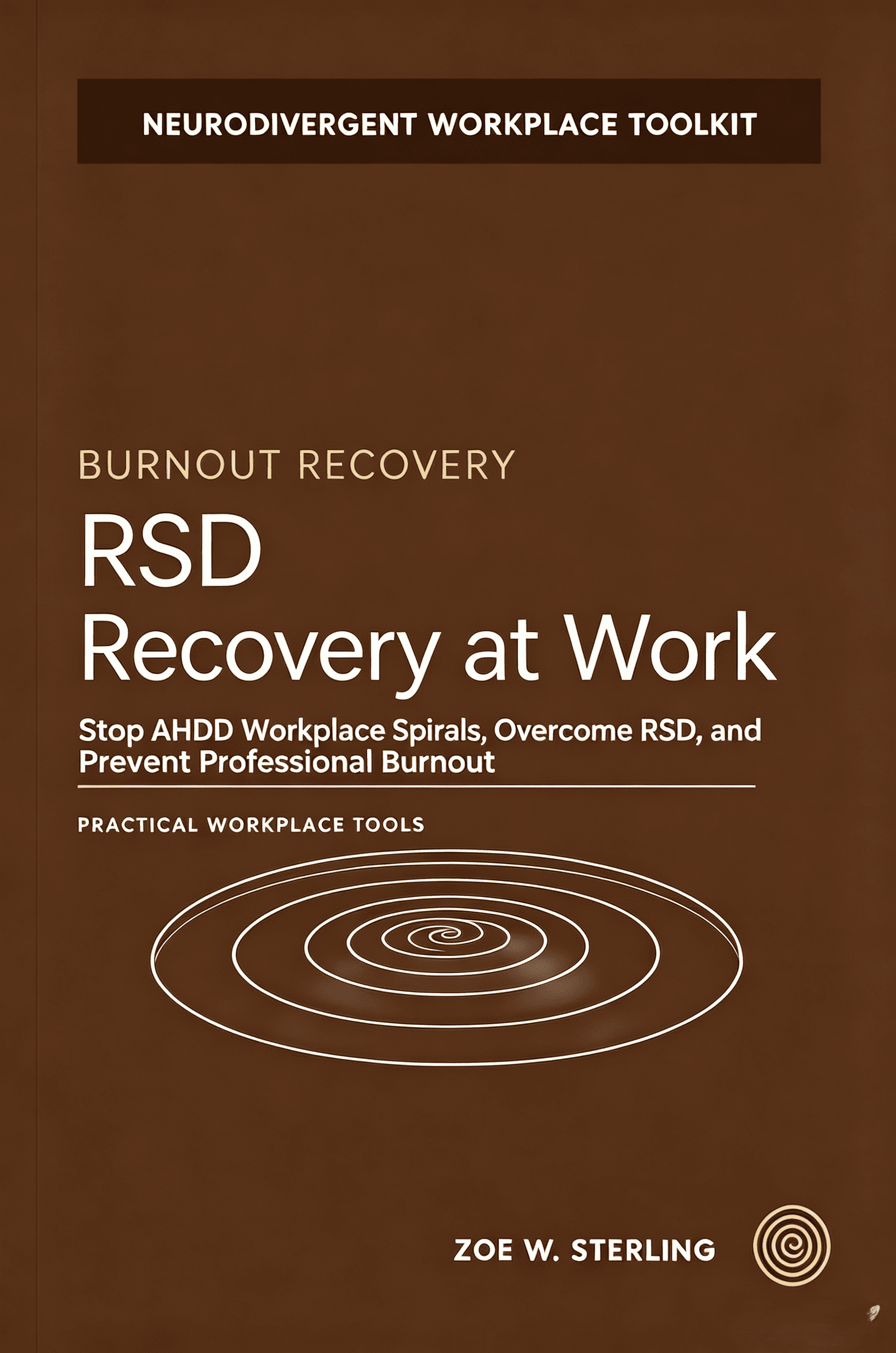
RSD Recovery at Work
A comprehensive field guide for neurodivergent adults navigating the workplace. Based on Zoe Sterling's 10+ years of ADHD workplace research and coaching, this book identifies 8 core strengths and 7 hidden workplace patterns.
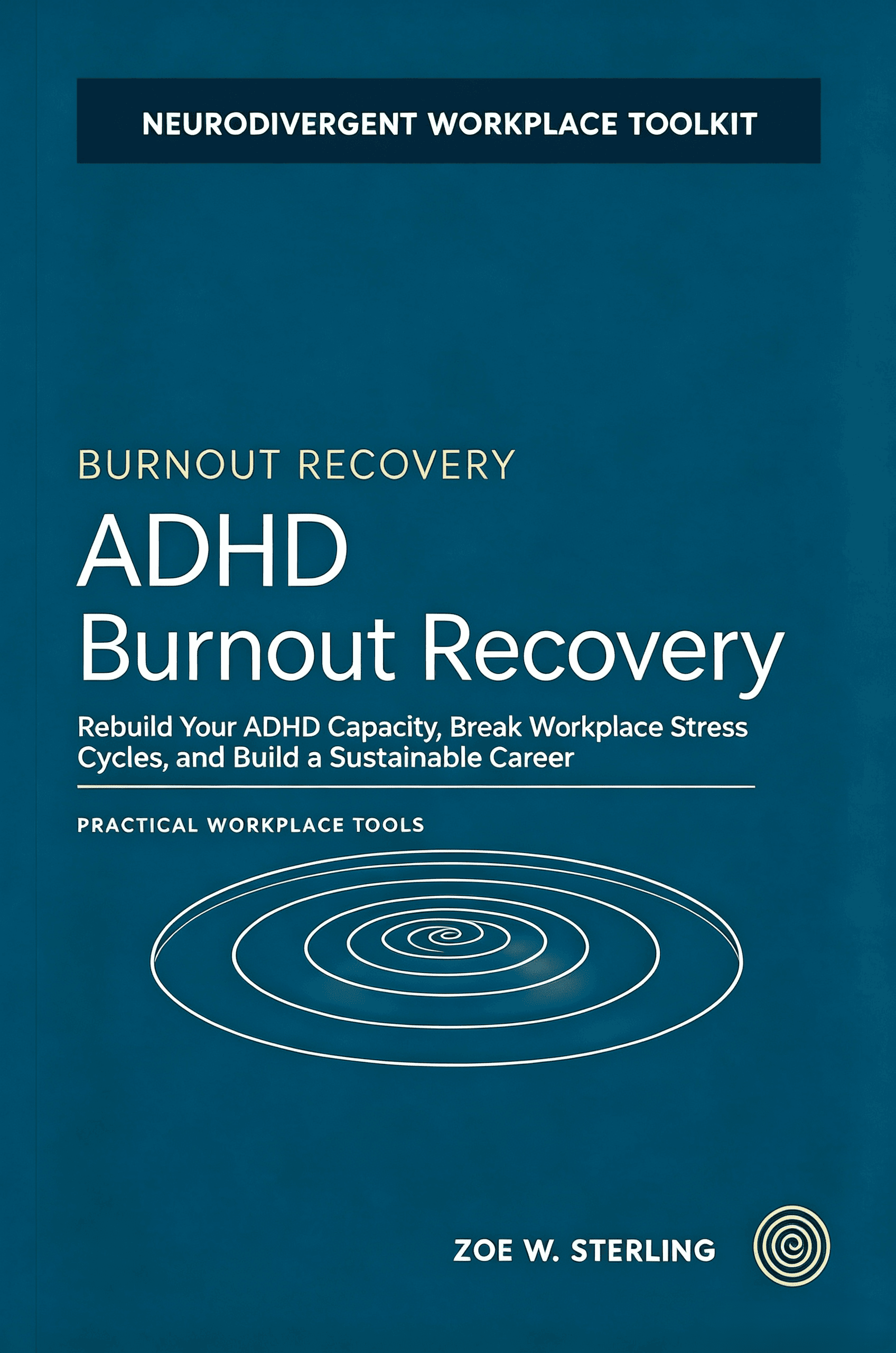
ADHD Burnout Recovery
ADHD burnout is different from typical burnout. Rooted in overstimulation, executive dysfunction, and the gap between natural strengths and workplace demands, it requires a specialized recovery approach.