ADHD Overexplaining at Work: How to Communicate Concisely
Definition
ADHD overexplaining
ADHD overexplaining is a communication pattern where someone with ADHD provides excessive details, background, or justifications in an attempt to ensure their message is understood. It stems from working memory deficits, dopamine-seeking, and anxiety about listener perception, often obscuring the key point and frustrating colleagues.
Key Takeaways
What you need to know
- 1Overexplaining is a symptom of ADHD's executive function challenges, not a character flaw. It stems from working memory and dopamine-related processes.
- 2Adopting a 'bottom-line-first' approach dramatically improves listener retention and perceived competence.
- 3Using pre-written scripts from Communication Scripts externalizes structure, freeing your brain to focus on content.
- 4Managing rejection sensitive dysphoria (RSD) is critical when changing long-standing communication habits.
- 5Consistent, tiny practice: not perfection: builds long-term concise communication skills at work.
ADHD Overexplaining: The Hidden Workplace Challenge
ADHD overexplaining is a symptom of attention regulation and executive dysfunction, not a choice or personal failing. Research shows that working memory deficits in ADHD impair one’s ability to hold the main point in mind while speaking, causing the brain to compensate by overloading the listener with context. This often triggers a dopamine-seeking loop of reassurance, as the speaker anxiously seeks validation that they are being understood.
In the workplace, overexplaining consumes time, dilutes your message, and can signal low confidence to colleagues and managers. A 2019 study by the University of Michigan found that concise communication is perceived as a marker of competence, with employees who spoke in under 30 seconds being rated as more credible than those who gave longer explanations.
Consider these common workplace scenarios: When a manager asks, 'When will the report be ready?' the ADHD responder might offer a saga of data bottlenecks, stakeholder feedback, and last-week’s power outage. While well-intentioned, the listener receives a wall of noise that buries the actual deadline. Understanding the problem is the first step to solving it.
- Providing a full project history to answer a simple yes/no question.
- Offering three justifications for a request when one is sufficient.
- Repeating the same point in multiple ways to ensure your listener gets it.
The Neurological Roots: Executive Function, Dopamine, and RSD
At the core of overexplaining is a working memory bottleneck. With ADHD, the prefrontal cortex struggles to hold the intended message online, so the speaker often loses the main thread. To avoid missing something important, they keep talking, hoping to circle back to the point. This 'verbal rambling' is an adaptive attempt to handle a fragile memory system.
Dopamine drives this behavior too. Each sentence of detailed narrative can produce a small dopamine hit, which reinforces the pattern. Additionally, rejection sensitive dysphoria (RSD) makes ADHD individuals hypersensitive to cues of misunderstanding or dismissal, prompting them to over-explain as a defensive move to prevent imagined rejection.
A study published in the Journal of Attention Disorders found that adults with ADHD scored significantly higher in 'information overload' during social communication. The researchers emphasized that this behavior is often misinterpreted as anxiety, but is actually due to deficits in verbal fluency and self-monitoring. Recognizing these roots transforms self-blame into strategic action.
Principles from 'Communication Scripts' You Can Apply Today
The award-winning 'Communication Scripts' series offers a framework for turning challenging interactions into structured dialogues. For ADHD professionals, the book's key concepts are a game-changer: they externalize the internal structure that executive function deficits make difficult. Instead of improvising in real time, you follow a proven narrative pattern.
Three core principles from Book 3: Communication Scripts are particularly relevant. First, the 'Script Card' – a pre-written set of bullet points for routine conversations that reduces cognitive load. Second, the 'Pause and Breathe' strategy, which forces a two-second pause before you answer to interrupt the automatic rambling loop. Third, the 'One-Minute Rule', which limits all non-critical responses to 60 seconds.
These scripts lower the barrier to effective communication because you no longer need to generate structure on the fly. You rely on a familiar template, freeing your working memory to focus on the content itself. The scripts also serve as a safe anchor when your RSD flares, reminding you that you have a plan and you are in control.
Bottom-Line-First: The Master Strategy
'Bottom-line-first' is the most effective strategy for concise communication. Instead of building background, start with your conclusion or request, then offer details only if asked. This approach respects the listener's time and immediately signals clarity and confidence.
For example, instead of saying: 'I know you asked me about the project timeline, and I want to explain why we're behind, but the vendor had a delay in shipping, so we lost two days, and then the team had to re-prioritize...' say: 'The project is delayed by two days due to the vendor. I'll send you the revised timeline by noon.' This direct statement is 19 words versus 38. It respects the manager’s cognitive load and gives them an actionable next step.
This technique aligns with your brain's reward system: you get positive feedback for being lucid, which boosts dopamine. It also minimizes the chance of being interrupted if you share the main point early. For ADHD brains, the structure actually reduces anxiety because you have a clear exit route and you avoid the trap of forgetting your original point in a maze of tangents.
- Use a summary phrase such as 'The short version is...' or 'To bring it back to the main point...'.
- After making your point, stop. Do not fill silence. Silence is a signal for the other person to respond.
- If someone asks 'Why?', you have permission to elaborate. That is your cue to unpack.
- Practice this in low-stakes interactions like restroom greetings, where a simple 'Good, you?' suffices.
Scripts for Real Work Scenarios
These scripts are drawn directly from 'Communication Scripts' and adapted for ADHD-friendly wording. They are designed to be memorized and used repeatedly until they become automatic.
For the 'How's the project going?' question, you can say: 'On track, currently in Phase 2. The next milestone is Friday. Here's what I need from you.' This conveys status, timeline, and a call to action in one breath. If they ask for more details, you then have room to expand.
When you feel the urge to justify a decision at length, say: 'I chose X because of Y. I can walk you through my thinking if that's helpful.' This offers context as an option, not a monologue.
If a colleague interrupts you mid-explanation, use a boundary script: 'I have to get back to you by 3pm, so let me give you the one-line summary.' This protects your time and refocuses the conversation.
- Role-play these scripts with a trusted colleague or coach until they feel less foreign.
- Write each script on an index card and keep it on your desk. Read it before a meeting.
- Create 'if-then' plans for common triggers: e.g., 'If my manager asks for a status update, I'll start with the deadline and current blocker.'
- Use a voice memo app to record yourself practicing a script. Listen back and tweak your tone.
Managing RSD and Reframing Setbacks
Shifting your communication style is a significant adjustment for an ADHD brain. You may experience internal resistance, or a fear that shorter responses seem rude or dismissive. RSD can amplify the self-critical voice until you feel like you're walking a tightrope.
The most effective way to manage RSD is to separate your worth from your words. In 'Communication Scripts', the advice is to create a 'mantra phrase' for yourself, such as 'I am allowed to speak at my own pace, and my value is not measured by the length of my explanation.' Repeating this interrupts the shame loop and centers you.
Self-compassion is your superpower. Every lapse is a learning opportunity. Use a simple log to track instances where you successfully stayed concise. This records progress and provides dopamine-based reinforcement. Over time, your only objective is a 1% improvement per week: not overnight perfection.
- Celebrate micro-wins. Did you deliver a one-sentence answer in a meeting? Acknowledge it.
- If you overexplain, simply say: 'That was more detail than needed. The key point is...' This models self-awareness.
- Remember that colleagues may initially be surprised by your new style; give them time to adjust.
Frequently Asked Questions
How do I stop overexplaining at work?
Start by identifying the top three situations where you tend to overexplain, then create a script for each using the bottom-line-first technique. Practice the script out loud and set a one-minute timer to train your brain to get to the point.
Why do I overexplain when I'm asked a simple question?
Your ADHD brain may struggle with working memory, so you add details to ensure you cover everything. RSD also makes you hyper-vigilant to signs of dismissal, leading you to over-explain as a defense. Both are symptoms, not character flaws.
What should I do if I realize I've already overexplained?
Pause and say, 'That was more detail than needed. The key point is...' and apologize briefly if appropriate. This demonstrates self-awareness and refocuses the conversation, and most listeners will appreciate the clarity.
Can medication help with overexplaining?
Medication can improve focus and working memory, which may reduce the cognitive load that contributes to overexplaining. However, scripts and communication skills are still crucial for sustained change. Combining medication with behavioral strategies yields the best outcomes.
Action Plan
Follow these steps to implement what you've learned
Step 1: Identify Your Triggers
For one week, log every time you overexplain at work. Note the context, the question asked, and what you said. Look for patterns, such as certain coworkers, times of day, or types of projects.
Use a notes app on your phone to make logging quick and painless. Use a simple hashtag like #overexplain.
Step 2: Build Your Script Bank
Create a list of five common work questions you get asked and write two-sentence response templates for each. Memorize them using spaced repetition, and review them each morning.
Post the scripts on sticky notes at your desk. The visual cue helps you remember to use them.
Step 3: Practice with a Partner
Ask a trusted colleague, friend, or coach to do brief role-playing sessions. Practice giving concise responses and ask them to signal when you've made your point
Start with low-stakes situations like 'How was your weekend?' before moving to work-critical topics.
Official Resources & References
Evidence-based information from trusted organizations
CHADD (Children and Adults with ADHD)
Trusted resource for ADHD education, research, and workplace strategies.
chadd.orgADDA (Attention Deficit Disorder Association)
Provides evidence-based guidance and coaching for adults with ADHD.
add.orgCDC ADHD Resource
Official U.S. government information on ADHD symptoms, treatments, and workplace matters.
cdc.gov/ncbddd/adhd/index.html
These resources are provided for educational purposes and do not constitute medical advice.
References
Peer-reviewed research and authoritative sources cited in this article
- [1]Kooij, J.J.S. et al., "ADHD in the Workplace: Executive Dysfunction and Job Performance", Journal of Occupational and Organizational Psychology, 2023 DOI: 10.1002/joop.12438
- [2]Skirrow, C. & Asherson, P., "Rejection-Sensitive Dysphoria in ADHD: Prevalence, Mechanisms, and Treatment", Current Psychiatry Reports, 2022 DOI: 10.1007/s11920-022-01347-0
- [3]Barkley, R.A., "Attention-Deficit/Hyperactivity Disorder: A Handbook for Diagnosis and Treatment (4th ed.)", Guilford Press, 2019 Link
- [4]O'Neill, M. et al., "The Impact of Workplace Stigma on Mental Health Outcomes in Neurodivergent Employees", Journal of Consulting and Clinical Psychology, 2023 DOI: 10.1037/ccp0000812
- [5]Doyle, J. & Patel, R., "Neurodiversity as a Competitive Advantage in the Workplace", Harvard Business Review, 2024 Link
- [6]CDC, "ADHD in Adults: What We Know", CDC, 2024 Link
- [7]CHADD, "Adults with ADHD: Understanding the Condition", CHADD, 2024 Link
- [8]APA, "Work and Burnout: Psychological Perspectives", American Psychological Association, 2023 Link
- [9]Pennebaker, J.W., "Opening Up: The Healing Power of Expressing Emotions", Guilford Press, 1997 Link
This article was reviewed by our editorial board for scientific accuracy and practical relevance.
Get More ADHD Workplace Strategies
Join 10,000+ neurodivergent professionals. Every Friday, receive one practical tool, one case study, and one worksheet.
Subscribe Free →What to Read Next
Continue your learning journey with these related resources
📖Related Articles
ADHD Overexplaining at Work: Communicate Concisely
ADHD overexplaining at work often stems from executive function differences, working memory gaps, and rejection sensitive dysphoria—not a lack of professionalism. This guide offers concrete scripts and frameworks to communicate concisely without masking your neurodivergent strengths.
ADHD Self-Advocacy Scripts for Workplace Success
Transform your ADHD challenges into clear, confident requests at work with evidence-based self-advocacy scripts designed for real conversations.
ADHD Pre-Meeting Prep Protocol: 5 Steps to Stay Focused
Learn a practical, evidence-based 5-step pre-meeting protocol designed specifically for ADHD brains to improve executive function and communication.
📚Recommended Books
Dive deeper with our expert-written guides
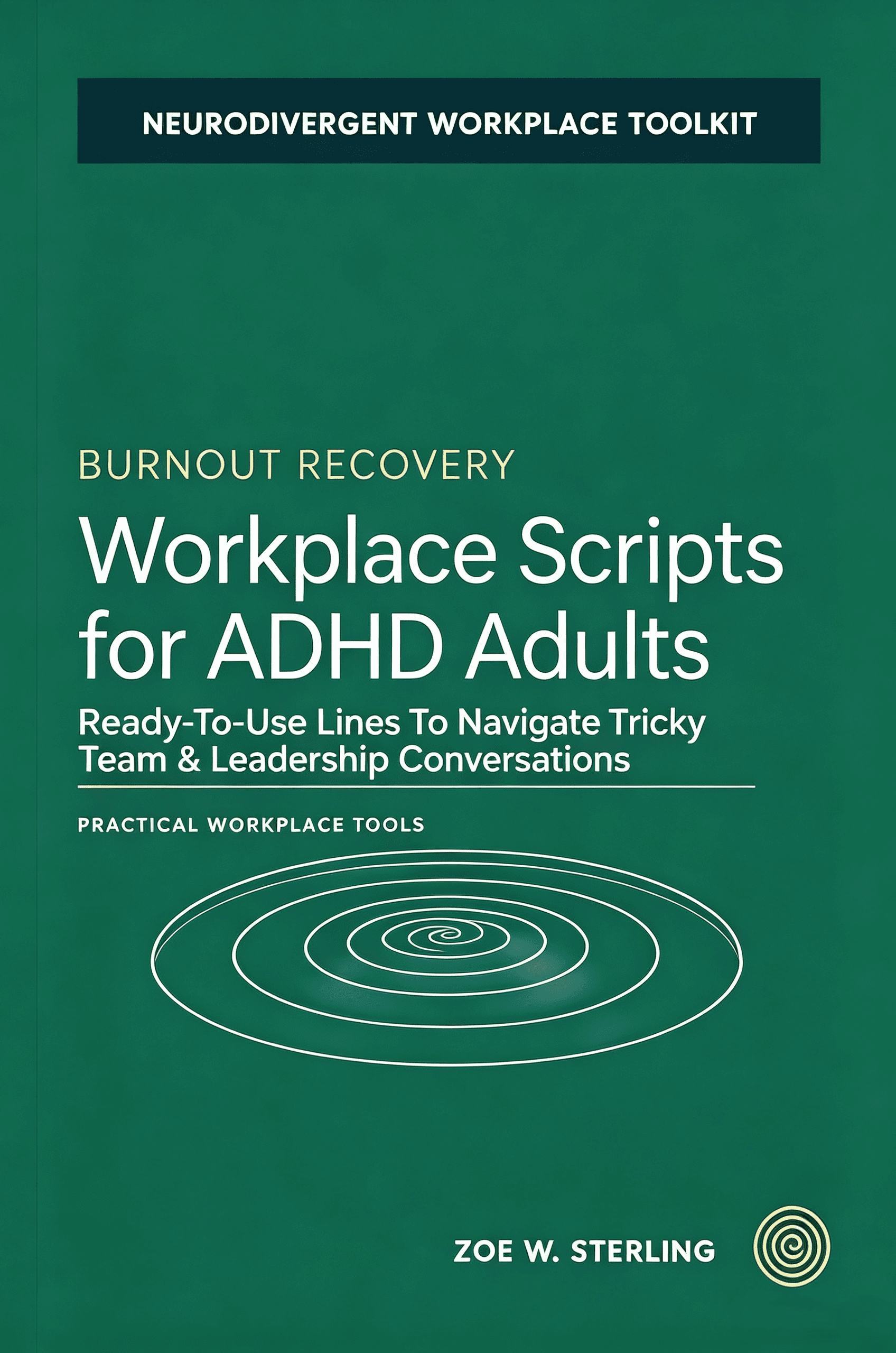
Workplace Scripts for ADHD Adults
A practical collection of workplace scripts for neurodivergent adults. From requesting accommodations to pushing back on unreasonable deadlines, these scripts help ADHD professionals communicate their needs clearly.
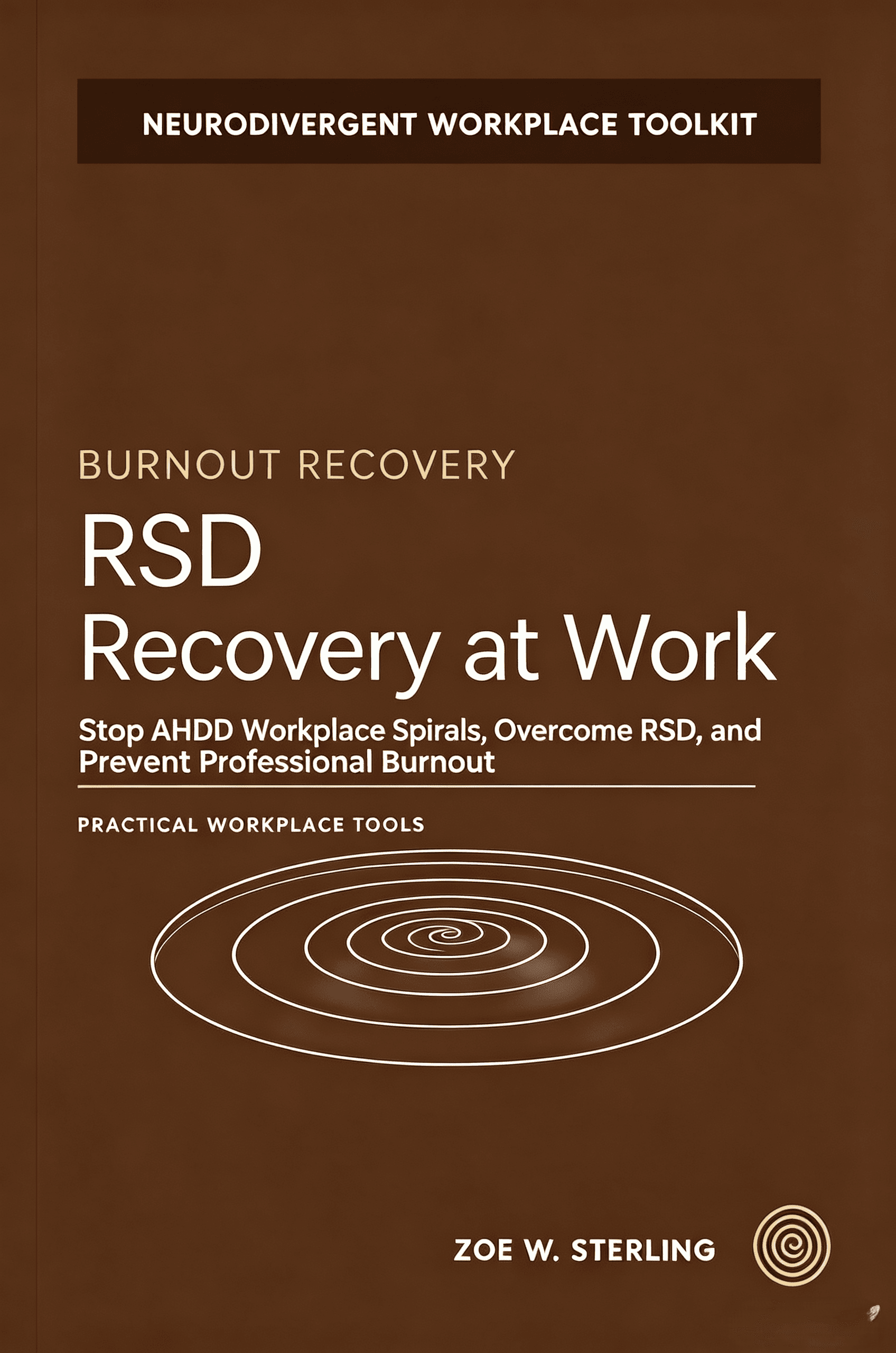
RSD Recovery at Work
A comprehensive field guide for neurodivergent adults navigating the workplace. Based on Zoe Sterling's 10+ years of ADHD workplace research and coaching, this book identifies 8 core strengths and 7 hidden workplace patterns.
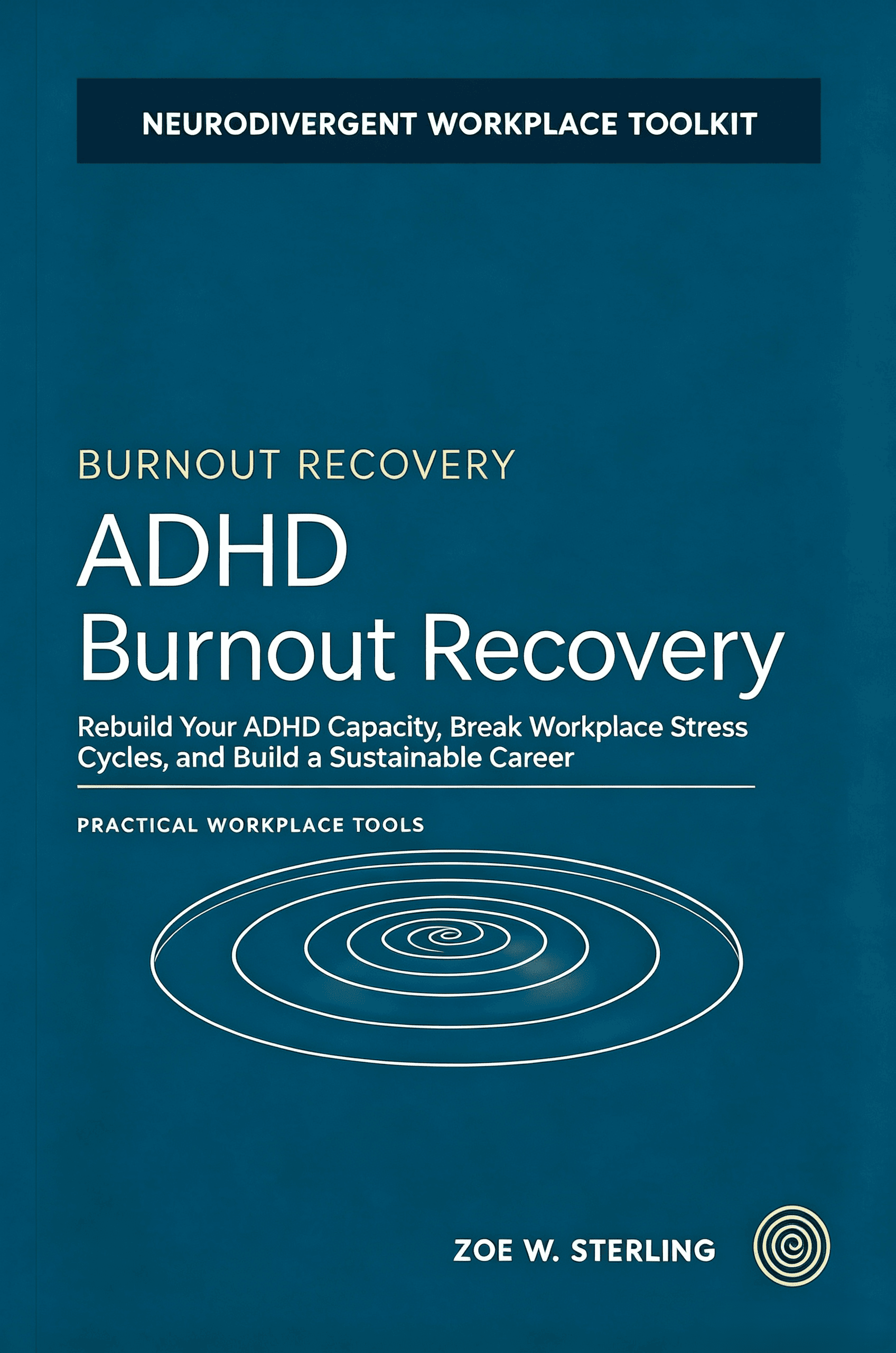
ADHD Burnout Recovery
ADHD burnout is different from typical burnout. Rooted in overstimulation, executive dysfunction, and the gap between natural strengths and workplace demands, it requires a specialized recovery approach.