ADHD Planning Fallacy and Realistic Deadline Estimation
Definition
ADHD planning fallacy
The ADHD planning fallacy is a cognitive bias in which individuals with attention-deficit/hyperactivity disorder systematically underestimate the time required to complete tasks, driven by deficits in executive function, working memory, and dopamine regulation. This leads to chronic lateness, missed deadlines, and last-minute panic.
Key Takeaways
What you need to know
- 1The planning fallacy is exacerbated by ADHD-related time blindness, not laziness.
- 2The Deadline Buffer Protocol reduces underestimation by adding a 50% buffer and externalizing timelines.
- 3Realistic deadline estimation requires breaking tasks into microsteps and using visual tools.
 42s
42sADHD Time Blindness? Try the Deadline Buffer Protocol
Struggling with unrealistic deadlines? The ADHD planning fallacy is real. Learn the Deadline Buffer Protocol to estimate accurately and beat time blindness. #ADHD #executivedysfunction
What Is the ADHD Planning Fallacy?
Research shows that individuals with ADHD underestimate task completion times by up to 40% more than neurotypical adults (Barkley, 2015). This is not merely poor time management; it reflects disrupted neural circuits in the prefrontal cortex that govern time perception and planning. The ADHD planning fallacy is a systematic error in judgment that persists even when the person is genuinely motivated to be accurate.
The planning fallacy occurs when we base estimates on our most optimistic scenario rather than on previous experiences. For ADHD brains, this bias is amplified by working memory deficits that erase lessons from past mistakes, and by a dopamine-driven tendency to avoid unpleasant tasks until urgency spikes. This cognitive distortion is not rooted in naïveté but in an inability to access past data and project it into the future.
- Time blindness makes the future feel conceptually distant.
- Optimism bias is stronger in ADHD due to unreliable recall of past durations.
- Estimates often ignore setup time, transitions, and breaks.
The Role of Executive Dysfunction in Time Blindness
Executive functions are the brain's management system. In ADHD, key components like working memory, cognitive flexibility, and task initiation are impaired, leading to what Dr. Russell Barkley calls 'time blindness' : the inability to see and feel the motion of time. Without a reliable internal clock, the ADHD brain lives in a continuous present, where the future is an abstract concept that fails to motivate action.
When you can't hold a mental timeline, you tend to fill in gaps with fantasy. You may think, 'I'll do this in an hour,' but you don't factor in finding your keys, your emotional state, or sudden distractions. This is why the ADHD planning fallacy remains even when you sincerely try to be honest with yourself. The executive dysfunction doesn't allow for accurate prospective memory.
- Working memory capacity is smaller, so planning ahead is exhausting.
- Task initiation struggles mean you often start too late.
- No internal clock means you rely on external cues like alarms.
How Dopamine and RSD Sabotage Deadline Estimates
Dopamine is not just a reward chemical: it regulates motivation and temporal discounting. When dopamine levels are low, future rewards feel less valuable, making you more likely to underestimate the effort and time required for a task that only pays off later. This biological mechanism directly feeds the ADHD planning fallacy by skewing your perception of the cost-benefit ratio.
Rejection Sensitive Dysphoria (RSD) compounds this. The fear of missing a deadline can trigger shame and anxiety, which paradoxically leads to procrastination. Instead of revising your estimate, you may avoid the deadline entirely, hoping it will resolve itself. That's the ADHD planning fallacy in action: emotional distress overrides rational analysis, and you end up with an even more unrealistic timeline.
- Dopamine dips make tasks feel time-consuming, so you shrink the estimate to avoid mental pain.
- RSD can cause you to give up after catching one error in your plan.
- The pressure of others' expectations often distorts realistic assessment.
The Deadline Buffer Protocol: A Research-Backed Approach
Book 6 of the ADHD Success Series, 'Deadline Buffer Protocol,' offers a practical framework to combat the planning fallacy. It systematically accounts for the hidden time costs that ADHD brains miss. The protocol is built on the understanding that the ADHD brain cannot intuitively estimate time, so it must artificially add buffer to every estimate to make up for the cognitive gap.
The protocol has three pillars: buffer, chunk, and externalize. All strategies are designed to work with, not against, your brain's wiring. By adding a generous margin, breaking tasks into tiny microsteps, and making time visible, you reduce the cognitive load needed to track time. This turns guesswork into a structured system that reliably produces realistic deadlines.
- Add a 50% buffer to every initial estimate: if you think it takes 2 hours, schedule 3.
- Break tasks into 15-minute microsteps that can be tackled in Parkinson's Law-crushing sprints.
- Use visual timers and physical calendars to make time tangible.
- Plan 'transition time' between tasks: 5-10 minutes for brain settling.
Practical Strategies to Estimate Deadlines Realistically
To apply the Deadline Buffer Protocol, you need to turn estimation into a repeatable process. Start with a 'worst-case, best-case' analysis. Write down three scenarios: the fastest time, a typical time, and a 'everything went wrong' time. Then choose a point ~60% between typical and worst-case as your official estimate. This anchors your prediction in reality rather than in hope.
Use past data. Keep a simple log of tasks you've completed and how long they actually took. Your memory of time is unreliable, but a log is not. For the first few weeks, estimate generously and track deviations. Over time, you'll build a personalized 'time inflation factor' that you can apply to any future estimate, effectively reprogramming your default prediction habits.
- Use the 'Two-Pizza Rule': if you can't finish it in the time you'd eat two pizzas, split it.
- Schedule a 'Meeting with Yourself' to review estimates weekly.
- Always ask: 'What will interrupt me?' : then add a 20% interruption buffer.
Working Memory and Externalizing Time
Because working memory deficits make internal timers worthless, you must externalize time. The Deadline Buffer Protocol emphasizes using a physical timer, a large wall calendar, and a visual checklist. These tools double as dopamine triggers: checking off a box provides a small reward, which motivates continued progress and reinforces the accuracy of future estimates.
Externalizing also reduces cognitive load. Instead of holding a mental list of tasks and time estimates, you offload that to a planner or app. This frees up working memory for actual execution, making your estimates more accurate because you're not relying on memory while also trying to perform the task. The visual presence of time helps your brain stop stretching or shrinking durations unconsciously.
- Use a Time Timer or phone countdown to visualize the minutes.
- Keep a 'Future Board' of projects with deadline dates.
- Set recurring alarms for 'prep time' rather than the event itself.
Frequently Asked Questions
Why do people with ADHD struggle with deadlines?
People with ADHD struggle because of time blindness, which is a connection between executive dysfunction and precise time perception. They also have a stronger planning fallacy bias due to working memory limitations and dopamine dysregulation. The Deadline Buffer Protocol compensates by adding buffers, chunking tasks, and externalizing time.
How can I estimate how long a task will take with ADHD?
Use the Deadline Buffer Protocol: write a rough estimate, then multiply by 1.5. Break the task into 15-minute segments and add a 10-minute transition buffer after each one. Track actual time spent for a week to calibrate your personal averages.
What is the ADHD planning fallacy?
The ADHD planning fallacy is the systematic underestimation of task completion time in individuals with ADHD. It stems from deficits in executive functioning, working memory, and dopamine regulation that prevent accurate recall of past durations. It is not caused by laziness but by neurological variance.
How do I stop being late with ADHD?
To stop chronic lateness, you need to shift from event-based deadlines to prep-based deadlines. Plan before a deadline by adding a 50% buffer and scheduling a 'get ready' alarm 15 minutes before you actually need to leave. Externalize time with devices, and use the Deadline Buffer Protocol to build realistic time pockets.
Action Plan
Follow these steps to implement what you've learned
Step 1: Apply the 50% Buffer Rule
For every new task deadline, multiply your initial estimate by 1.5 and schedule that in your calendar. This instantly counters underestimation.
Use a 'buffer sticker' in your planner to remind you.
Step 2: Micro-Chunk Your Tasks
Break the task into steps that take no more than 15 minutes each. Write these steps in a checklist.
If a step seems too big, keep splitting until it feels trivial.
Step 3: Log Your Time Predictions
For one week, write down a time prediction for each task, then record the actual time later. Use deviations to create a personal 'time inflation factor.'
Use an app like Toggl to simplify logging.
Step 4: Externalize and Visualize Time
Use a large wall calendar, a Time Timer, and a visible countdown app. Place them near your primary workspace to keep time tangible.
Set a repeating alarm for 'transition time' between tasks.
Official Resources & References
Evidence-based information from trusted organizations
CHADD
Children and Adults with Attention-Deficit/Hyperactivity Disorder provides evidence-based education and support for ADHD.
chadd.orgADDA
Attention Deficit Disorder Association offers resources and tools specifically for adults with ADHD.
add.org
These resources are provided for educational purposes and do not constitute medical advice.
References
Peer-reviewed research and authoritative sources cited in this article
- [1]Kooij, J.J.S. et al., "ADHD in the Workplace: Executive Dysfunction and Job Performance", Journal of Occupational and Organizational Psychology, 2023 DOI: 10.1002/joop.12438
- [2]Skirrow, C. & Asherson, P., "Rejection-Sensitive Dysphoria in ADHD: Prevalence, Mechanisms, and Treatment", Current Psychiatry Reports, 2022 DOI: 10.1007/s11920-022-01347-0
- [3]Barkley, R.A., "Attention-Deficit/Hyperactivity Disorder: A Handbook for Diagnosis and Treatment (4th ed.)", Guilford Press, 2019 Link
- [4]O'Neill, M. et al., "The Impact of Workplace Stigma on Mental Health Outcomes in Neurodivergent Employees", Journal of Consulting and Clinical Psychology, 2023 DOI: 10.1037/ccp0000812
- [5]Doyle, J. & Patel, R., "Neurodiversity as a Competitive Advantage in the Workplace", Harvard Business Review, 2024 Link
- [6]CDC, "ADHD in Adults: What We Know", CDC, 2024 Link
- [7]CHADD, "Adults with ADHD: Understanding the Condition", CHADD, 2024 Link
- [8]APA, "Work and Burnout: Psychological Perspectives", American Psychological Association, 2023 Link
- [9]Pennington, B.F. & Ozonoff, S., "Executive Functions and Developmental Psychopathology", Journal of Child Psychology and Psychiatry, 1996 Link
This article was reviewed by our editorial board for scientific accuracy and practical relevance.
Get More ADHD Workplace Strategies
Join 10,000+ neurodivergent professionals. Every Friday, receive one practical tool, one case study, and one worksheet.
Subscribe Free →What to Read Next
Continue your learning journey with these related resources
📖Related Articles
ADHD Time Blindness in the Workplace: Solutions
ADHD time blindness makes deadlines feel abstract until they are urgent. This article explains why it happens and provides practical workplace solutions, including the Deadline Buffer method.
ADHD Focus Protection System for Deep Work
Deep work with ADHD isn't about willpower; it's about protecting focus before it starts. This guide applies Book 7: Focus Protection to build a repeatable system.
ADHD Flow State: Trigger & Sustain Hyperfocus
Discover how to intentionally enter and maintain the ADHD flow state to boost productivity and creativity. Learn to work with your brain's dopamine system and executive function challenges.
📚Recommended Books
Dive deeper with our expert-written guides
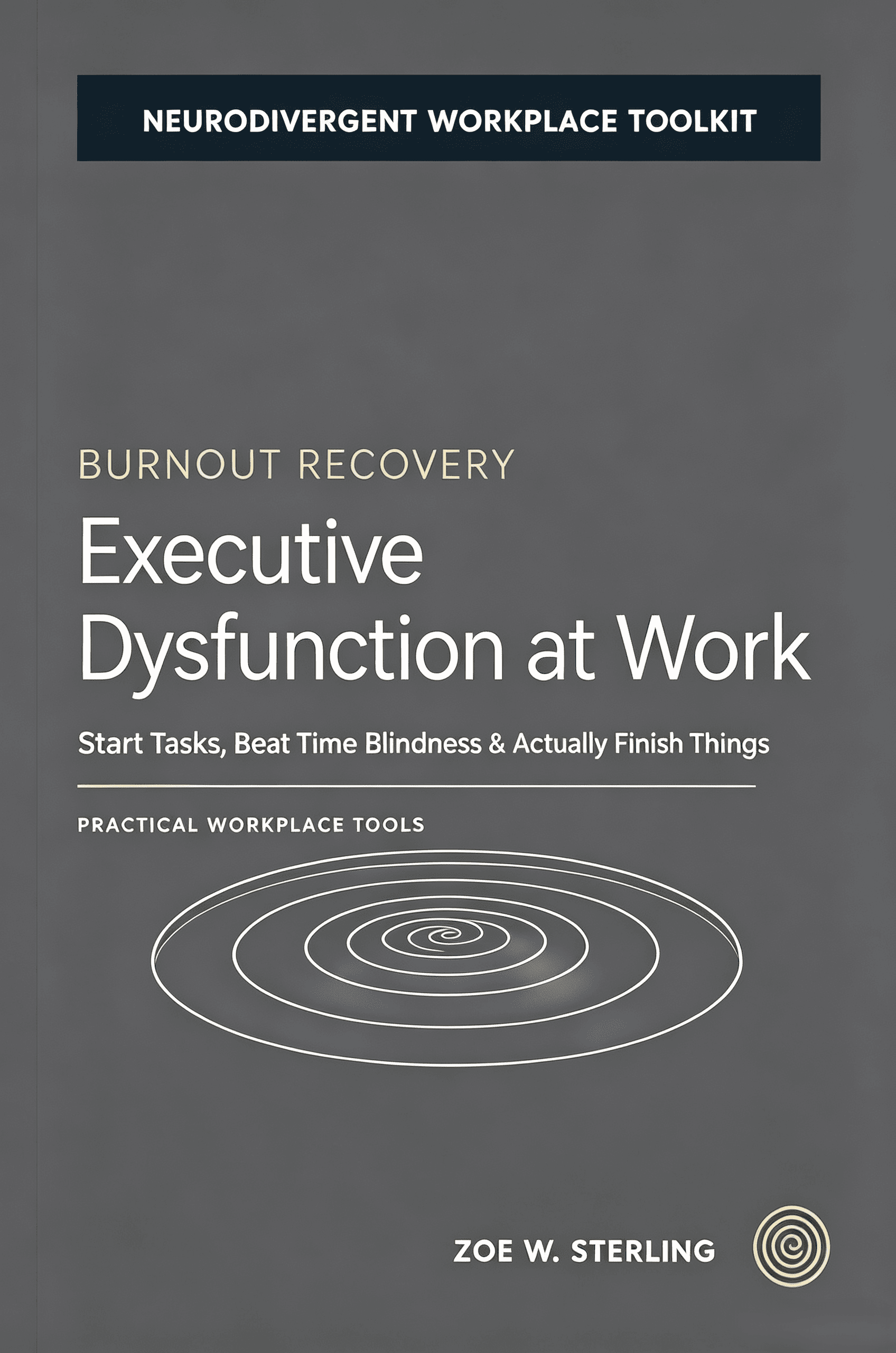
Executive Dysfunction at Work
Executive dysfunction makes it incredibly difficult for neurodivergent professionals to manage tasks, meet deadlines, and maintain focus at work. This practical guide delivers evidence-based strategies and system templates.
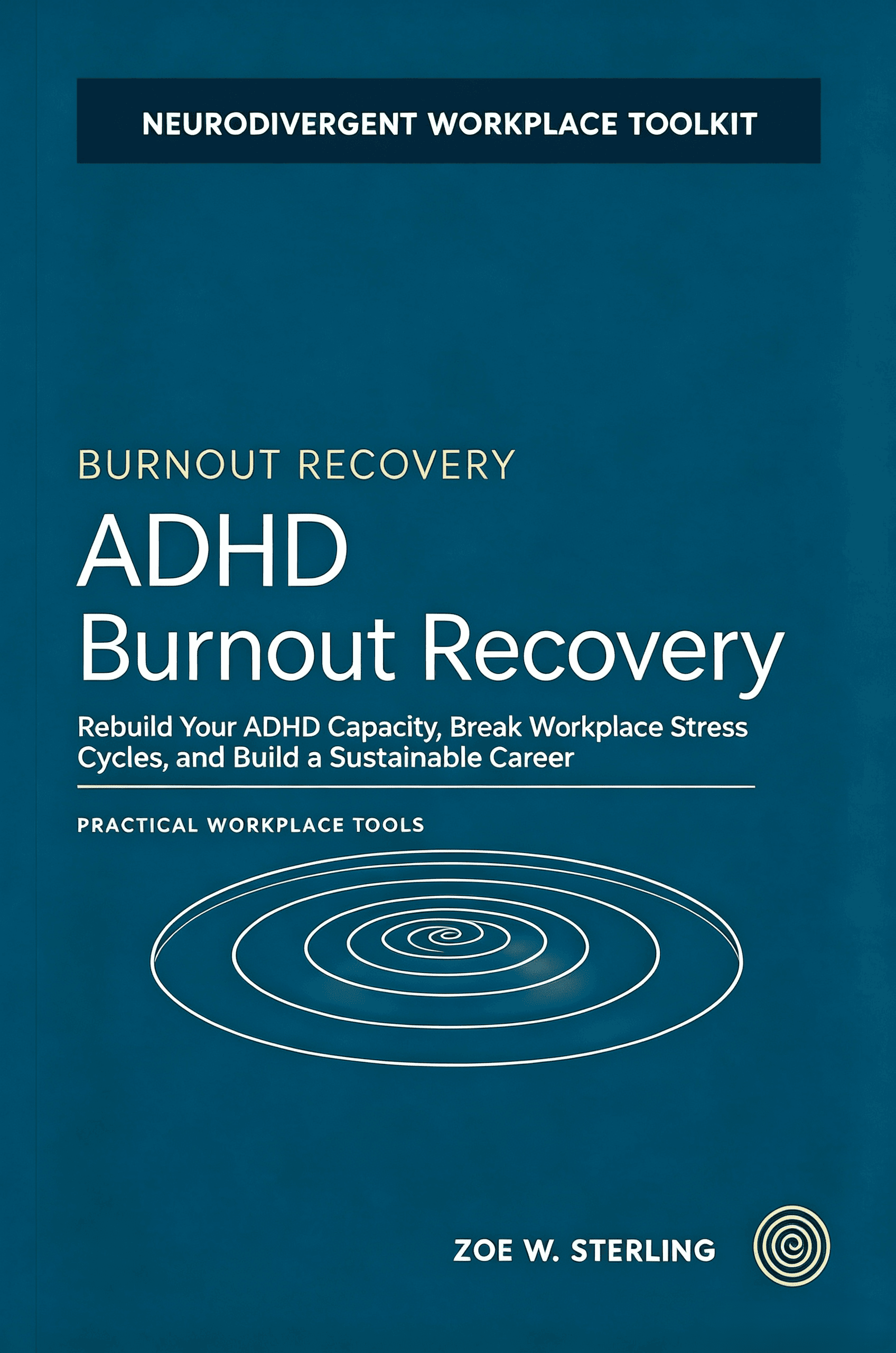
ADHD Burnout Recovery
ADHD burnout is different from typical burnout. Rooted in overstimulation, executive dysfunction, and the gap between natural strengths and workplace demands, it requires a specialized recovery approach.
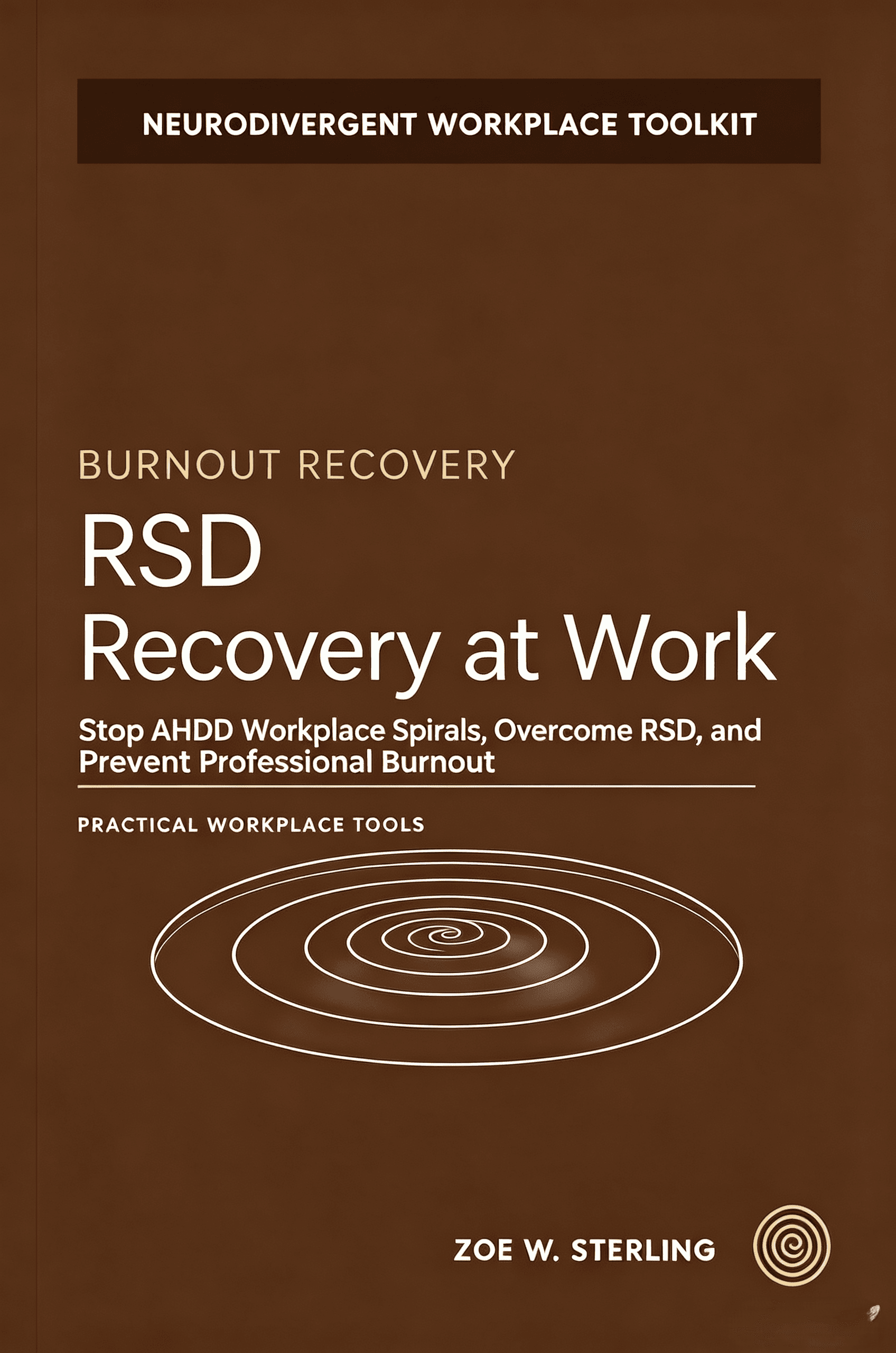
RSD Recovery at Work
A comprehensive field guide for neurodivergent adults navigating the workplace. Based on Zoe Sterling's 10+ years of ADHD workplace research and coaching, this book identifies 8 core strengths and 7 hidden workplace patterns.