Workplace Spirals: Understanding the 7 Hidden Patterns That Trap ADHD Professionals
定義
Workplace Spiral
A repeating, self-reinforcing pattern of behavior, thought, and emotion that traps ADHD professionals in cycles of stress, underperformance, and burnout. Workplace spirals are driven by the interaction of ADHD-specific neurological features (RSD, executive dysfunction, dopamine dysregulation) with neurotypical workplace demands (performance pressure, social norms, feedback expectations).
核心要點
你需要了解的要点
- 1Workplace spirals are self-reinforcing cycles that trap ADHD professionals: awareness is the first step to breaking free
- 2The 7 spirals framework provides a vocabulary for understanding your workplace patterns
- 3Each spiral has a specific trigger, a temporary payoff, and a long-term "cost": understanding all three is key to intervention
- 4Breaking a spiral requires interrupting the cycle at the earliest possible stage, not when you're already deep in it
- 5The most effective intervention is replacing the spiral behavior with a healthier alternative that meets the same underlying need
 42s
42sADHD Workplace Spirals: How to Break Free
Stuck in the same ADHD patterns at work? Learn the 7 workplace spirals and how to break them. Practical steps for neurodivergent professionals. #ADHD #workplace #neurodivergent
Recognizing the Spiral Pattern
Have you ever noticed that the same workplace challenges keep repeating in your life? The chronic overwork. The last-minute crunches. The resentment after saying yes too many times. These aren't coincidences: they're spirals.
A workplace spiral is a self-reinforcing cycle where your ADHD neurology interacts with neurotypical workplace demands to create a pattern that traps you. The more you try to escape using the same strategies, the deeper you get. Breaking free requires a fundamentally different approach.
The seven most common workplace spirals for ADHD professionals:
- The RSD Overachiever: Driven by RSD fear of being 'not good enough,' you overwork to prove your worth → Burnout → More RSD → More overwork
- The Burnout Magnet: Competence leads to more work → You can't say no (RSD) → More work → Burnout → Even more work (because you've shown you can handle it)
- The Analysis Paralysis Expert: Executive dysfunction + perfectionism → You plan endlessly without starting → Deadlines approach → Last-minute panic work → Exhaustion
- The Last-Minute Hero: Dopamine-seeking behavior → You wait for the deadline pressure to activate → Intense hyperfocus work → Burnout → Swear 'never again' → Repeat next time
- The People-Pleaser: RSD + fear of rejection → You say yes to every request → Overloaded → Resentful → More RSD → More people-pleasing
- The Masking Performer: Fear of being 'found out' → You mask ADHD traits at all costs → Energy depletion → Burnout → More masking to compensate
- The Defensive Procrastinator: RSD fear of doing it 'wrong' → You avoid the task → More anxiety → RSD spiral → More avoidance
Diagnosing Your Spiral Pattern
Not all spirals are equally damaging. Some are merely annoying; others are career-threatening. Take this diagnostic approach to understand your specific spiral:
- Name the pattern: Describe your spiral in concrete terms ('I always end up working 60-hour weeks after a performance review')
- Identify the trigger: What starts the cycle? (e.g., 'A performance review comment about 'being more strategic' makes me panic and overwork')
- Recognize the payoff: What temporary relief does the spiral provide? (e.g., 'Working 60 hours makes me feel like I'm proving I'm not inadequate')
- Calculate the cost: What long-term damage does it cause? (e.g., 'I burn out every 3 months, my health suffers, and I produce lower-quality work')
- Map the cycle: Document the sequence of events from trigger to consequence to understand the full spiral mechanics
Breaking Free: The 3-Step Intervention Framework
Breaking a spiral requires interrupting it at the earliest stage, not when you're already deep in the cycle. Use this 3-step framework:
- Step 1 : Name It: Awareness is the most powerful tool. When you notice the trigger, say out loud (or write down): "I notice I'm entering the RSD Overachiever spiral. This is what's happening."
- Step 2 : Interrupt the Trigger: Use a pre-planned intervention that specifically targets your spiral. Examples: For the RSD Overachiever: "I will set a boundary: 'I can take on one new task this week, not three.'" For the Analysis Paralysis Expert: "I will use the 2-minute rule: I'll start the task for just 2 minutes."
- Step 3 : Replace the Pattern: Replace the spiral behavior with a healthier alternative that meets the same underlying need. The RSD Overachiever needs to feel valued → Replace overwork with: "I will document my wins and share them in my next check-in."
Preventing Spiral Recurrence
Once you've broken a spiral, you need to prevent it from re-forming. These maintenance strategies work:
- Early warning system: Identify the early signs of your specific spiral (e.g., 'I notice I'm checking my email at 10pm again') and intervene immediately
- Accountability partner: Share your spiral pattern and intervention strategy with a trusted colleague or coach
- Regular check-ins: Review your spiral patterns monthly to assess risk
- Build alternative routines: Replace the spiral's trigger with a healthier alternative (e.g., instead of overworking after feedback, take a walk and journal)
- Address root causes: Some spirals have deeper roots (e.g., unresolved RSD, low self-esteem). Work with a therapist to address these foundations.
常見問題
What is a workplace spiral?
A workplace spiral is a repeating pattern of behavior, thinking, and emotional response that traps ADHD professionals in a cycle of stress, underperformance, and burnout. Spirals are self-reinforcing: each cycle makes the next one more likely and more intense. Breaking free requires identifying the specific spiral pattern and interrupting it at the earliest possible stage.
What are the 7 workplace spirals?
The 7 spirals are: 1) The RSD Overachiever (overworking to prove worth), 2) The Burnout Magnet (attracting more work due to competence), 3) The Analysis Paralysis Expert (getting stuck in planning), 4) The Last-Minute Hero (waiting until deadlines to activate), 5) The People-Pleaser (saying yes to everything), 6) The Masking Performer (hiding ADHD traits at all costs), 7) The Defensive Procrastinator (avoiding tasks due to RSD fear).
How do I identify which spiral I'm in?
Start with a Spiral Assessment: 1) Review the 7 spiral descriptions and identify which ones resonate most, 2) Track your workplace patterns for 2 weeks (when do you feel most stuck? What triggers the spiral?), 3) Identify the specific trigger that starts each cycle, 4) Understand the payoff (what temporary relief does the spiral provide?), 5) Recognize the cost (what long-term damage does it cause?).
How do I break a spiral once I've identified it?
Breaking a spiral requires interrupting the cycle at its earliest stage. The intervention framework has 3 steps: 1) Name the spiral: "I notice I'm entering the RSD Overachiever spiral," 2) Interrupt the trigger: Use a pre-planned strategy (e.g., a boundary, a time box, a cognitive reframe), 3) Replace with a new pattern: Implement a healthier behavior that addresses the underlying need (e.g., "I will set clear capacity boundaries instead of overworking").
官方資源與參考資料
來自可信組織的循證資訊
CDC - ADHD in Adults
Centers for Disease Control and Prevention: Evidence-based information on ADHD in adults, including workplace accommodations.
www.cdc.gov/ncbddd/adhd/index.htmlCHADD - Adults with ADHD
Children and Adults with ADHD: Resources for managing ADHD symptoms in professional settings.
chadd.org/adults-with-adhd/ADA.gov - Reasonable Accommodations
Americans with Disabilities Act: Your rights to workplace accommodations for ADHD under federal law.
www.ada.gov/reasonable-accommodations/
這些資源僅供教育目的提供,不構成醫療建議。
参考文献
本文引用的同行评审研究与权威来源
- [1]Kooij, J.J.S. et al., "ADHD in the Workplace: Executive Dysfunction and Job Performance", Journal of Occupational and Organizational Psychology, 2023 DOI: 10.1002/joop.12438
- [2]Skirrow, C. & Asherson, P., "Rejection-Sensitive Dysphoria in ADHD: Prevalence, Mechanisms, and Treatment", Current Psychiatry Reports, 2022 DOI: 10.1007/s11920-022-01347-0
- [3]Barkley, R.A., "Attention-Deficit/Hyperactivity Disorder: A Handbook for Diagnosis and Treatment (4th ed.)", Guilford Press, 2019 Link
- [4]O'Neill, M. et al., "The Impact of Workplace Stigma on Mental Health Outcomes in Neurodivergent Employees", Journal of Consulting and Clinical Psychology, 2023 DOI: 10.1037/ccp0000812
- [5]Doyle, J. & Patel, R., "Neurodiversity as a Competitive Advantage in the Workplace", Harvard Business Review, 2024 Link
- [6]CDC, "ADHD in Adults: What We Know", CDC, 2024 Link
- [7]CHADD, "Adults with ADHD: Understanding the Condition", CHADD, 2024 Link
- [8]APA, "Work and Burnout: Psychological Perspectives", American Psychological Association, 2023 Link
本文由我們的編輯委員會審閱,以確保科學準確性與實用性。
獲取更多 ADHD 職場策略
加入超過 10,000 位神經多樣性專業人士。每週五收到一個實用工具、一個案例研究和一個工作紙。
免費訂閱 →下一步閱讀
繼續您的學習之旅
📖相關文章
📚推薦書籍
深入閱讀我們專家撰寫的指南
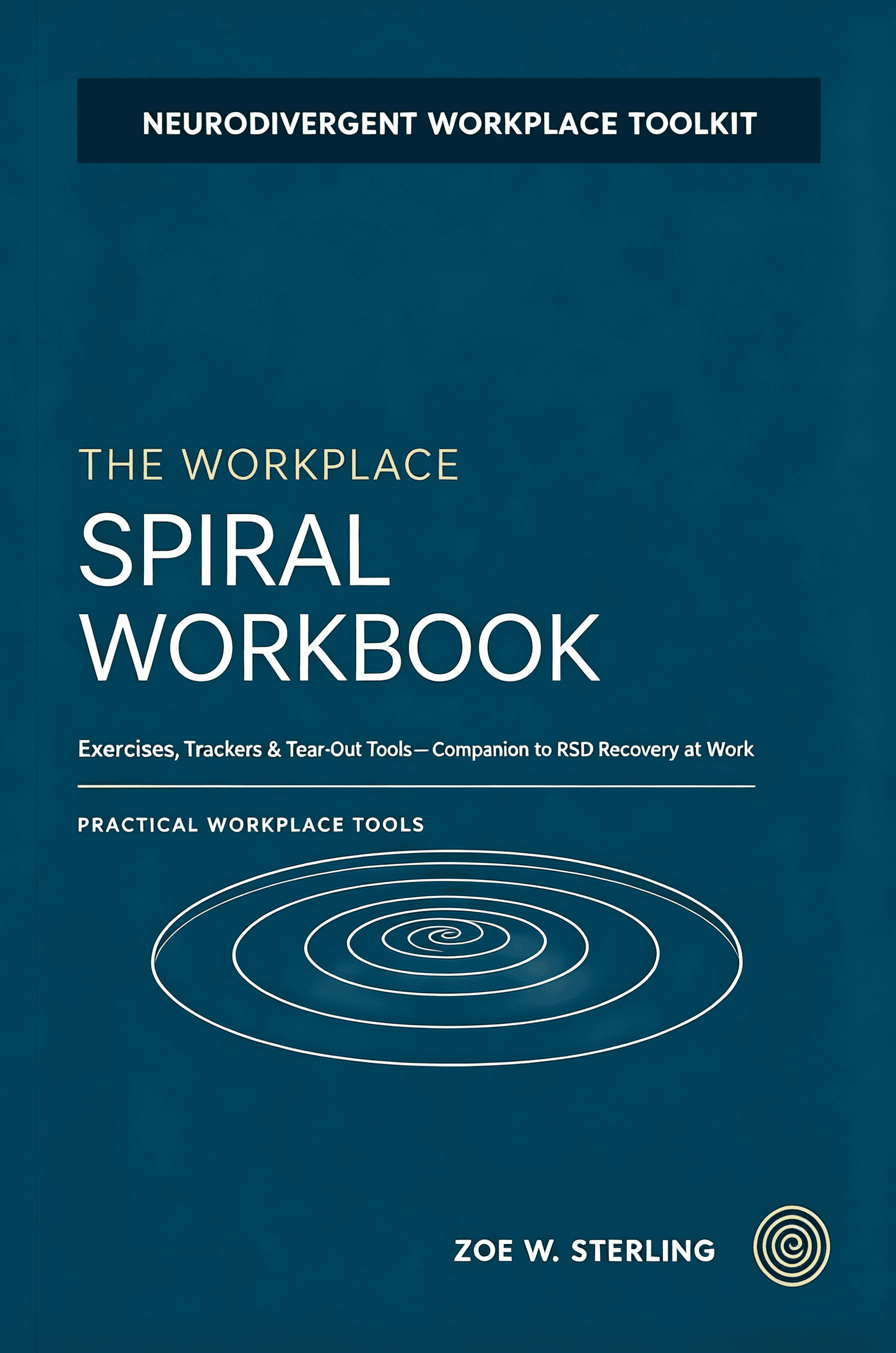
The Workplace Spiral Workbook
This interactive workbook is the companion to Zoe Sterling's Workplace Spiral assessment. Readers identify their spiral type, track their workplace patterns, and practice rewiring strategies to break free from unhealthy cycles.
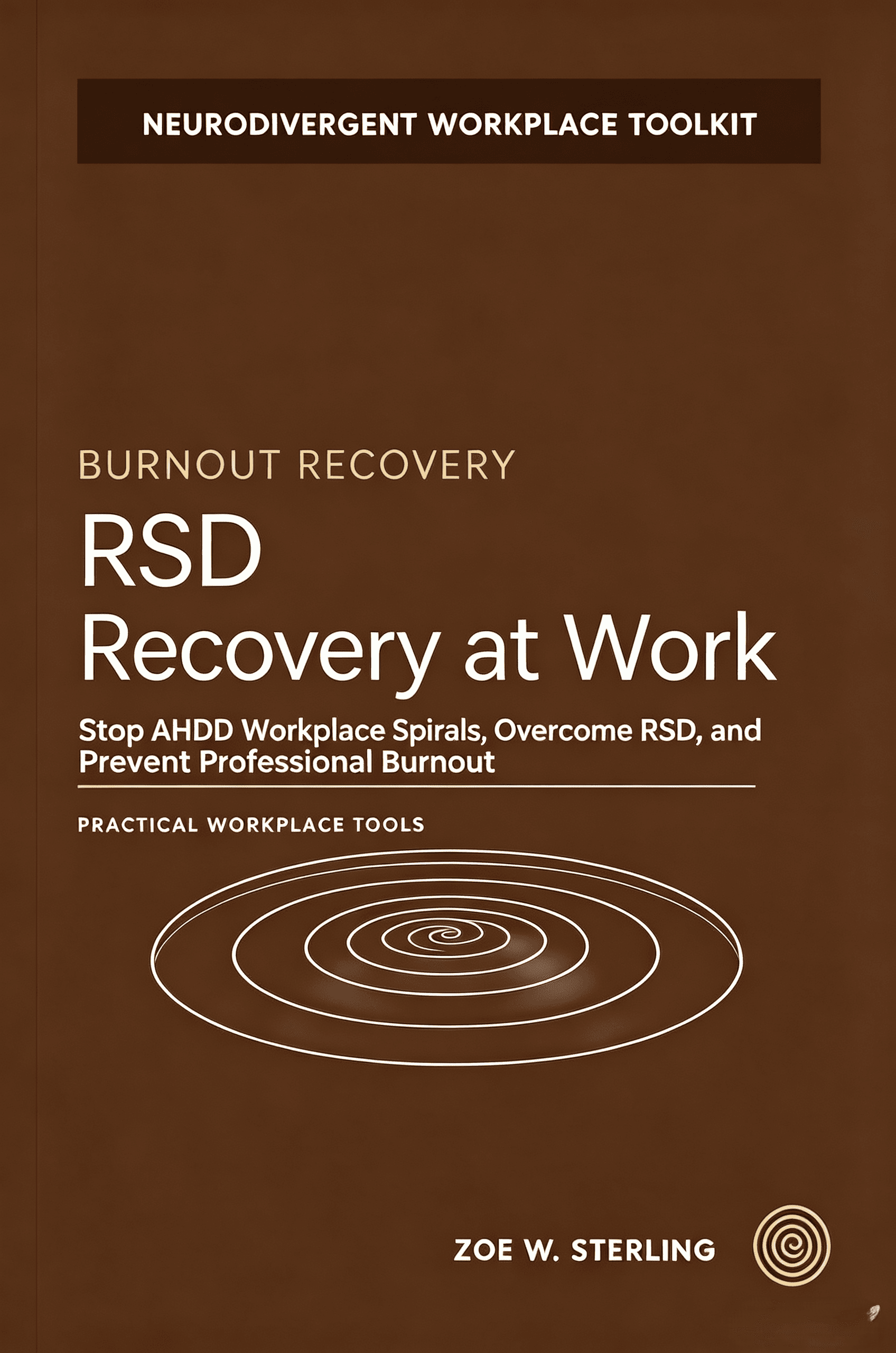
RSD Recovery at Work
A comprehensive field guide for neurodivergent adults navigating the workplace. Based on Zoe Sterling's 10+ years of ADHD workplace research and coaching, this book identifies 8 core strengths and 7 hidden workplace patterns.
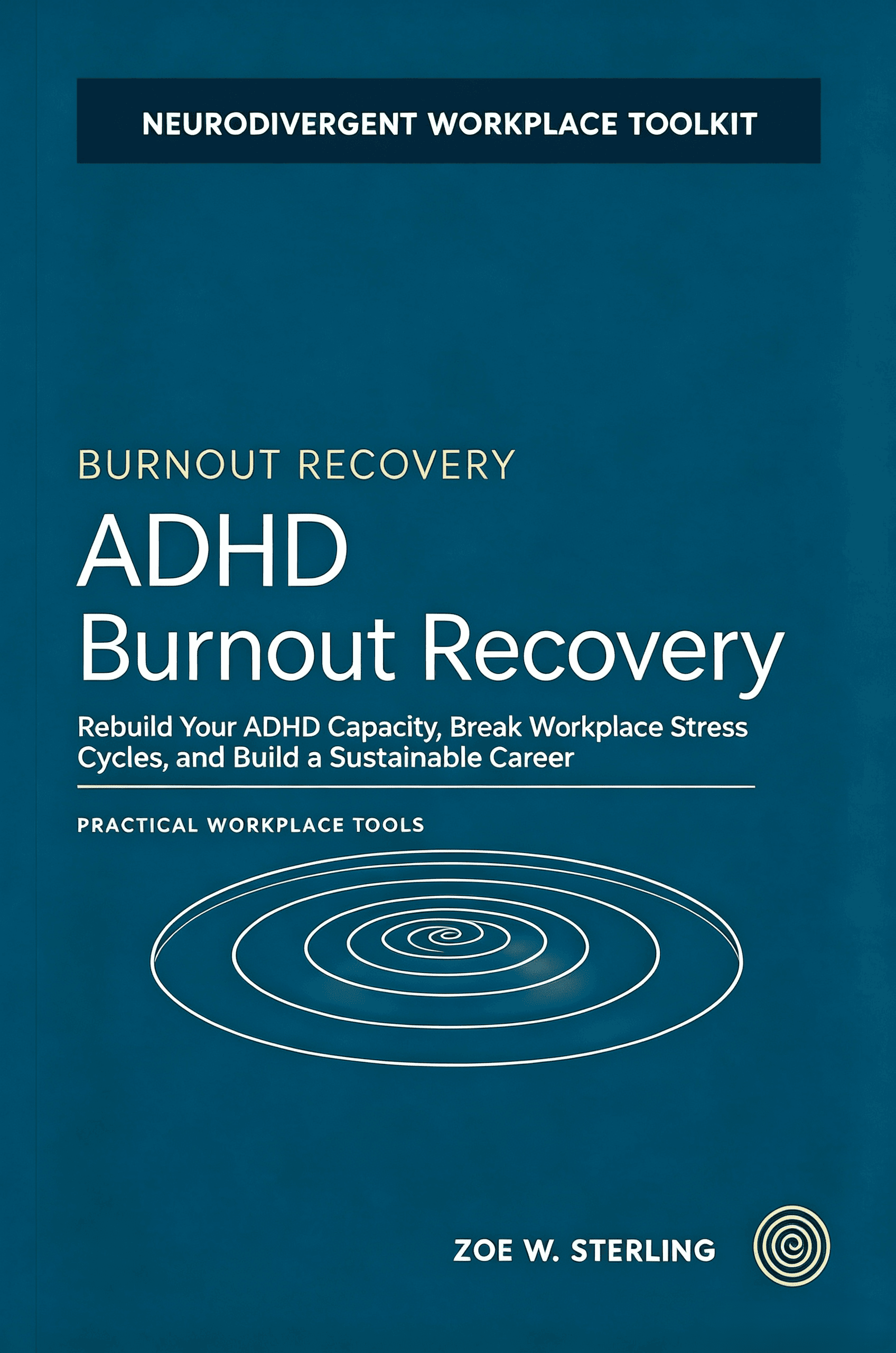
ADHD Burnout Recovery
ADHD burnout is different from typical burnout. Rooted in overstimulation, executive dysfunction, and the gap between natural strengths and workplace demands, it requires a specialized recovery approach.