Definition
Reasonable Accommodation for ADHD
A workplace modification or adjustment that enables a qualified individual with ADHD to perform the essential functions of their job without imposing an undue hardship on the employer. Under the ADA, accommodations must be provided unless they create significant difficulty or expense relative to the size and resources of the employer.
Key Takeaways
Was Sie wissen müssen
- 1ADHD qualifies as a disability under the ADA: you have legal rights to accommodations
- 2The most effective accommodations for ADHD are flexible scheduling, reduced meetings, and sensory-friendly spaces
- 3Frame accommodation requests around business benefit, not personal need ('This helps me produce better work')
- 4Document all requests and decisions in writing to protect your rights
- 5You do not need a formal diagnosis to request accommodations, but one makes the process smoother
 25s
25sADHD Accommodations at Work: Your Legal Rights
Learn how to get ADHD accommodations at work. Know your rights under the ADA. #ADHD #workplace #accommodations
Knowing Your Legal Rights
The first and most important thing to know: ADHD qualifies as a disability under the Americans with Disabilities Act (ADA). This means your employer is legally required to provide reasonable accommodations that help you do your job.
But here's the reality: most employees never request accommodations because they fear stigma, don't know their rights, or don't know how to articulate what they need. This guide changes that. You'll learn exactly what to ask for, how to ask for it, and what to do if your request is denied.
Key legislation protecting ADHD professionals includes:
- Americans with Disabilities Act (ADA): Requires employers with 15+ employees to provide reasonable accommodations
- Equality Act (UK): Provides similar protection, strengthening protection for neurodivergent workers
- Accessibility for Ontarians with Disabilities Act (Canada): Mandates accommodation up to the point of undue hardship
- European Accessibility Act: Coming into force in 2025, requires reasonable accommodations across EU workplaces
The Top 10 ADHD Accommodations That Actually Work
Not all accommodations are equally effective for ADHD. These are the ten accommodations with the highest success rates for neurodivergent professionals:
- Flexible scheduling: Core hours (e.g., 10am-3pm) with flexible start/end times to align with your natural energy
- Reduced meeting frequency: Replace some meetings with async updates, shared docs, or voice notes
- Written meeting agendas and summaries: Receive agendas 24 hours before and summaries within 24 hours after
- Sensory-friendly workspace: Reduce background noise, adjustable lighting, permission to use noise-canceling headphones
- Remote/hybrid work: Work from home 2-3 days per week to reduce overstimulation and masking demands
- Extended deadlines: Add 25-50% more time for complex or multi-step tasks that require executive function
- Preferential seating: Sit near exits in meeting rooms for easy sensory breaks
- Modified feedback format: Written feedback first, then verbal discussion to reduce RSD triggers
- Task restructuring: Break large projects into smaller milestones with clear checkpoints
- Quiet time blocks: Schedule 90-minute uninterrupted focus blocks in your calendar that colleagues respect
How to Request Accommodations (Without Burning Bridges)
Requesting accommodations is a professional conversation, not a personal plea. Follow this framework for success:
- Prepare your case: Document specific examples of when your ADHD impacts your work (e.g., 'After back-to-back meetings, I need 2 hours to recover')
- Focus on business impact: Frame requests as 'This will help me produce higher quality work more consistently'
- Be specific: Instead of 'I need more flexibility,' say 'I need flexible core hours so I can schedule deep work during my peak focus times'
- Suggest solutions: Don't just identify problems: propose solutions your employer can implement
- Put it in writing: Email your request so you have a paper trail. Include a proposed trial period (e.g., 'Let's try this for 30 days and evaluate')
- Be willing to negotiate: Your employer may suggest alternative accommodations that work better for both parties
Sustaining Your Accommodations Long-Term
Getting accommodations is only the first step. You also need to sustain them. Here's how:
- Check in regularly: After 30 days, share with your manager how the accommodation is helping
- Provide data: If possible, share productivity metrics or quality improvements that resulted
- Be flexible: If an accommodation isn't working for the team, propose alternatives
- Document success: Keep records of how accommodations help you perform better during performance reviews
- Know your escalation path: If accommodations are being revoked without justification, contact HR or legal
Frequently Asked Questions
Are ADHD accommodations legally required?
Yes. Under the Americans with Disabilities Act (ADA), ADHD qualifies as a disability for which employers must provide reasonable accommodations. The same applies in most countries under equivalent legislation (Equality Act in the UK, Accessibility for Ontarians with Disabilities Act in Canada, etc.).
What accommodations are most effective for ADHD?
The most effective accommodations for ADHD are: 1) Flexible scheduling (core hours vs. fixed schedule), 2) Reduced meeting frequency, 3) Written agendas and summaries for all meetings, 4) Sensory-friendly workspace (reduced noise, adjustable lighting), 5) Permission to work from home or alternate locations, 6) Extended deadlines for complex tasks, 7) Preferential seating near exits in meeting rooms.
How do I request accommodations without risking my job?
The law protects you. Follow these steps: 1) Review your employee handbook for accommodation procedures. 2) Submit a written request (email is fine) specifying what you need and why it helps. 3) Be clear about the business benefit: 'This accommodation will help me produce higher quality work more consistently.' 4) Document everything. 5) If denied, request the written decision and escalate through HR or legal channels.
Do I need a formal ADHD diagnosis to get accommodations?
Technically, no. The ADA uses a 'qualified individual' standard: you need to demonstrate that your ADHD substantially limits a major life activity. However, a formal diagnosis from a qualified healthcare provider makes the process much smoother. If you don't have a diagnosis, you can still request accommodations based on self-identified needs and performance evidence.
Offizielle Ressourcen & Referenzen
Evidenzbasierte Informationen von vertrauenswürdigen Organisationen
CDC - ADHD in Adults
Centers for Disease Control and Prevention: Evidence-based information on ADHD in adults, including workplace accommodations.
www.cdc.gov/ncbddd/adhd/index.htmlCHADD - Adults with ADHD
Children and Adults with ADHD: Resources for managing ADHD symptoms in professional settings.
chadd.org/adults-with-adhd/ADA.gov - Reasonable Accommodations
Americans with Disabilities Act: Your rights to workplace accommodations for ADHD under federal law.
www.ada.gov/reasonable-accommodations/
Diese Ressourcen dienen Bildungszwecken und stellen keine medizinische Beratung dar.
Referenzen
Peer-reviewed Forschung und autoritative Quellen, auf die in diesem Artikel verwiesen wird
- [1]Kooij, J.J.S. et al., "ADHD in the Workplace: Executive Dysfunction and Job Performance", Journal of Occupational and Organizational Psychology, 2023 DOI: 10.1002/joop.12438
- [2]Skirrow, C. & Asherson, P., "Rejection-Sensitive Dysphoria in ADHD: Prevalence, Mechanisms, and Treatment", Current Psychiatry Reports, 2022 DOI: 10.1007/s11920-022-01347-0
- [3]Barkley, R.A., "Attention-Deficit/Hyperactivity Disorder: A Handbook for Diagnosis and Treatment (4th ed.)", Guilford Press, 2019 Link
- [4]O'Neill, M. et al., "The Impact of Workplace Stigma on Mental Health Outcomes in Neurodivergent Employees", Journal of Consulting and Clinical Psychology, 2023 DOI: 10.1037/ccp0000812
- [5]Doyle, J. & Patel, R., "Neurodiversity as a Competitive Advantage in the Workplace", Harvard Business Review, 2024 Link
- [6]CDC, "ADHD in Adults: What We Know", CDC, 2024 Link
- [7]CHADD, "Adults with ADHD: Understanding the Condition", CHADD, 2024 Link
- [8]APA, "Work and Burnout: Psychological Perspectives", American Psychological Association, 2023 Link
Dieser Artikel wurde von unserem Redaktionsbeirat auf wissenschaftliche Genauigkeit und praktische Relevanz geprüft.
Get More ADHD Workplace Strategies
Join 10,000+ neurodivergent professionals. Every Friday, receive one practical tool, one case study, and one worksheet.
Subscribe Free →Weiterlesen
Setzen Sie Ihre Lernreise mit diesen verwandten Ressourcen fort
📖Ähnliche Artikel
ADHS-Kreativität für Problemlösung am Arbeitsplatz nutzen
ADHS-Kreativität ist ein mächtiger Aktivposten bei der Problemlösung am Arbeitsplatz. Erfahren Sie, wie Sie Ihre einzigartige Gehirnverdrahtung nutzen können, um zu innovieren und Herausforderungen zu überwinden.
ADHS-Arbeitsplatz-Abwärtsspirale und Gehirntypen
Die ADHS-Arbeitsplatz-Abwärtsspirale ist ein vorhersehbares Muster nachlassender Leistung, aber Spiralbewertung und Gehirntyp-Erkenntnisse bieten einen Ausweg.
Wie Masking bei ADHS-Profis das Hochstapler-Syndrom verursacht
Für viele ADHS-Profis ist chronisches Masking – das Verbergen von Symptomen, um dazuzugehören – ein direkter Auslöser für das Hochstapler-Syndrom. Erfahren Sie, wie Sie sich aus diesem toxischen Kreislauf befreien können.
📚Empfohlene Bücher
Tauchen Sie tiefer in unsere Expertenführer ein
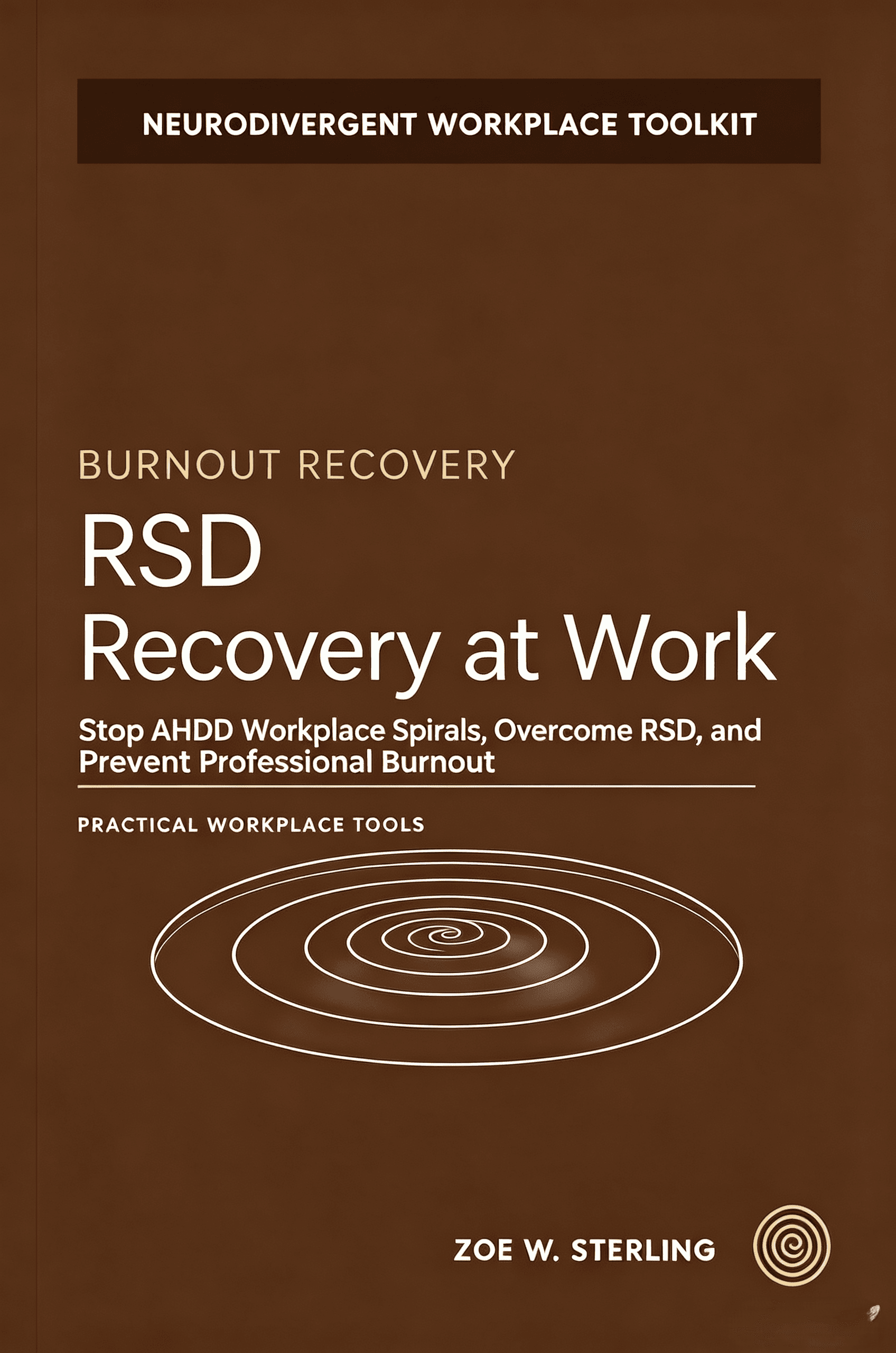
RSD Recovery at Work
A comprehensive field guide for neurodivergent adults navigating the workplace. Based on Zoe Sterling's 10+ years of ADHD workplace research and coaching, this book identifies 8 core strengths and 7 hidden workplace patterns.
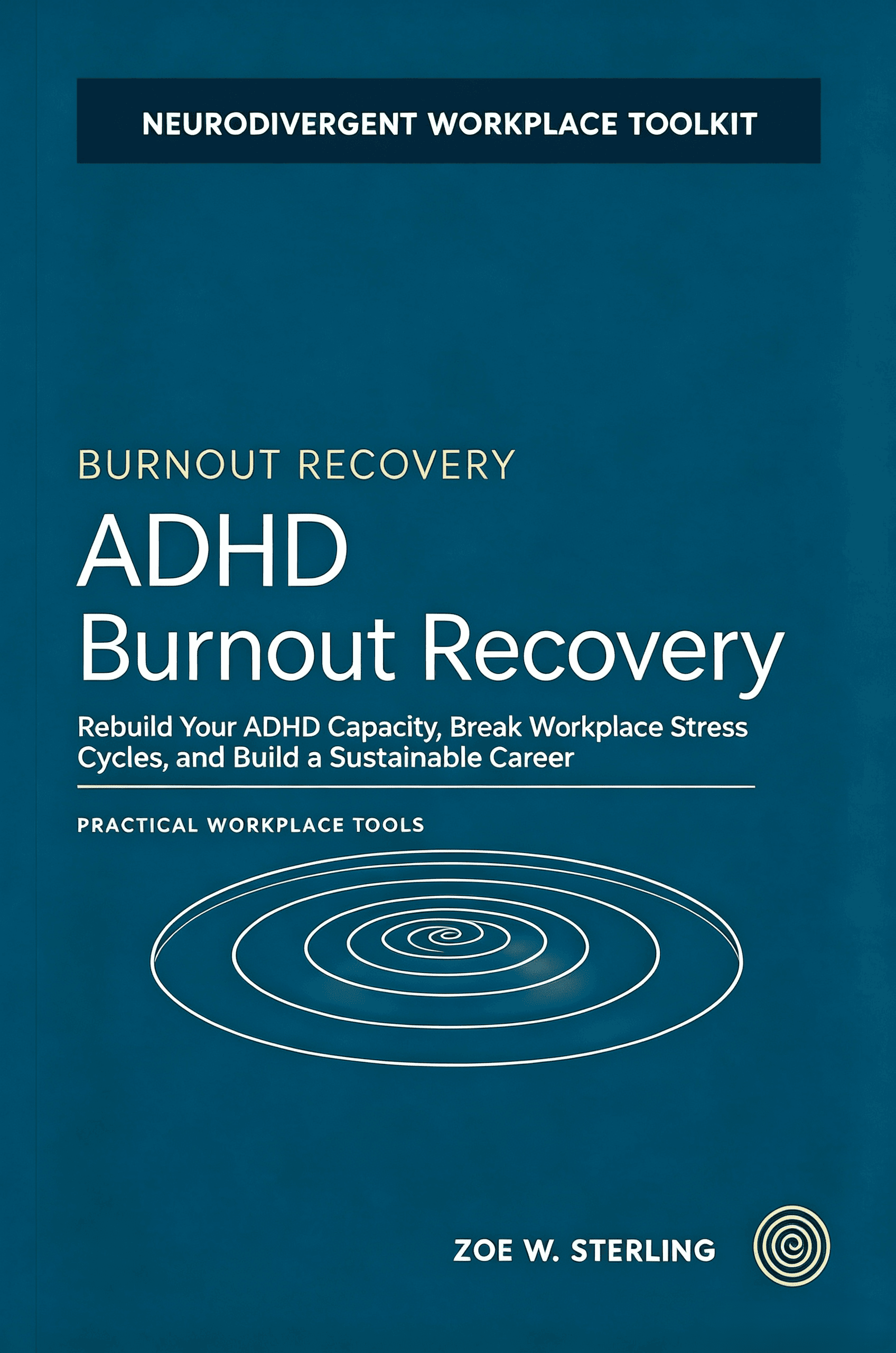
ADHD Burnout Recovery
ADHD burnout is different from typical burnout. Rooted in overstimulation, executive dysfunction, and the gap between natural strengths and workplace demands, it requires a specialized recovery approach.
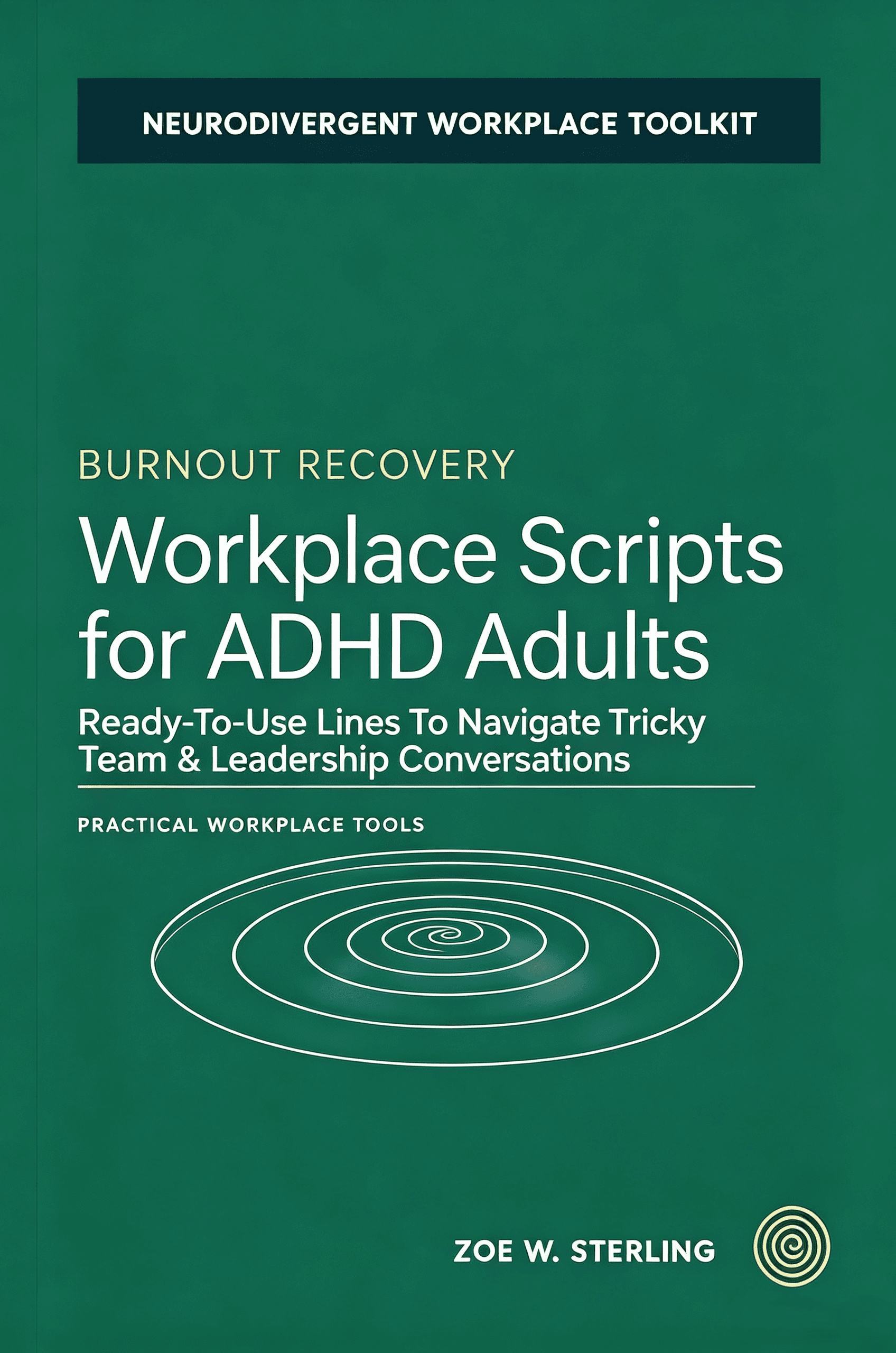
Workplace Scripts for ADHD Adults
A practical collection of workplace scripts for neurodivergent adults. From requesting accommodations to pushing back on unreasonable deadlines, these scripts help ADHD professionals communicate their needs clearly.