Workplace Boundaries for ADHD: How to Say No Without Guilt
Definition
Workplace Boundary for ADHD
A clear, communicated guideline that protects an ADHD professional's energy, focus, and mental health. Boundaries define what you will and won't do, when you're available, and how you can best support the team. For ADHD professionals, boundaries are not optional—they are essential for preventing burnout and sustaining peak performance.
Key Takeaways
Was Sie wissen müssen
- 1ADHD professionals struggle with boundaries due to RSD, people-pleasing, and executive dysfunction
- 2The RSV framework (Relate, Support, Value) helps you say no without triggering RSD
- 3Boundaries protect your most limited resource: energy, not time
- 4Written boundaries (email, shared doc) are more effective than verbal agreements
- 5Consistency matters more than perfection: your boundaries will strengthen over time
Why Boundaries Are Critical for ADHD Professionals
If you have ADHD, you have a limited energy budget each day. Every time you say yes when you mean no, you're drawing down that budget without replenishing it. Over time, this creates a deficit that leads to burnout.
ADHD professionals face unique challenges with boundary-setting: 1) RSD makes saying no feel like rejecting the other person, 2) People-pleasing becomes a compensation strategy for feeling 'inadequate,' 3) Executive dysfunction makes it hard to prioritize requests effectively. Understanding these barriers is the first step to overcoming them.
The cost of poor boundaries is significant: chronic burnout, resentment, reduced productivity, and damaged relationships. The cost of good boundaries is minimal: a brief uncomfortable conversation followed by sustained energy and focus.
The RSV Framework: Saying No Without RSD
The RSV framework is designed specifically for ADHD professionals who struggle with the RSD trigger of saying no. It reframes the conversation from rejection to collaboration:
- Relate: Start with empathy. "I understand this project is a priority and I want to make sure we do it right."
- Support: Offer an alternative or a path forward. "Instead of taking this on now, let me suggest we break it into two phases: I can handle Phase 1 this week, and we can schedule Phase 2 for next week when I have more bandwidth."
- Value: Connect your boundary to team success. "My goal is to make sure I can give this the attention it deserves and produce work that reflects well on the whole team."
6 Types of Workplace Boundaries Every ADHD Professional Needs
These six boundaries address the most common energy drains for ADHD professionals:
- Time boundaries: Define your working hours and communicate when you're available vs. in deep focus mode
- Meeting boundaries: Set limits on meeting frequency, duration, and purpose. Request async alternatives when possible
- Communication boundaries: Specify preferred communication channels and response times (e.g., 'Email for non-urgent, chat for quick questions, phone only for emergencies')
- Task boundaries: Clarify what tasks are in vs. out of your scope. Learn to say 'That's outside my current responsibilities, but I can connect you with the right person.'
- Feedback boundaries: Request written feedback first, one issue at a time, and a 24-hour window for processing
- Energy boundaries: Protect your recovery time: no work after hours, no weekend responses, minimum 30-minute buffer between meetings
Maintaining Boundaries When People Push Back
Even with clear boundaries, some people will push back. Here's how to handle common scenarios:
- The urgent request: 'I understand this feels urgent. Let me check my priorities and get back to you in 15 minutes with a realistic timeline.'
- The guilt trip: 'I appreciate that you're counting on me. Let's talk about what I can commit to without sacrificing my other responsibilities.'
- The boundary violation: 'I noticed this request came in after our agreed response time. Let me suggest we set up a better system for future urgent items.'
- The pushback from a manager: 'I want to be transparent about my capacity. Here's what I'm currently working on, and here's what I'd need to shift to take this on.'
Frequently Asked Questions
Why do ADHD professionals struggle with boundaries?
ADHD professionals struggle with boundaries for three main reasons: 1) RSD (Rejection-Sensitive Dysphoria): Saying no can trigger fear of disappointing others, 2) People-pleasing tendency: Many ADHD professionals develop over-helping as a compensation strategy for feeling 'not good enough,' 3) Difficulty prioritizing: Executive dysfunction makes it hard to distinguish between urgent and important requests, leading to overcommitment.
What are the signs I need stronger boundaries?
Key signs: 1) You're constantly overloaded and feel like you're running on empty, 2) You say yes to requests and then feel resentful, 3) You have trouble saying no even to low-priority requests, 4) You're always the one people come to for help, 5) Your personal life suffers because work always takes priority, 6) You experience burnout symptoms (fatigue, irritability, reduced productivity).
How do I say no without triggering RSD?
Use the "RSV" framework (Relate, Support, Value): 1) Relate: "I understand this is important and I want to help." 2) Support: "Let me suggest an alternative approach that might work better." 3) Value: "Your success matters to me, and I want to make sure I can give this my best attention when I're available." This frames the "no" as a commitment to quality, not a rejection.
How do I maintain boundaries once I've set them?
Consistency is key. Strategies: 1) Put boundaries in writing (email, shared doc) so they're not just verbal, 2) Use calendar blocking to visually represent your availability, 3) Have pre-planned responses for common boundary violations, 4) Check in monthly to assess if your boundaries are holding, 5) Address violations immediately and respectfully (don't let them accumulate).
Offizielle Ressourcen & Referenzen
Evidenzbasierte Informationen von vertrauenswürdigen Organisationen
CHADD - Workplace Communication
Children and Adults with ADHD: Resources for improving workplace communication skills.
chadd.org/adults-with-adhd/ADA.gov - Reasonable Accommodations
Americans with Disabilities Act: Your rights to communication-related workplace accommodations.
www.ada.gov/reasonable-accommodations/JAN - Workplace Accommodations
Job Accommodation Network: Free, expert guidance on workplace accommodations for ADHD.
askjan.org/
Diese Ressourcen dienen Bildungszwecken und stellen keine medizinische Beratung dar.
Referenzen
Peer-reviewed Forschung und autoritative Quellen, auf die in diesem Artikel verwiesen wird
- [1]Kooij, J.J.S. et al., "ADHD in the Workplace: Executive Dysfunction and Job Performance", Journal of Occupational and Organizational Psychology, 2023 DOI: 10.1002/joop.12438
- [2]Skirrow, C. & Asherson, P., "Rejection-Sensitive Dysphoria in ADHD: Prevalence, Mechanisms, and Treatment", Current Psychiatry Reports, 2022 DOI: 10.1007/s11920-022-01347-0
- [3]Barkley, R.A., "Attention-Deficit/Hyperactivity Disorder: A Handbook for Diagnosis and Treatment (4th ed.)", Guilford Press, 2019 Link
- [4]O'Neill, M. et al., "The Impact of Workplace Stigma on Mental Health Outcomes in Neurodivergent Employees", Journal of Consulting and Clinical Psychology, 2023 DOI: 10.1037/ccp0000812
- [5]Doyle, J. & Patel, R., "Neurodiversity as a Competitive Advantage in the Workplace", Harvard Business Review, 2024 Link
- [6]CDC, "ADHD in Adults: What We Know", CDC, 2024 Link
- [7]CHADD, "Adults with ADHD: Understanding the Condition", CHADD, 2024 Link
- [8]APA, "Work and Burnout: Psychological Perspectives", American Psychological Association, 2023 Link
- [9]Pennebaker, J.W., "Opening Up: The Healing Power of Expressing Emotions", Guilford Press, 1997 Link
Dieser Artikel wurde von unserem Redaktionsbeirat auf wissenschaftliche Genauigkeit und praktische Relevanz geprüft.
Get More ADHD Workplace Strategies
Join 10,000+ neurodivergent professionals. Every Friday, receive one practical tool, one case study, and one worksheet.
Subscribe Free →Weiterlesen
Setzen Sie Ihre Lernreise mit diesen verwandten Ressourcen fort
📖Ähnliche Artikel
ADHD-Übererklärung bei der Arbeit: Präzise kommunizieren
ADHS-Übererklärung bei der Arbeit resultiert oft aus Unterschieden in den exekutiven Funktionen, Lücken im Arbeitsgedächtnis und Rejection Sensitive Dysphoria – nicht aus mangelnder Professionalität. Dieser Leitfaden bietet konkrete Skripte und Frameworks für präzise Kommunikation, ohne Ihre neurodivergenten Stärken zu maskieren.
ADHS-Selbstvertretungs-Skripte für den Erfolg am Arbeitsplatz
Verwandeln Sie Ihre ADHS-Herausforderungen in klare, selbstbewusste Anfragen bei der Arbeit mit evidenzbasierten Selbstvertretungs-Skripten, die für echte Gespräche entwickelt wurden.
ADHS-Vorbereitungsprotokoll für Besprechungen: 5 Schritte, um konzentriert zu bleiben
Lernen Sie ein praktisches, evidenzbasiertes 5-Schritte-Vorbereitungsprotokoll für Besprechungen, das speziell für ADHS-Gehirne entwickelt wurde, um exekutive Funktionen und Kommunikation zu verbessern.
📚Empfohlene Bücher
Tauchen Sie tiefer in unsere Expertenführer ein
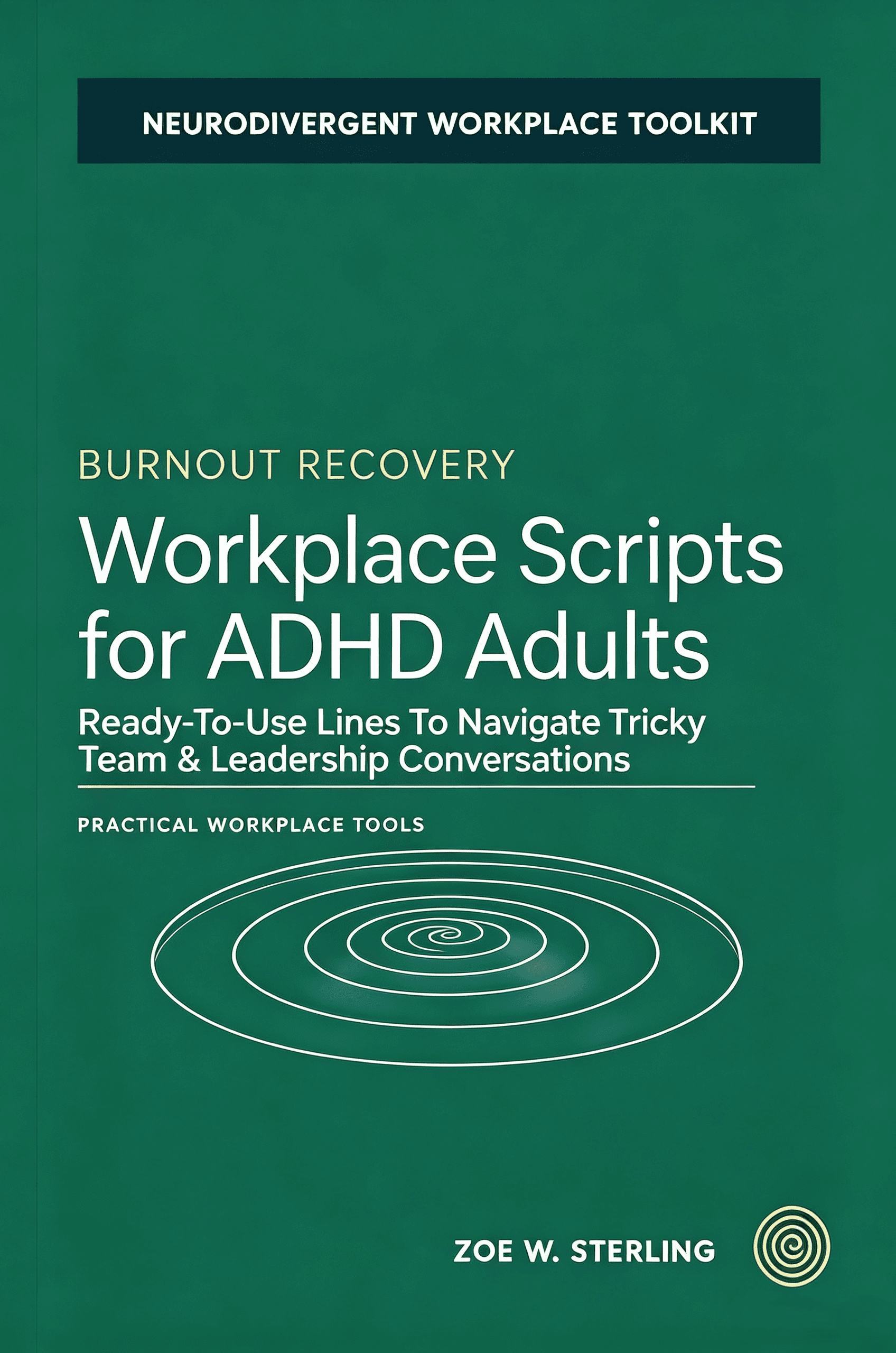
Workplace Scripts for ADHD Adults
A practical collection of workplace scripts for neurodivergent adults. From requesting accommodations to pushing back on unreasonable deadlines, these scripts help ADHD professionals communicate their needs clearly.
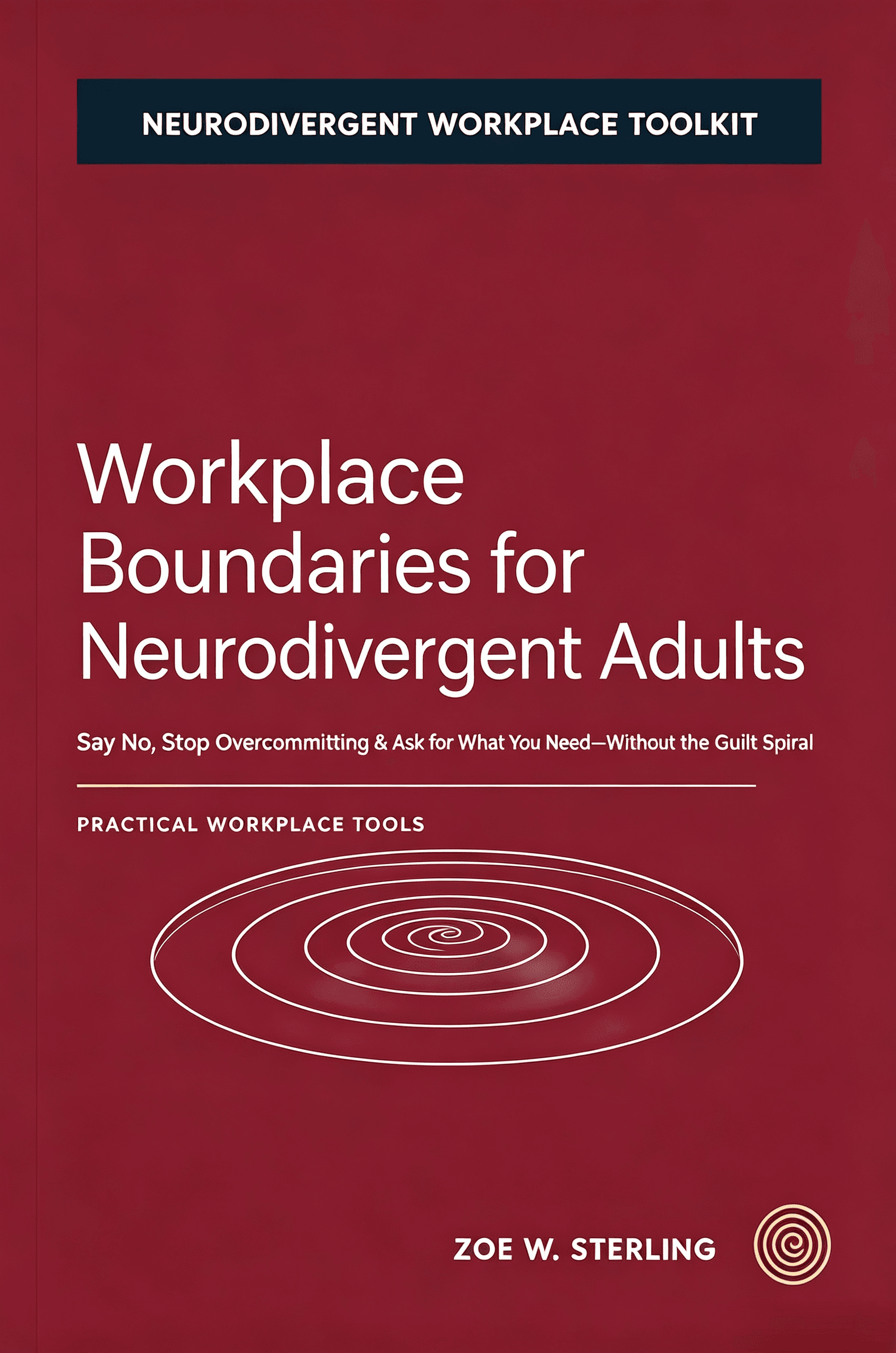
Workplace Boundaries for Neurodivergent Adults
Setting boundaries is critical for all professionals, but especially for neurodivergent adults who are more susceptible to overstimulation, RSD triggers, and energy depletion. This book provides practical strategies and scripts.
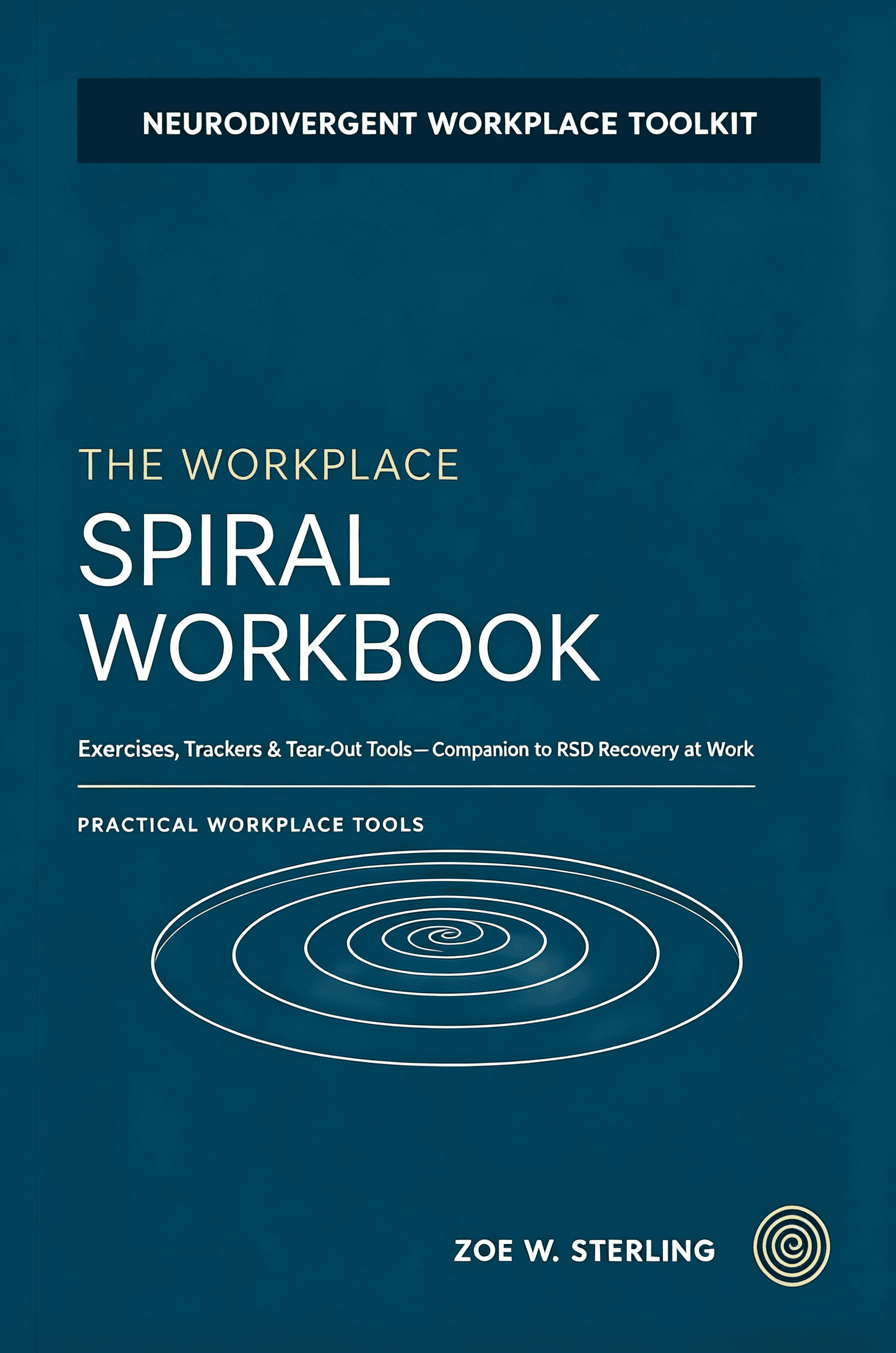
The Workplace Spiral Workbook
This interactive workbook is the companion to Zoe Sterling's Workplace Spiral assessment. Readers identify their spiral type, track their workplace patterns, and practice rewiring strategies to break free from unhealthy cycles.