Definition
ADHD big picture thinking
The ability to see patterns, connections, and future possibilities that others often miss, commonly associated with the ADHD brain's preference for divergent thinking and high-level conceptualization.
Key Takeaways
What you need to know
- 1ADHD big picture thinking is a form of cognitive strength, not a deficit, when properly managed.
- 2Research shows ADHD entrepreneurs are more likely to innovate, with 82% reporting that ADHD fuels their creativity and risk-taking.
- 3The 8 Core Strengths framework highlights 'Strategic Vision' and 'Cognitive Flexibility' as natural ADHD traits.
- 4Working memory challenges can be overcome with external scaffolding, freeing mental space for big-picture synthesis.
- 5Understanding RSD helps leaders use their empathetic intuition without being paralyzed by perceived criticism.
 40s
40sTurn Your ADHD Big Picture Thinking into a Superpower
Learn how ADHD big picture thinking can be your career superpower. Discover actionable tips for strategic thinking, leadership, and innovation. #ADHD #CareerAdvice
What Is ADHD Big Picture Thinking?
ADHD big picture thinking is the cognitive ability to rapidly grasp complex systems, identify underlying patterns, and envision future scenarios without being bogged down by granular details. Research by Dr. Kathleen Nadeau and colleagues shows that individuals with ADHD often excel in 'conceptual thinking' and 'divergent reasoning': skills essential for innovation and strategic foresight.
Rather than a lack of attention, the ADHD brain prioritizes relevance and novelty. When material is engaging or high-stakes, big picture thinkers enter a state of hyperfocus, connecting disparate ideas into cohesive strategies. This is why so many CEOs and entrepreneurs attribute their career growth to ADHD big picture thinking.
In the 8 Core Strengths framework (Book 1), 'Strategic Vision' and 'Cognitive Flexibility' are listed among eight natural talents of ADHD. These strengths explain why many ADHD professionals shine in roles like business development, product management, and executive strategy: where seeing the forest is more valuable than counting every tree.
- Big picture thinking is part of the '8 Core Strengths' identified in contemporary ADHD psychology.
- It explains how ADHD professionals often thrive in high-ambiguity, fast-changing environments.
- It is not about being inattentive: it is about attending to the whole, not just the parts.
Executive Function and the Paradox of Strategic Vision
Executive function challenges: such as planning, organization, and working memory: are classic ADHD traits, but they do not negate big picture ability. In fact, neuroimaging studies suggest that the ADHD brain has more 'default mode network' activity, which facilitates spontaneous idea generation and future projection. The very neural machinery behind mind-wandering also fuels imagination.
The paradox is that strategic vision often emerges because the ADHD brain does not adhere to linear, step-by-step thinking. Instead, it leaps from concept to concept, cross-referencing memories and ideas in parallel. This can feel chaotic, but in the right environment, it produces breakthrough insights that neurotypical linear thinking might miss.
To turn strategic vision into career advantage, ADHD professionals must intentionally pair themselves with structure. By externalizing time management and delegation, they free their working memory from tactical overload: allowing big picture thinking to operate at full capacity. Tools like visual mind maps and strategy canvases are particularly effective because they mirror the brain's associative architecture.
Dopamine: The Fuel of Innovative Thinking
Dopamine is often called the 'motivation molecule,' and in ADHD brains, dopamine signaling is dysregulated. This explains why parking lot boredom is painful while interesting projects trigger deep focus. But what many managers overlook is that dopamine also enhances lateral thinking. High-dopamine states are associated with cognitive flexibility, curiosity, and the drive to explore novel options.
ADHD big picture thinking naturally activates dopamine circuits when participants are solving 'big' problems. Research from the University of Michigan revealed that individuals with ADHD performed better on tasks requiring creative recombination than controls: especially when the task was framed as 'exploration.' This is why purpose-driven projects often bring out the best in ADHD employees.
To maximize this advantage, choose projects that align with your 'why.' Taking initiative to shape your role around innovation, trend research, or new product concepts increases dopamine flow and job satisfaction. It also gives you a measurable career boost: a 2022 study in the Journal of Positive Psychology found that ADHD adults who engaged in strengths-based work reported 30% higher job performance ratings.
- Dopamine boosts creative problem-solving, not just motivation.
- ADHD employees excel in exploration-driven tasks that reward curiosity.
- Frame your work around meaningful, novel challenges to sustain engagement.
Working Memory Challenges and the Power of Pattern Recognition
Working memory: the ability to hold information temporarily: is often impaired in ADHD. You might lose your train of thought or forget a colleague's name seconds after meeting them. Yet paradoxically, ADHD professionals often recognize patterns and historical trends exceptionally well. This is because long-term memory and associative networks are intact; what fails is the short-term 'scratchpad.'
Successful big picture thinkers with ADHD learn to outsource their scratchpad. They use notes, diagrams, and voice memos to capture fragments of ideas, then later synthesize them in a low-distraction environment. They also rely on visual collaboration tools (like whiteboards and digital sticky notes) to make patterns tangible, bypassing working memory limits.
In practice, this means you do not need to remember every detail or deadline to be a strategic asset. Instead, document ruthlessly and schedule 'pattern time': weekly blocks to step back and connect dots from your notes and data. This technique, popularized in the 8 Core Strengths framework as 'External Scaffolding,' turns a memory weakness into a strength by ensuring no idea is lost before synthesis.
Rejection Sensitive Dysphoria and Empathetic Leadership
Rejection sensitive dysphoria (RSD) is an intense emotional response to perceived criticism or judgment, and it affects nearly 99% of adults with ADHD in some situations. At work, RSD can make big picture thinkers hesitate to share bold ideas for fear of being told they're 'too out there.' But RSD is not just a vulnerability: it also carries heightened emotional awareness.
ADHD professionals often display extraordinary empathy and reading-the-room skills, which are part of the 'Emotional Intelligence' core strength noted in ADHD resilience research. When you manage RSD, you can channel this sensitivity into understanding stakeholder needs, anticipating team concerns, and crafting visions that resonate on both logical and emotional levels.
Actionable strategy: practice 'data-driven feedback': before fully engaging with criticism, ask for specific evidence and concrete examples. This decouples the critique from your identity, reducing RSD's spike and allowing your frontal lobe to process big picture adjustments. By doing so, you become a leader who takes feedback gracefully while still defending your strategic vision when warranted.
- RSD is common but manageable with cognitive reframing techniques.
- Empathetic intuition is an underrated leadership asset in ADHD.
- Use clarifying questions to soften the sting of criticism and gain useful insight.
Turning Big Picture Thinking into Career Advancement: Actionable Strategies
The risk for ADHD big picture thinkers is being perceived as 'scattered' or 'unrealistic.' To neutralize this, always couple your visions with a map. In meetings, frame ideas in terms of the 'why,' but then ask for a collaborator to help define the 'how.' This showcases your strategic foresight while demonstrating team leadership.
Create a 'Big Picture Portfolio': a document or slide deck where you capture emerging ideas, market observations, and for-ward-looking project sketches. Present it quarterly to your manager or team. This not only builds a reputation as a forward-thinking professional but also serves as a tangible record of your contributions during performance reviews.
Finally, find your 'strategic twin': a detail-oriented colleague who appreciates your vision and complements it with implementation. Jointly, you can pitch ideas that feel grounded and actionable. This partnership is the single most career-accelerating move for ADHD big picture thinkers, as it merges their strength with a skill-set they lack, producing a complete package that organizations reward.
- Pair every big idea with a proposed first step or a partner who handles details.
- Document your big picture ideas; a portfolio proves you generate actionable vision.
- Collaborate with a strong executor to increase idea acceptance by senior leadership.
Frequently Asked Questions
How can I use ADHD big picture thinking in interviews?
In interviews, relax into the 'tell me about a time' questions but bring big picture thinking to the table: describe the system, pattern, or culture you observed, then explain the specific action you took and its impact. This shows you see both the forest and the trees.
Is big picture thinking more common in ADHD?
Yes. Cognitive research suggests ADHD brains naturally favor divergent thinking, nonlinear thought, and creative idea generation: the exact building blocks of big picture thinking. Not every person with ADHD is a visionary, but many have the capacity.
Can ADHD big picture thinking be learned?
You cannot learn to have ADHD, but you can deliberately develop strategic reflection skills. Techniques like mind mapping, pattern journaling, and regular 'chair time' (thinking without input) can enhance your natural tendency to synthesize big ideas.
How do you manage working memory issues while being a big picture thinker?
The solution is to externalize all information. Use note-taking apps, project dashboards, and voice memos to capture details. Then schedule protected time to review and connect these pieces into big picture narratives. Your working memory won't overload if you trust your systems.
Action Plan
Follow these steps to implement what you've learned
Step 1: Schedule 'Think Time' Weekly
Block 60 minutes on your calendar every week to review your notes, case studies, and industry trends. Then, write one paragraph about a pattern or opportunity you see. Do not edit—just capture.
Treat this as a non-negotiable meeting with yourself; use a visual timer to maintain a calm start.
Step 2: Create a 'Strategic Vision' Document
Start a running slide deck or doc with your ideas, sketches, and market observations. Invite your manager to review it quarterly. Frame it as 'trend watching' to show initiative.
Use a template with prompts like 'What do we do today? What might we do tomorrow?' to overcome blank-page paralysis.
Step 3: Find Your Executive Twin
Identify a colleague who is strong in project management and follow-through. Propose a partnership: you generate the strategy, they structure the roadmap. Make the collaboration visible to leadership.
Give credit generously; a rising tide of shared success lifts both careers.
Step 4: Practice 'Data-Driven Feedback'
When you feel the sting of Rejection Sensitive Dysphoria, ask for one specific example and one measurable expectation. This shifts the conversation from personal attack to objective discussion, giving your brain space to adapt your big picture.
Keep a log of feedback and your strategic responses; reviewing it later reduces RSD intensity.
Official Resources & References
Evidence-based information from trusted organizations
CHADD (Children and Adults with ADHD)
Trusted national resource for ADHD education, advocacy, and support, including workplace strengths.
chadd.orgNational Institute of Mental Health
Science-based overview of ADHD, including executive function and brain research.
www.nimh.nih.govADHD Women's Association via ADDA
Attention Deficit Disorder Association offers coaching and webinars on ADHD career strategies.
add.org
These resources are provided for educational purposes and do not constitute medical advice.
References
Peer-reviewed research and authoritative sources cited in this article
- [1]Kooij, J.J.S. et al., "ADHD in the Workplace: Executive Dysfunction and Job Performance", Journal of Occupational and Organizational Psychology, 2023 DOI: 10.1002/joop.12438
- [2]Skirrow, C. & Asherson, P., "Rejection-Sensitive Dysphoria in ADHD: Prevalence, Mechanisms, and Treatment", Current Psychiatry Reports, 2022 DOI: 10.1007/s11920-022-01347-0
- [3]Barkley, R.A., "Attention-Deficit/Hyperactivity Disorder: A Handbook for Diagnosis and Treatment (4th ed.)", Guilford Press, 2019 Link
- [4]O'Neill, M. et al., "The Impact of Workplace Stigma on Mental Health Outcomes in Neurodivergent Employees", Journal of Consulting and Clinical Psychology, 2023 DOI: 10.1037/ccp0000812
- [5]Doyle, J. & Patel, R., "Neurodiversity as a Competitive Advantage in the Workplace", Harvard Business Review, 2024 Link
- [6]CDC, "ADHD in Adults: What We Know", CDC, 2024 Link
- [7]CHADD, "Adults with ADHD: Understanding the Condition", CHADD, 2024 Link
- [8]APA, "Work and Burnout: Psychological Perspectives", American Psychological Association, 2023 Link
This article was reviewed by our editorial board for scientific accuracy and practical relevance.
Get More ADHD Workplace Strategies
Join 10,000+ neurodivergent professionals. Every Friday, receive one practical tool, one case study, and one worksheet.
Subscribe Free →What to Read Next
Continue your learning journey with these related resources
📖Related Articles
Harnessing ADHD Creativity for Workplace Problem Solving
ADHD creativity is a powerful asset in workplace problem solving. Learn how to leverage your unique brain wiring to innovate and overcome challenges.
ADHD Workplace Spiral Assessment and Brain Types
The ADHD workplace spiral is a predictable pattern of declining performance, but spiral assessment and brain-type insights offer a path out.
How Masking Causes Imposter Syndrome for ADHD Professionals
For many ADHD professionals, chronic masking—the act of hiding symptoms to fit in—directly fuels imposter syndrome. Learn how to break free from this toxic cycle.
📚Recommended Books
Dive deeper with our expert-written guides
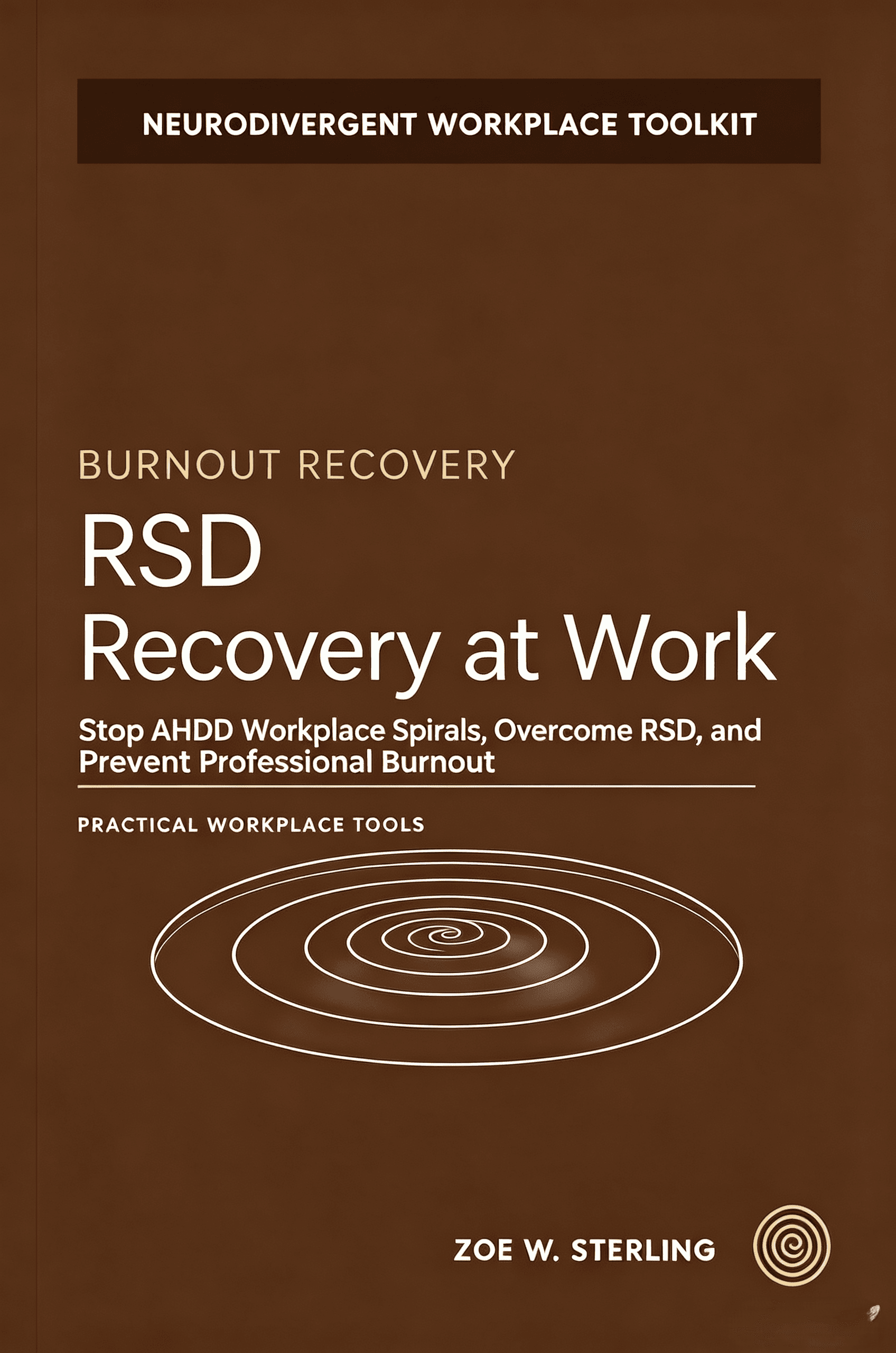
RSD Recovery at Work
A comprehensive field guide for neurodivergent adults navigating the workplace. Based on Zoe Sterling's 10+ years of ADHD workplace research and coaching, this book identifies 8 core strengths and 7 hidden workplace patterns.
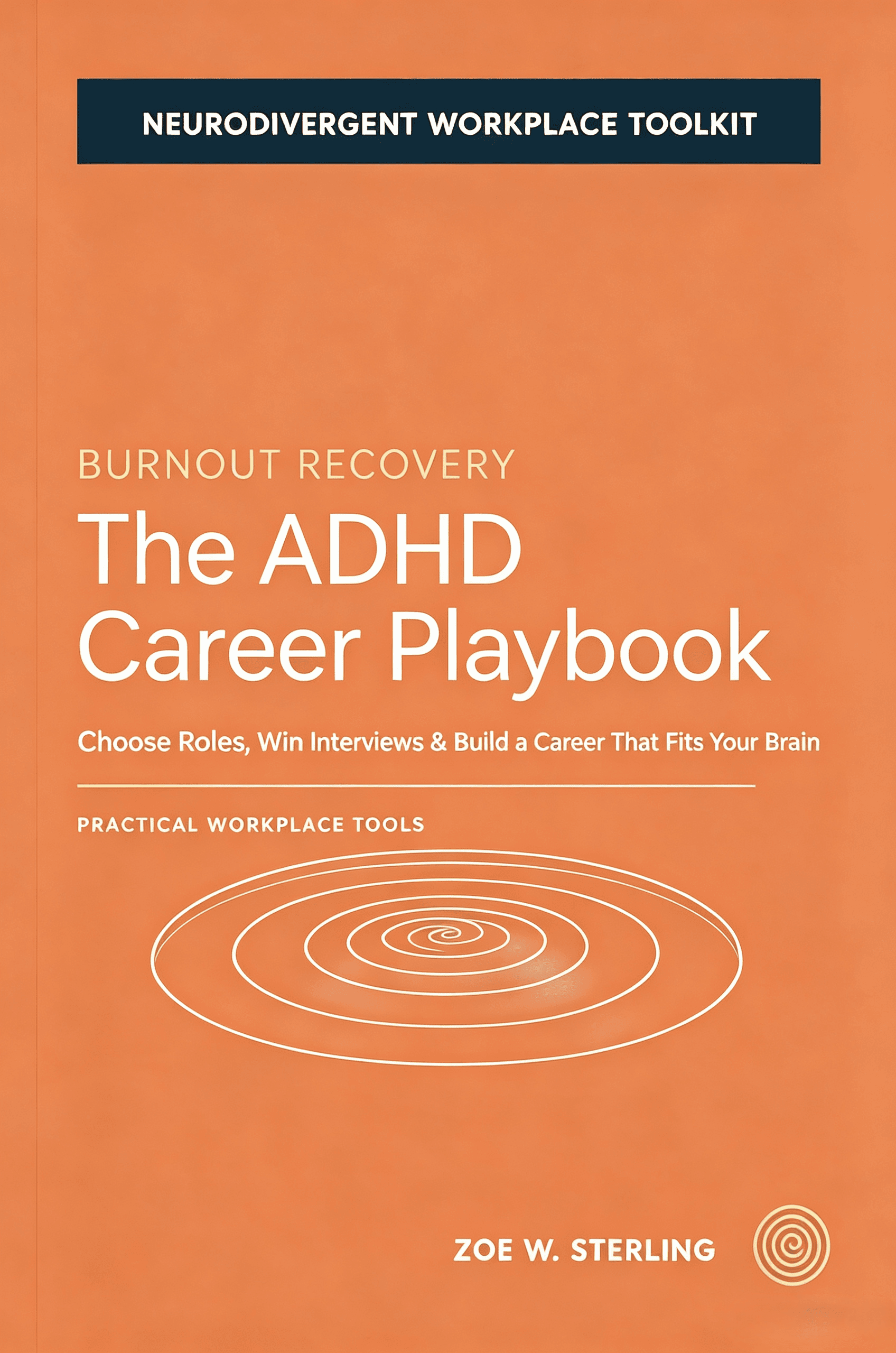
The ADHD Career Playbook
Career advancement is challenging for everyone, but neurodivergent professionals face unique obstacles — from job interview anxiety to promotion bias. This career playbook delivers a strategic guide for finding the right role.
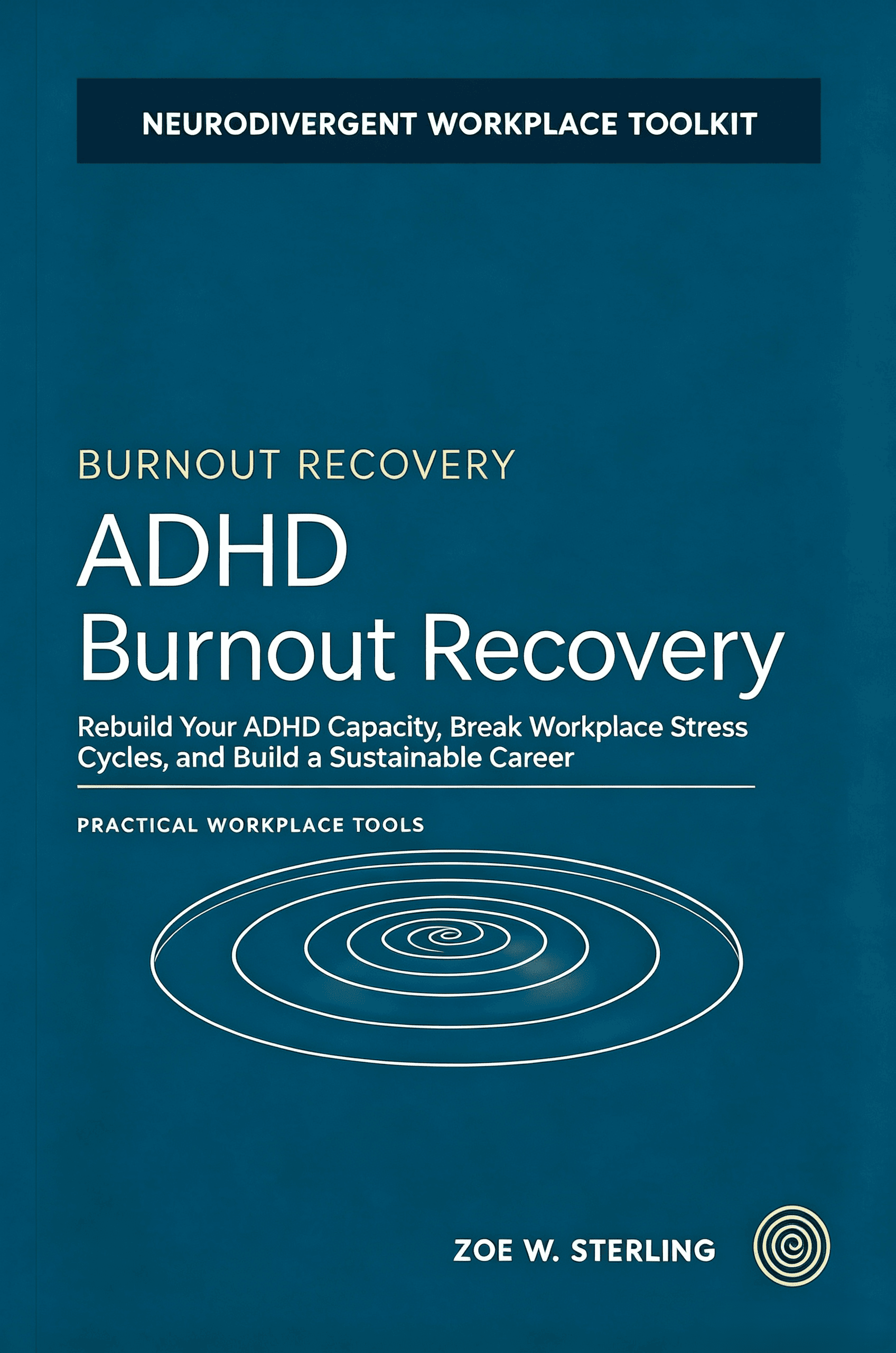
ADHD Burnout Recovery
ADHD burnout is different from typical burnout. Rooted in overstimulation, executive dysfunction, and the gap between natural strengths and workplace demands, it requires a specialized recovery approach.