Definition
Rejection Sensitive Dysphoria (RSD)
Rejection Sensitive Dysphoria is an intense and overwhelming emotional response to perceived rejection, criticism, or failure, even when the feedback is harmless or constructive. It is a common but often misdiagnosed feature of ADHD, deeply tied to dopamine dysregulation and executive function deficits. RSD causes neurological and psychological pain that feels identical to physical injury.
Key Takeaways
What you need to know
- 1RSD is not an official DSM diagnosis but a widely recognized emotional experience in ADHD, affecting nearly everyone with the condition.
- 2RSD is rooted in ADHD-related differences in dopamine regulation and executive function, making it a neurological reaction, not deliberate oversensitivity.
- 3You can train your brain to respond more thoughtfully to feedback using evidence-based strategies like labeling, pausing, and cognitive reframing.
- 4ADHD medications and therapies like CBT and DBT can substantially reduce RSD-related distress.
- 5Self-compassion is the ultimate antidote: it helps you separate your worth from any single piece of feedback.
 35s
35sRSD Explained: Why Feedback Hurts So Much
Feeling destroyed by harmless feedback? It's likely RSD (rejection sensitive dysphoria). Learn to manage emotional overload with ADHD. Discover practical steps: label, pause, reframe, self-compassion. #ADHD #RSD #neurodivergent
When Kind Feedback Feels Like a Knife
Imagine this: a colleague says, 'Could you tweak the formatting on that report?' and you suddenly feel worthless. Your heart slams, your thoughts spiral, and you spend the next hours trying to suppress the sting. The logical part of you knows the comment was benign—yet the emotional wound feels physical. If you have ADHD, this experience might be uncomfortably familiar.
What you're feeling is not a character flaw or an overreaction. It likely has a name: rejection sensitive dysphoria (RSD). Although RSD isn’t a formal diagnosis, research and clinical experience show that a staggering number of adults with ADHD report intense emotional responses to perceived rejection or criticism. One study suggests that up to 99% of ADHDers experience some form of RSD. Understanding this can be a lifeline, helping you make sense of reactions that otherwise feel inexplicable and isolating.
RSD isn't just 'normal sensitivity.' It's a brain-based, flood-the-system response that overwhelms your body and mind. The good news? Once you know what you're dealing with, you can learn to manage RSD and prevent it from hijacking your life.
What Is RSD and Why Does It Happen with ADHD?
Rejection Sensitive Dysphoria is best described as a neurological reaction driven by ADHD. Clinical psychiatrist Dr. William Dodson, who popularized the term, explains that RSD is 'an extreme emotional reaction to a real or imagined rejection.' The word 'dysphoria' is key—it means a state of unease or dissatisfaction, and in RSD, that feeling is so intense, it can be mistaken for major depression or agitation.
Why does ADHD create this vulnerability? Research points to differences in the brain’s dopamine system—the same system that regulates reward, attention, and emotional control. In an ADHD brain, dopamine signaling is blunted, making the system hypersensitive to any form of social disapproval. Because executive function (your brain’s 'management system') is also impaired, an individual with ADHD processes feedback differently, often interpreting it as a threat before reason kicks in.
This is not a matter of 'thinking errors' alone. Functional MRI scans suggest that when people with ADHD experience perceived rejection, parts of the amygdala (the fear center) and anterior cingulate cortex (which processes social pain) light up abnormally. In that instant, the brain treats benign feedback as a digital attack, bypassing working memory and logical reasoning. That's why you may know intellectually that the feedback is harmless, but you still feel destroyed.
RSD vs. Ordinary 'Feeling Hurt'
Everyone gets their feelings hurt now and then, but RSD differs in intensity, duration, and trigger. It is the difference between a paper cut and a surgical knife. For a person without ADHD, a mild critique might cause brief disappointment. For someone with RSD, the same critique can trigger a full-body panic response, racing thoughts, and physical symptoms such as nausea or trembling.
Additionally, RSD is activated by *perceived* rejection, not actual rejection. An ambiguous text from a friend—'Hey, can’t talk right now'—can feel like a dismissal, even if the friend is simply busy. Ordinary hurt is also proportional to the event; RSD is not. An 80% emotional reaction to a 5% threat is a key sign.
Understanding these differences helps you label what is happening. Instead of saying 'I’m crazy' or 'I’m too sensitive,' you can say, 'My brain is having an RSD response.' That label creates crucial space for action.
- Severity: RSD feels like an emergency, while ordinary hurt is lighter.
- Duration: RSD can last for hours or days, replaying in a loop.
- Trigger: Even neutral comments or deadpan facial expressions can set it off.
- Rational recall: People with RSD often can’t recall the exact positive facts, only the sting.
RSD in the Wild: How It Shows Up in Daily Life
In the workplace, RSD might cause you to dread feedback sessions, over-apologize for small mistakes, or avoid asking for help. A manager who says 'this is good maybe add more detail' can easily be decoded as 'you are not good enough,' leading to procrastination or perfectionism. You may find yourself working twice as hard to avoid future criticism—yet still believing every piece of guidance is a sign of impending failure.
In relationships, RSD can be devastating. You might misinterpret a partner’s tired tone as anger, a friend’s ability not to text back as abandonment, and then lash out or shut down. This emotional whiplash often drives loved ones away, creating the very rejection you feared most—a self-fulfilling prophecy that deepens RSD.
Social situations also trigger RSD. Forgetting a name, speaking out of turn, or being excluded from a project can trigger an intense episode. You might leave early, avoid people, or start a conflict as a preemptive strike. Over time, this can erode confidence and fuel social isolation.
Actionable Strategies to Tame RSD
The first step is simple but powerful: give your RSD a name. By calling it RSD, you stop saying 'there’s something wrong with me' and start saying 'my brain is experiencing a known ADHD symptom.' This shift de-stigmatizes the reaction and opens the door to intervention. Next, use the 'pause practice'—when feedback comes, resist responding immediately. Tell yourself you'll wait at least 20 minutes. That gap allows your sympathetic nervous system to settle.
Then, engage your working memory deliberately. Ask yourself questions like, 'What exactly did the person say?', 'What is the evidence of actual rejection?', and 'Have I survived criticism before?' Write down the literal words if you need to. People with RSD often conflate interpretation with fact, so externalizing the event helps your brain recalibrate.
Finally, build a self-compassion script. For example, say, 'I am allowed to feel upset, but this feeling is temporary. My worth is not determined by one comment.' Research shows self-compassion reduces the severity of RSD episodes over time. You can also channel dopamine positively—a quick walk, mindful breathing, or even a few deep knee-bends can counter the adrenaline and help reset your nervous system.
- Every time you catch your catastrophic interpretation, write a 'fair witness' response.
- Set up an 'RSD emergency contact'—a trusted friend who knows you might call to reality-check.
- Track your triggers. For a week, jot down the feedback that activated RSD and jot down the objective facts to build evidence against the thought loop.
When to Seek Professional Support (You Don’t Have to Go It Alone)
If RSD is interfering with your job, relationships, or daily well-being, seeking professional help is a positive step. Therapy approaches such as cognitive behavioral therapy (CBT) and dialectical behavior therapy (DBT) teach skills to navigate emotional storms. CBT helps you identify the negative automatic thoughts that fuel RSD and reframe them. DBT offers emotion regulation tools for crisis moments.
For many people with ADHD, medication is life-changing. Stimulant and non-stimulant ADHD treatments increase effective dopamine levels, which can stabilize the emotions that underpin RSD. In a 2020 review of ADHD treatments, researchers noted that ADHD medication often reduces mood lability, including emotional dysregulation. Consult a psychiatrist who understands the emotional dimensions of ADHD to explore your options.
ADHD coaching can also provide practical, real-time strategies for managing feedback in the workplace. Coaches help you develop systems and scripts that ease RSD. Above all, do not internalize the myth that you’re 'too sensitive' or 'broken.' RSD is a recognized, legitimate aspect of ADHD—and it’s treatable.
Moving Forward with Self-Compassion
RSD might always be part of your ADHD, but it doesn't have to be the beginning and end of your story. With consistent practice, you can train your brain—the same brain that gives you creativity, empathy, and dynamic thinking—to respond more gently. You will still feel the initial sting, but the sting no longer has to consume your day.
Think of RSD as a smoke alarm that is hypersensitive. Instead of throwing away the alarm, you can install it in a better place, use a smaller pan, and learn that you are the one controlling the kitchen. Each time you navigate a feedback moment and come out okay, you are building a new neural pathway.
The next time harmless feedback comes your way, pause. Breathe. Say, 'I am not a rejection. I am a person with ADHD who is allowed to feel, and I am also allowed to respond with grace.' You will still have moments that hurt. But as you practice these skills, you will find that the feedback no longer destroys you—it teaches you.
Frequently Asked Questions
Is rejection sensitive dysphoria a formal ADHD diagnosis?
RSD is not included in the DSM-5 as a standalone diagnosis. It is considered a dimensional aspect of ADHD that describes intense emotional responses to perceived rejection. Many professionals recognize it clinically due to its prominent presentation in people with ADHD.
Can people without ADHD have RSD?
RSD is most strongly associated with ADHD, but similar symptoms can occur in other conditions like depression, anxiety, or borderline personality disorder. If you notice severe emotional reactions, a mental health professional can clarify the underlying cause.
Does ADHD medication help reduce RSD?
Yes. Medications that increase dopamine signaling, such as stimulants, can help stabilize emotional reactivity and reduce the intensity of RSD episodes. Many people report feeling less 'raw' and managing feedback more rationally after starting appropriate ADHD medication.
How can I explain RSD to my partner or boss?
Use concrete examples: 'When you give me direct feedback, my brain goes into panic mode and I may overreact. That's due to my ADHD; it’s not intentional. Here's a way to support me: give me a moment to process before I respond, and please offer clear—but kind—feedback.'
Action Plan
Follow these steps to implement what you've learned
Step 1: Label and detach
Whenever you feel that familiar emotional surge after feedback, say out loud, 'This is RSD.' Labeling helps your brain shift from 'I am a failure' to 'This is a known ADHD symptom.'
Write the label on a sticky note and place it on your monitor or dashboard.
Step 2: Pause, don't react
Create a 30-minute rule: any feedback you receive must wait 30 minutes before you craft a response. This breaks the immediate loop of emotional reasoning.
Try setting a timer after hearing feedback to space out your reaction.
Step 3: Do a factual review
Write down the exact words spoken and separate facts from interpretations. List evidence for and against the interpretation that you're being rejected.
Keep a 'feedback journal' to track patterns and your fair-witness reframes.
Step 4: Practice self-compassion
After an episode, comfort yourself as you would a friend. Say, 'No wonder I hurt—RSD makes feedback feel like a punch. I'm allowed to feel, and I'm still worthy.'
Try putting a hand on your heart and breathing slowly to activate the care-giving system.
Official Resources & References
Evidence-based information from trusted organizations
CHADD (Children and Adults with Attention-Deficit/Hyperactivity Disorder)
Provides comprehensive education and support resources on ADHD, including emotional regulation and RSD.
chadd.orgAttention Deficit Disorder Association (ADDA)
A trusted resource for adult ADHD, offering webinars, articles, and coaching directories.
add.orgNational Institute of Mental Health (NIMH)
Research-based information on ADHD symptoms and treatment to help you make evidence-informed decisions.
www.nimh.nih.gov/health/topics/attention-deficit-hyperactivity-disorder-adhd
These resources are provided for educational purposes and do not constitute medical advice.
This article was reviewed by our editorial board for scientific accuracy and practical relevance.
Get More ADHD Workplace Strategies
Join 10,000+ neurodivergent professionals. Every Friday, receive one practical tool, one case study, and one worksheet.
Subscribe Free →What to Read Next
Continue your learning journey with these related resources
📖Related Articles
RSD Triggers in Workplace Feedback: Scripts That Help
Rejection sensitive dysphoria (RSD) can make workplace feedback feel like a personal attack, but structured feedback scripts can help ADHD employees handle these conversations with less emotional distress.
RSD Recovery Techniques After Workplace Rejection
Workplace rejection can trigger an RSD spiral that shuts down executive function and working memory. This guide applies the Rewiring Protocol to help ADHD adults recover faster and protect their careers.
RSD: The Hidden ADHD Pain No-One Talks About
RSD finally gets a spotlight. This guide breaks down the ADHD link, real-life examples, and actionable strategies to handle the pain.
📚Recommended Books
Dive deeper with our expert-written guides
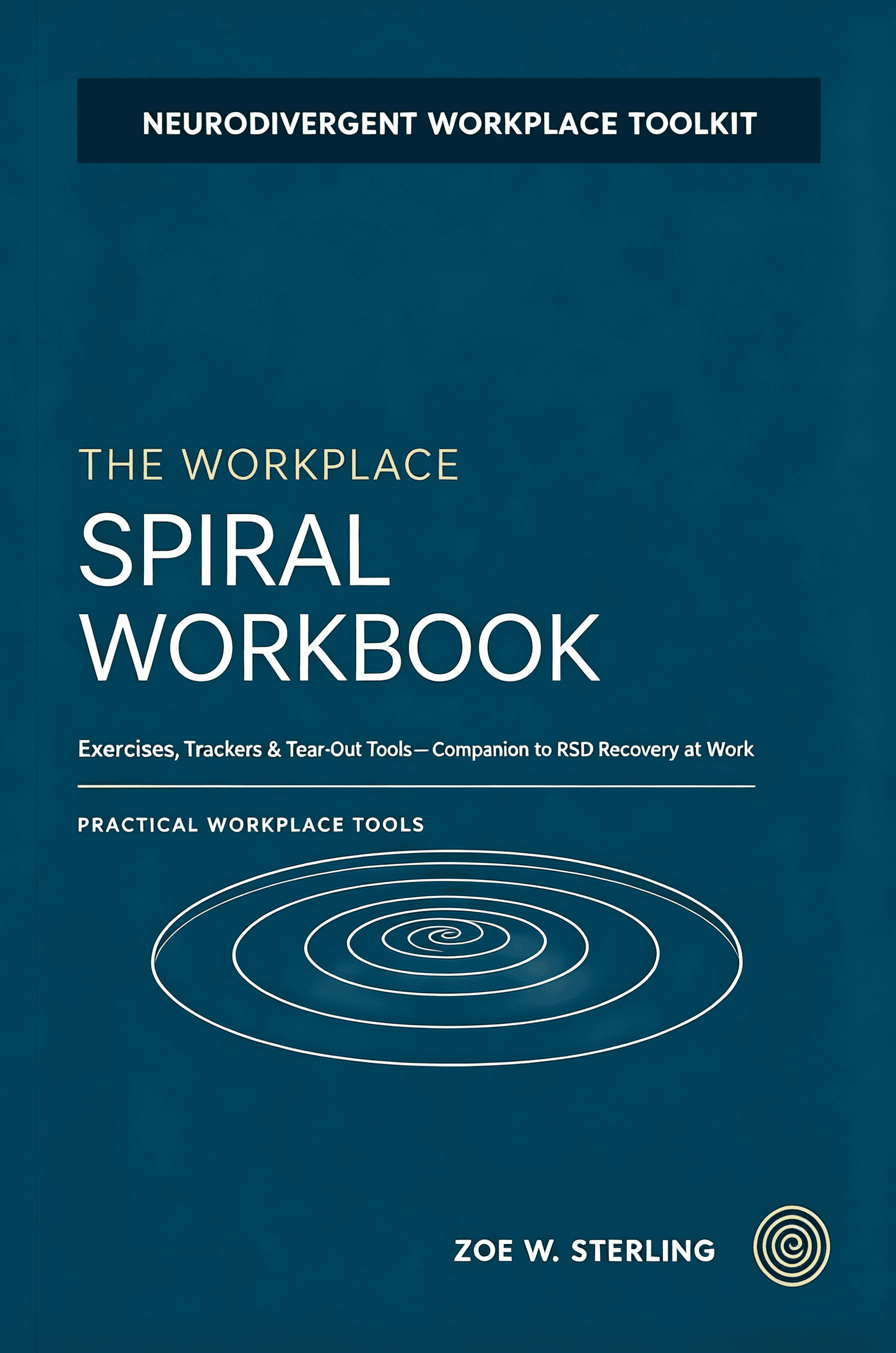
The Workplace Spiral Workbook
This interactive workbook is the companion to Zoe Sterling's Workplace Spiral assessment. Readers identify their spiral type, track their workplace patterns, and practice rewiring strategies to break free from unhealthy cycles.
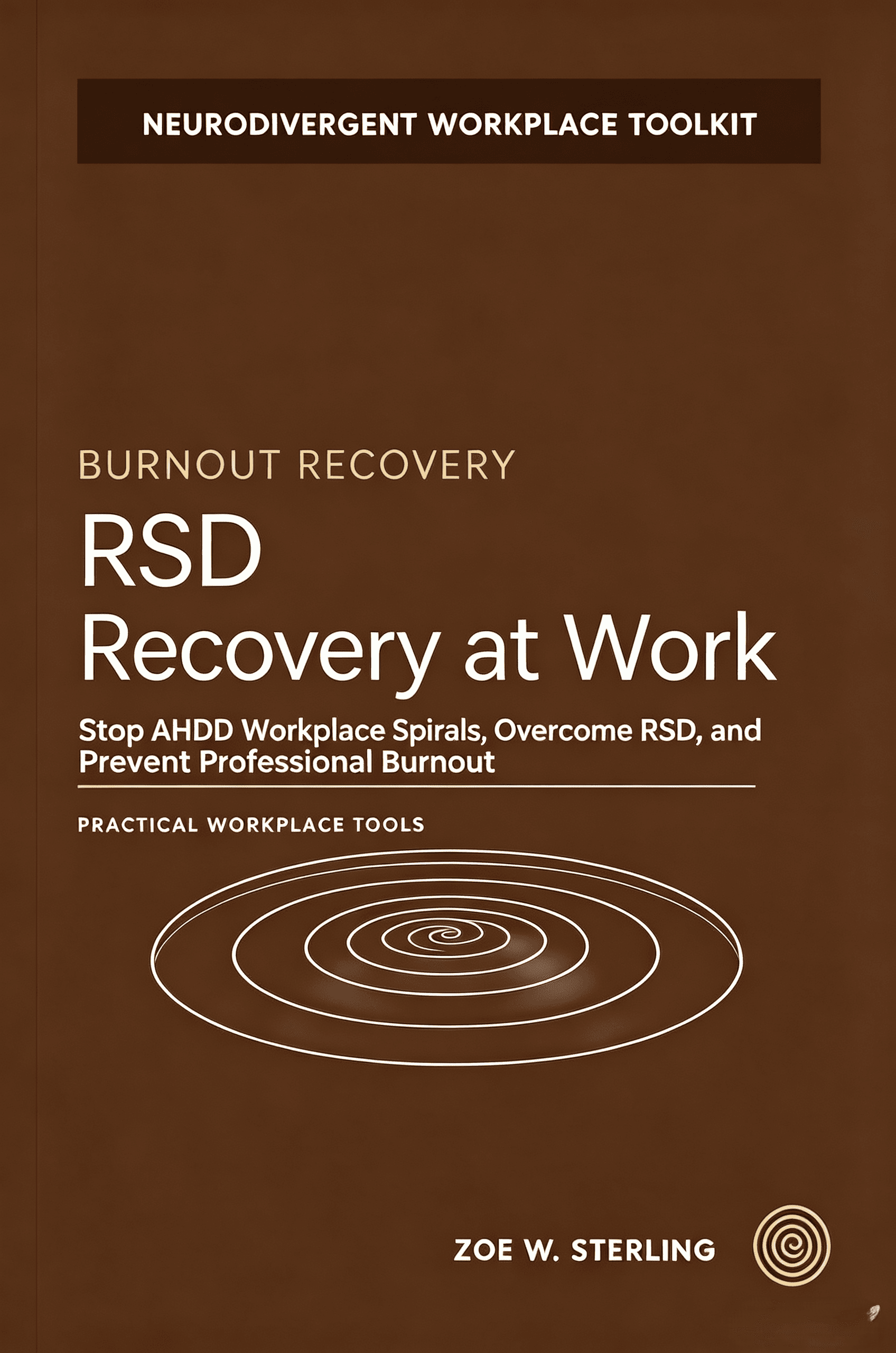
RSD Recovery at Work
A comprehensive field guide for neurodivergent adults navigating the workplace. Based on Zoe Sterling's 10+ years of ADHD workplace research and coaching, this book identifies 8 core strengths and 7 hidden workplace patterns.
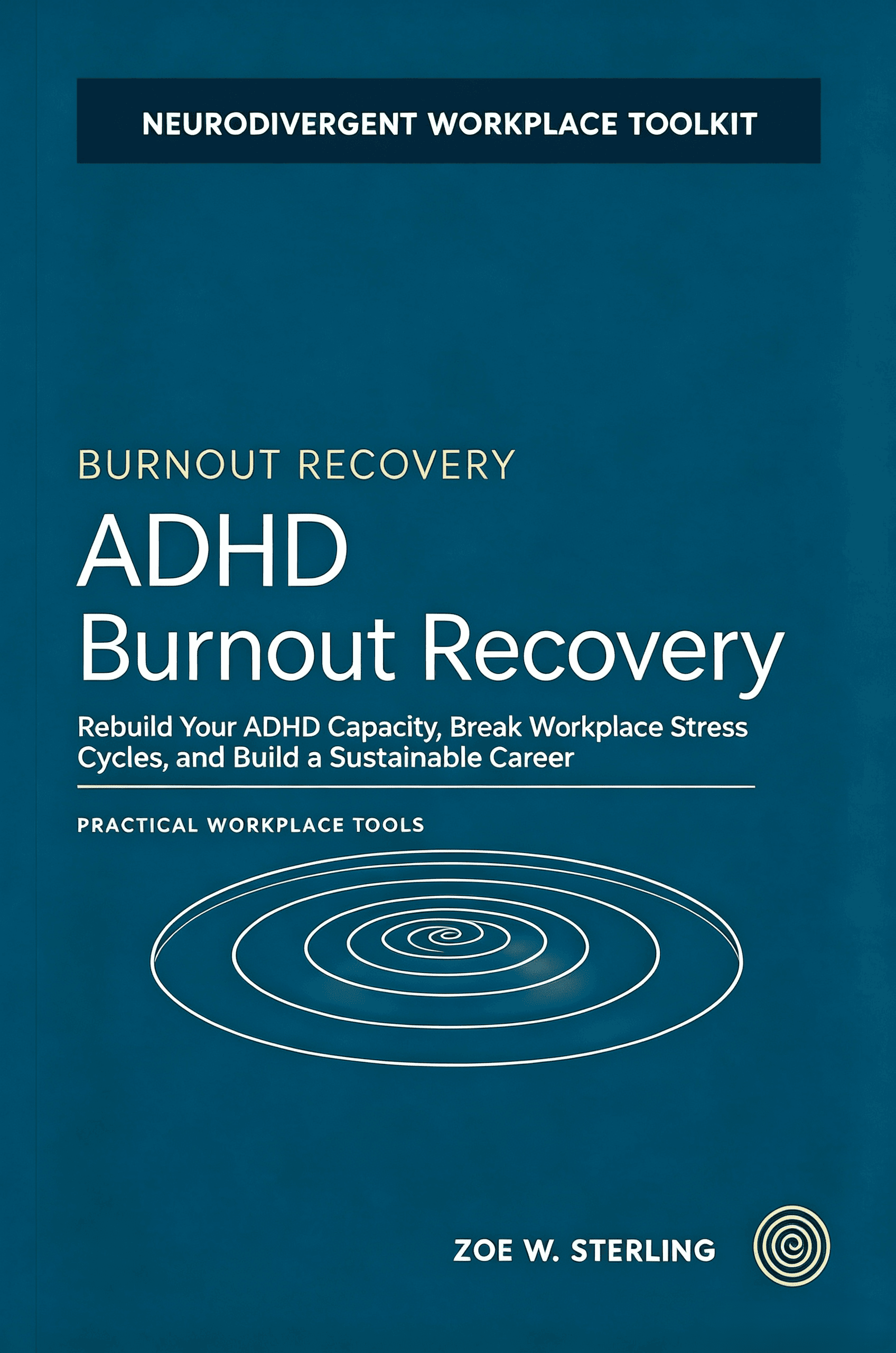
ADHD Burnout Recovery
ADHD burnout is different from typical burnout. Rooted in overstimulation, executive dysfunction, and the gap between natural strengths and workplace demands, it requires a specialized recovery approach.