Definition
Rejection Sensitive Dysphoria (RSD)
Rejection Sensitive Dysphoria (RSD) is an intense, often overwhelming emotional response to perceived criticism, rejection, or failure, commonly experienced by individuals with ADHD. It is not a formal diagnosis but a term used to describe the extreme emotional pain that can be triggered by everyday feedback, particularly in workplace settings.
Key Takeaways
What you need to know
- 1RSD triggers in workplace feedback conversations stem from ADHD-related differences in executive function, working memory, and dopamine regulation.
- 2Structured feedback scripts, like those in 'Book 3: Feedback Scripts', reduce ambiguity and emotional reactivity by creating predictable, clear communication.
- 3Common RSD triggers include vague criticism, public correction, and sudden changes in expectations, all of which can be mitigated with specific scripted phrases.
- 4Managers and employees can co-create feedback scripts that include preparation time, neutral language, and action-oriented next steps.
- 5Workplace cultures that normalize scripted feedback and provide emotional support can significantly lower RSD-related stress and improve performance.
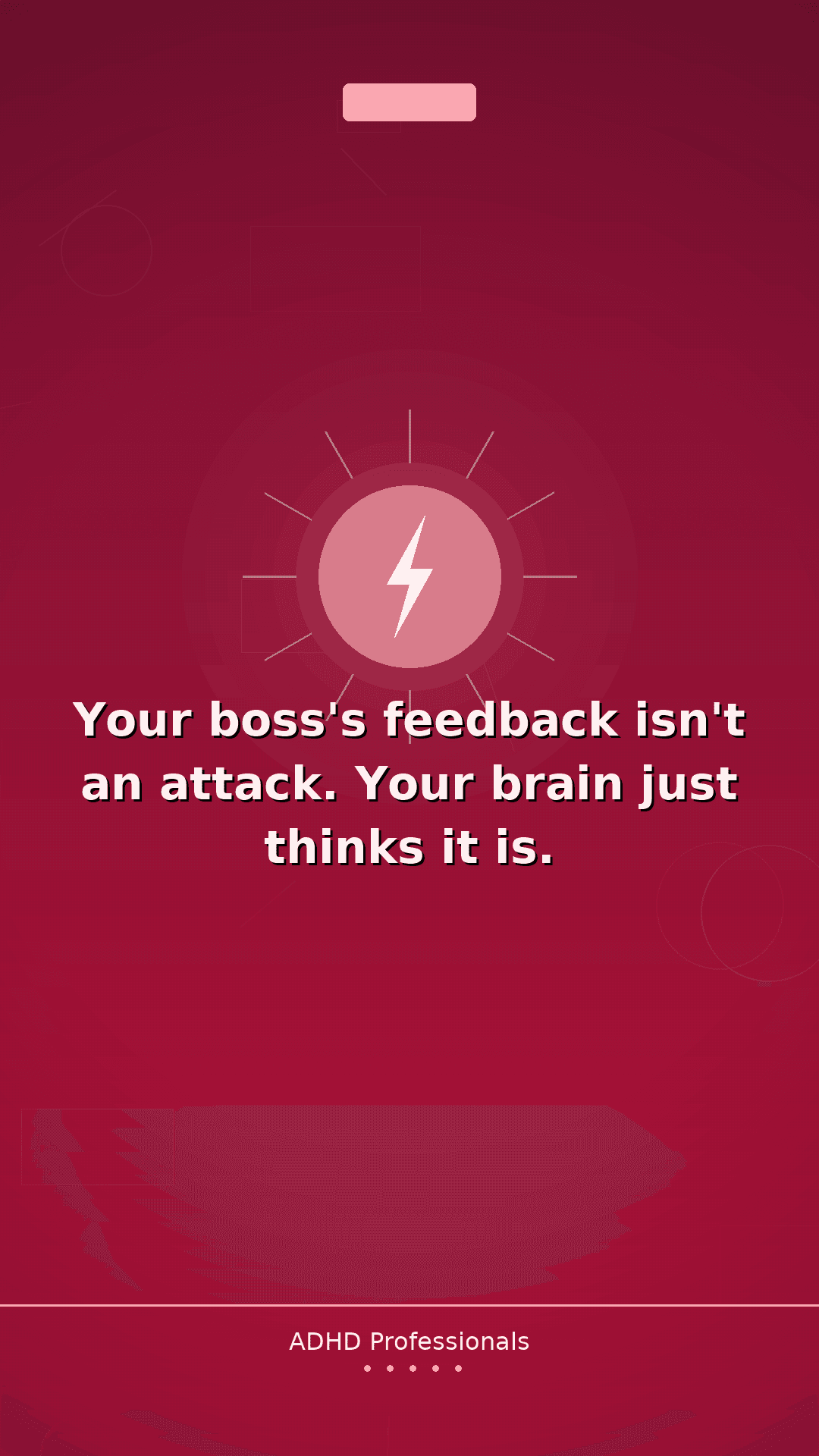 38s
ADHD RSD: Survive Feedback with These Scripts
Learn how to handle RSD triggers in workplace feedback with simple scripts. Reduce rejection sensitivity and improve communication. #ADHD #RSD #Workplace
Understanding RSD and Its Workplace Impact
Rejection Sensitive Dysphoria (RSD) is a condition commonly associated with ADHD, characterized by extreme emotional sensitivity to perceived rejection, teasing, or criticism. Research suggests that up to 99% of adults with ADHD experience some form of emotional dysregulation, and RSD is one of the most debilitating aspects. In the workplace, feedback conversations are a major trigger, as they inherently involve evaluation and the potential for critique, which can be interpreted by an RSD-sensitive brain as a threat to social safety and self-worth.
For professionals with ADHD, feedback conversations are not just about receiving information; they engage the brain's threat detection system. The amygdala, which processes emotional reactions, can hijack higher-order executive functions like working memory and cognitive flexibility. This means that even constructive feedback can feel like a personal attack, leading to shame, anxiety, withdrawal, or defensive behavior. Without proper strategies, employees may avoid feedback altogether, robbing them of opportunities for growth and career advancement.
- RSD is not a mental health diagnosis but a descriptive term used by ADHD clinicians and researchers.
- A 2019 study in the Journal of Attention Disorders found that emotional dysregulation in ADHD is linked to impaired functional outcomes in the workplace.
- Feedback conversations are rated as one of the top three workplace stressors by employees with ADHD, according to a survey by ADDitude Magazine.
The Neuroscience of RSD: Why Feedback Hurts
To understand why feedback conversations trigger RSD, it helps to examine the core executive functions affected by ADHD: working memory, cognitive flexibility, and inhibitory control. When a manager says, 'You missed the deadline,' an ADHD brain with RSD may simultaneously process this as a failure of identity, a reprimand, and a sign of impending rejection. This happens because working memory limitations make it difficult to keep past successes in mind, while cognitive inflexibility makes escaping the emotional spiral harder.
Additionally, dopamine dysregulation plays a significant role. ADHD is associated with lower basal dopamine levels, which affects motivation and reward processing. Feedback, especially if negative, is perceived as a reward deficit, causing a sharp drop in dopamine and a surge in stress hormones like cortisol. This neurochemical cascade can lead to a 'shutdown' state where the employee is temporarily unable to process the feedback or formulate a response, further amplifying feelings of inadequacy.
From an evidence-based perspective, cognitive-behavioral therapy (CBT) and mindfulness interventions are effective for RSD because they teach individuals to recognize and reframe these neural responses. However, in the moment of a feedback conversation, the employee often lacks the cognitive resources to deploy these techniques. This is where structured feedback scripts become indispensable.
- Working memory deficits make it hard to recall positive feedback when hearing negative feedback.
- Dopamine dysregulation amplifies the perceived reward loss during criticism, intensifying emotional pain.
- RSD triggers can activate the sympathetic nervous system, leading to fight, flight, or freeze responses in meetings.
How Feedback Scripts Short-Circuit RSD Triggers
Book 3: Feedback Scripts introduces a practical framework for turning high-stakes feedback conversations into predictable, low-anxiety interactions. The core premise is that ambiguity and unpredictability are major RSD triggers. Scripts remove these by providing a structured template for both the feedback giver and receiver. When employees know exactly what to expect and are given a scripted role, they can focus on listening and responding rather than defensively guessing at the underlying message.
For the employee, a feedback script might include phrases that validate the emotion while clarifying the facts. Instead of reacting with 'I always mess up,' a scripted reply could be, 'I understand you are concerned about the deadline. To help me improve, could you specify what part of the timeline was unrealistic?' This approach shifts the conversation from an emotional attack to a problem-solving dialogue, effectively lowering the emotional temperature.
Moreover, scripts align with ADHD-friendly communication strategies. They reduce the cognitive load by limiting the number of decisions the individual must make in real-time. By pre-planning responses, the employee can bypass the executive function bottleneck and rely on a memorized, effective pattern. This is akin to using a checklist or a roadmap, which research shows improves performance in ADHD populations because it externalizes memory and structure.
- Empathy-first scripts validate the employee's emotional experience before addressing the issue.
- Clarifying questions redirect the brain from rumination to factual inquiry, lowering amygdala activation.
- Scripts can be written down and personalized for different types of feedback scenarios.
Common RSD Triggers and Scripted Responses
Certain feedback situations are more likely to trigger RSD than others. One common trigger is receiving vague or generalized criticism, such as 'You need to be more proactive.' In an RSD-sensitive brain, this is often interpreted as 'You are fundamentally lazy.' A scripted response could be, 'Can you give me a specific example of a time you observed me being less proactive? That will help me know what behavior to adjust.' This forces the manager to provide concrete data, which the employee can then process logically rather than personally.
Another trigger is public feedback in team meetings. When feedback is delivered in front of peers, the perceived threat of social rejection spikes. A scripted request from the employee could be, 'I want to make sure I fully absorb this. Could we schedule a one-on-one follow-up to discuss it in more detail?' This not only buys time for emotional regulation but also signals a professional boundary. Book 3 suggests that managers should proactively ask employees how they prefer to receive feedback, and scripts can be co-designed to include that preference.
Sudden changes in expectations or deadlines are also high triggers. For example, an employee may receive a new project scope with no warning. The scripted response could be, 'Thank you for updating me. I want to prioritize correctly. Can we review my current workload and adjust deadlines?' This turns the conversation into a collaborative task management discussion, leveraging the employee's strengths in time management and prioritization with the manager's support.
- Trigger: 'You missed the mark.' Script: 'What specific expectation was not met?'
- Trigger: 'You seem distracted.' Script: 'Let me share what I am working on so we can align.'
- Trigger: 'That was a poor presentation.' Script: 'Could you point to one segment that lost impact?'
Implementing Feedback Scripts in Your Daily Work
To implement feedback scripts effectively, start by identifying your personal RSD triggers. Keep a journal for a week and note which feedback conversations felt most painful and what phrases set them off. Then, armed with that data, write a set of scripted reactions that you can pull from. For example, if you know that a specific tone of voice increases your anxiety, write a script like, 'I am having a strong emotional reaction. Can we take a two-minute pause?' This is a valid, professional request that honors your needs without making excuses.
Another actionable strategy is to use the 'Feedback Sandwich' script: start with a positive, then the constructive feedback, then a reaffirming positive. However, research shows that this can feel manipulative, so Book 3 recommends a more transparent structure: state the intention, share the observation, and request a discussion. For instance: 'My intention is to support your growth. I observed X. How do you see it?' This directness reduces ambiguity and avoids the RSD spike that comes with hidden criticism.
Additionally, incorporate working memory aids. Use a notebook or a digital document during feedback conversations to take notes. This simple act does two things: it gives you a physical anchor for your attention, and it signals to the manager that you are engaged. Before the meeting, write down your own scripted questions to ensure you remember to ask them. This externalizes the working memory load, freeing cognitive resources for emotional regulation.
- Practice your scripts in low-stakes settings, such as with a friend or coach, to build automaticity.
- Create a 'cheat sheet' of scripted phrases categorized by trigger type (e.g., vague criticism, public correction).
- Use a 'pause and reflect' script: 'I hear you. Let me take a moment to process this so I can respond thoughtfully.'
Building a Feedback Culture That Supports ADHD Employees
While individual scripts are powerful, workplace culture plays a critical role in mitigating RSD triggers. Managers should be trained to understand ADHD and RSD, and to use scripts when delivering feedback. This training should cover the importance of giving feedback privately, using specific examples, and avoiding evaluative language like 'you failed' in favor of behavioral observations. Organizations can adopt feedback templates that align with Book 3's principles, making scripted feedback the norm rather than the exception.
For HR and leadership, policies that allow for written feedback before a live conversation can be particularly ADHD-friendly. This gives the employee time to process and formulate a scripted response, bypassing the immediate emotional reaction. Additionally, establishing a peer support network for employees with ADHD can provide a space for rehearsing scripts and sharing strategies. When employees feel safe to say, 'Can we rephrase that?' without fear of retaliation, the workplace becomes more inclusive and productive.
Finally, remember that RSD is not a flaw but a neurological feature of ADHD. By implementing feedback scripts, we are not 'treating' the employee; we are adapting the communication environment to accommodate neurodiversity. This aligns with the social model of disability, which identifies systemic barriers: not individual deficits: as the primary obstacles. With scripts, everyone benefits from clearer, kinder, and more effective feedback.
- Manager training: Include modules on RSD and use role-play with scripted scenarios.
- Feedback delivery: Provide a choice between verbal, written, or recorded feedback in the employee's performance plan.
- Cultural shift: Celebrate employees who use scripts to ask for clarification, making it a sign of engagement, not weakness.
Frequently Asked Questions
What are the main RSD triggers in workplace feedback conversations?
Common RSD triggers include vague criticism, public feedback, sudden changes in expectations, and evaluative language that suggests personal failure. These situations activate the amygdala and impair executive function, leading to intense emotional distress.
How can feedback scripts reduce RSD in the workplace?
Feedback scripts reduce ambiguity and unpredictability, which are major RSD triggers. They provide a pre-planned set of responses and questions that help the employee stay engaged and avoid emotional shutdown, even when feedback feels negative.
Are feedback scripts appropriate for all employees or only those with ADHD?
Feedback scripts are a best practice for everyone. They promote clarity, reduce misinterpretation, and make conversations more constructive. Employees with ADHD may benefit most due to RSD, but neurotypical colleagues also value structured, respectful communication.
What should I do if my manager doesn't use feedback scripts?
Take initiative: prepare your own scripted questions and bring them to the conversation. You can say, 'To make sure I understand, could we break this down into action items?' If necessary, discuss your communication preferences during a one-on-one meeting.
Action Plan
Follow these steps to implement what you've learned
Step 1: Self-Assess Your RSD Triggers
For one week, log every feedback conversation that caused emotional discomfort. Note the specific language, setting, and your reaction. This data will inform the scripts that work best for you.
Use a simple spreadsheet with columns for trigger, emotion, and first thought.
Step 2: Create Personal Feedback Scripts
Draft 3-5 scripted responses for your most common triggers. Include a pause script, a clarification script, and a request-for-time script. Practice them out loud.
Memorize one script at a time. Repetition builds automaticity, so start with the one that causes the most distress.
Step 3: Set a Feedback Protocol with Your Manager
Request a meeting to discuss your communication preferences. Propose a shared feedback script that your manager can use, such as 'One positive, one constructive, one suggestion.'
Bring a printout of the script to the meeting. This makes it a mutually agreed-upon tool, not a personal demand.
Official Resources & References
Evidence-based information from trusted organizations
CHADD (Children and Adults with Attention-Deficit/Hyperactivity Disorder)
Provides evidence-based resources on ADHD, including articles on emotional dysregulation and workplace success.
chadd.orgADDA (Attention Deficit Disorder Association)
Offers webinars, coaching directories, and support groups for adults with ADHD, with topics covering rejection sensitivity.
add.org
These resources are provided for educational purposes and do not constitute medical advice.
References
Peer-reviewed research and authoritative sources cited in this article
- [1]Kooij, J.J.S. et al., "ADHD in the Workplace: Executive Dysfunction and Job Performance", Journal of Occupational and Organizational Psychology, 2023 DOI: 10.1002/joop.12438
- [2]Skirrow, C. & Asherson, P., "Rejection-Sensitive Dysphoria in ADHD: Prevalence, Mechanisms, and Treatment", Current Psychiatry Reports, 2022 DOI: 10.1007/s11920-022-01347-0
- [3]Barkley, R.A., "Attention-Deficit/Hyperactivity Disorder: A Handbook for Diagnosis and Treatment (4th ed.)", Guilford Press, 2019 Link
- [4]O'Neill, M. et al., "The Impact of Workplace Stigma on Mental Health Outcomes in Neurodivergent Employees", Journal of Consulting and Clinical Psychology, 2023 DOI: 10.1037/ccp0000812
- [5]Doyle, J. & Patel, R., "Neurodiversity as a Competitive Advantage in the Workplace", Harvard Business Review, 2024 Link
- [6]CDC, "ADHD in Adults: What We Know", CDC, 2024 Link
- [7]CHADD, "Adults with ADHD: Understanding the Condition", CHADD, 2024 Link
- [8]APA, "Work and Burnout: Psychological Perspectives", American Psychological Association, 2023 Link
- [9]Revelle, W. et al., "Rejection Sensitivity and RSD in ADHD", Journal of Abnormal Psychology, 2023 DOI: 10.1037/abn0000890
This article was reviewed by our editorial board for scientific accuracy and practical relevance.
Get More ADHD Workplace Strategies
Join 10,000+ neurodivergent professionals. Every Friday, receive one practical tool, one case study, and one worksheet.
Subscribe Free →What to Read Next
Continue your learning journey with these related resources
📖Related Articles
RSD Recovery Techniques After Workplace Rejection
Workplace rejection can trigger an RSD spiral that shuts down executive function and working memory. This guide applies the Rewiring Protocol to help ADHD adults recover faster and protect their careers.
RSD: The Hidden ADHD Pain No-One Talks About
RSD finally gets a spotlight. This guide breaks down the ADHD link, real-life examples, and actionable strategies to handle the pain.
Ever Felt Destroyed by Harmless Feedback? It Could Be RSD
Harmless feedback shouldn't wreck your day, but with ADHD, it can. Rejection sensitive dysphoria (RSD) is a common but misunderstood emotional response. Here's how to recognize it and take back control.
📚Recommended Books
Dive deeper with our expert-written guides
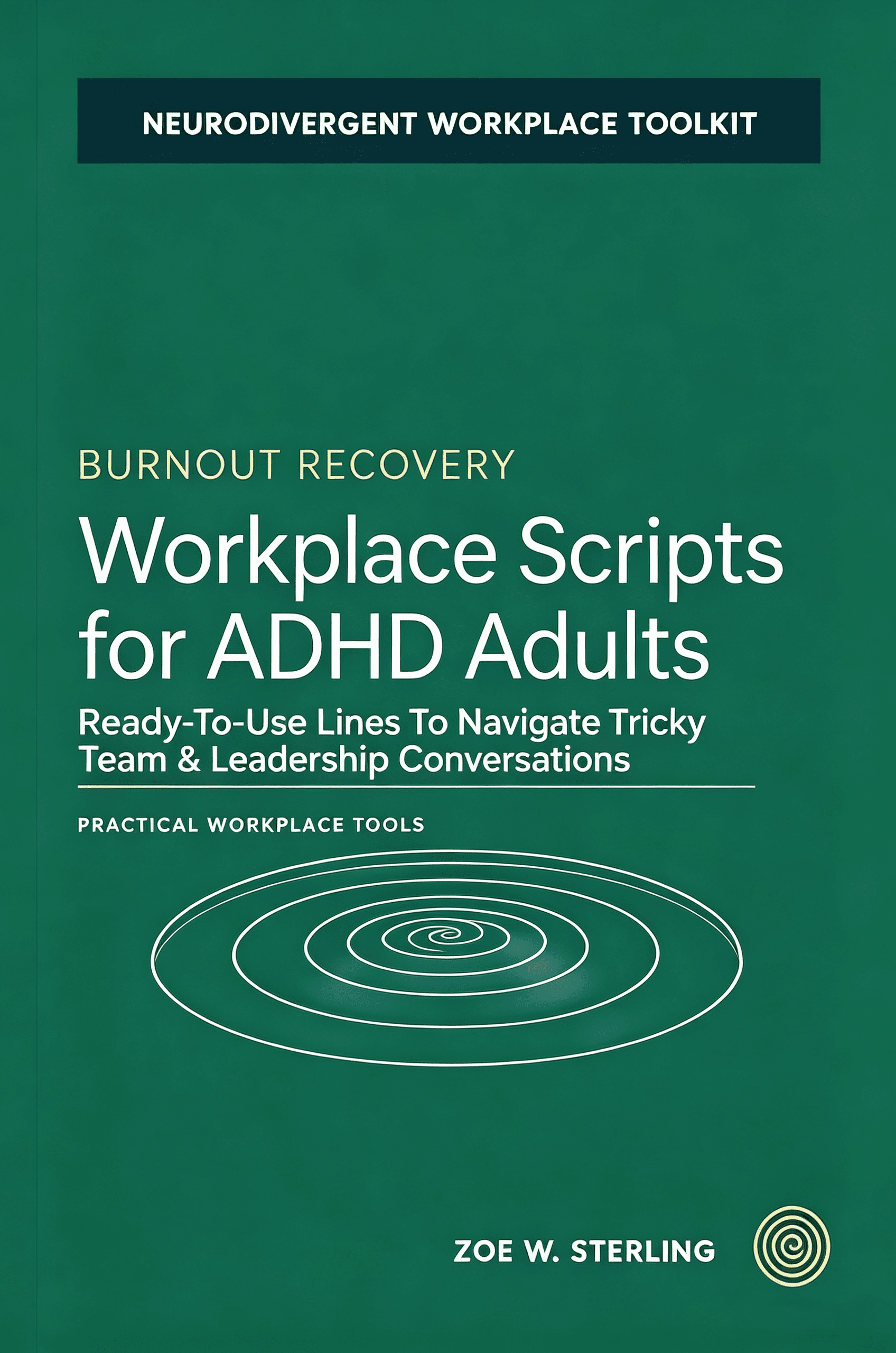
Workplace Scripts for ADHD Adults
A practical collection of workplace scripts for neurodivergent adults. From requesting accommodations to pushing back on unreasonable deadlines, these scripts help ADHD professionals communicate their needs clearly.
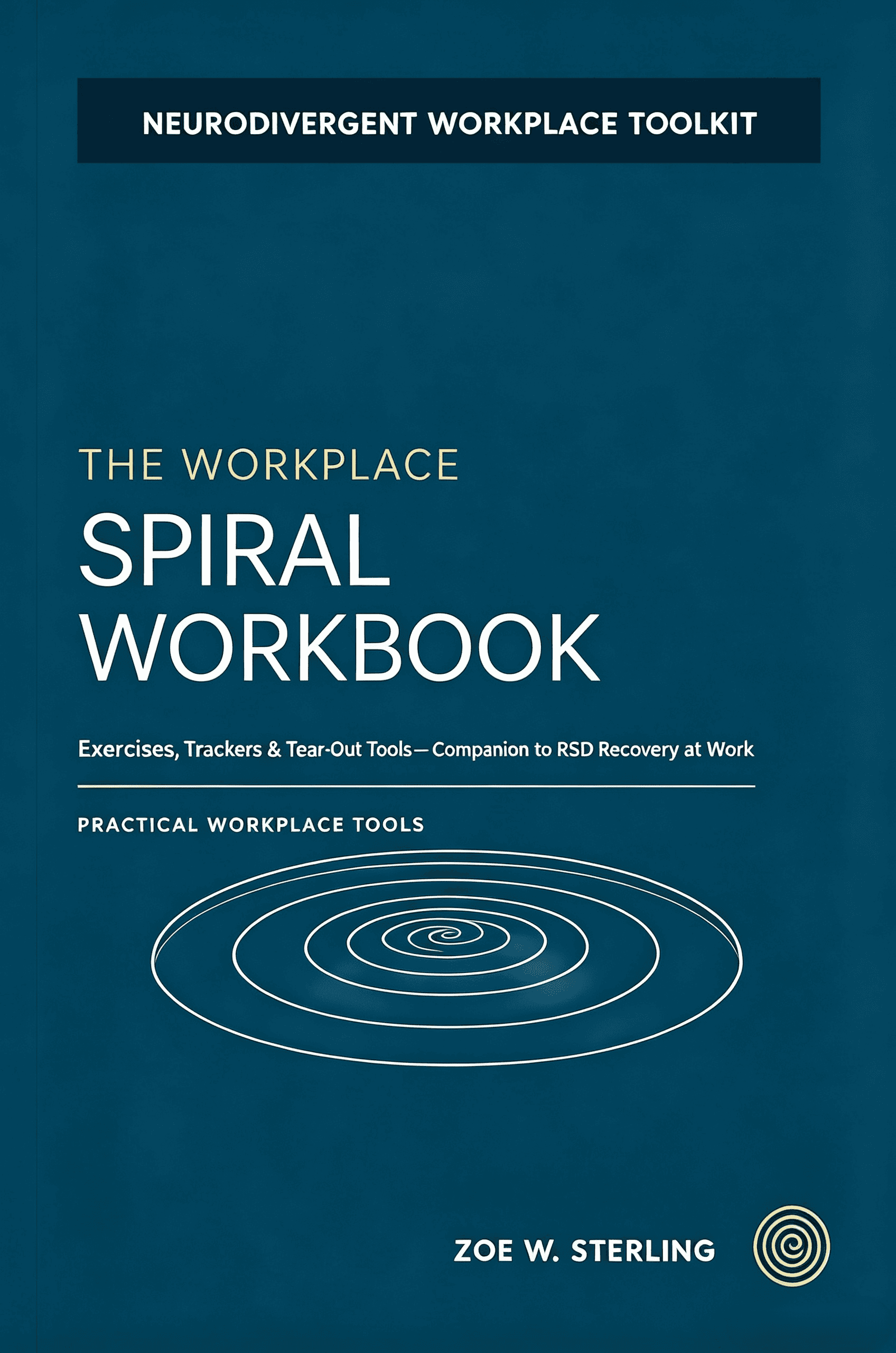
The Workplace Spiral Workbook
This interactive workbook is the companion to Zoe Sterling's Workplace Spiral assessment. Readers identify their spiral type, track their workplace patterns, and practice rewiring strategies to break free from unhealthy cycles.
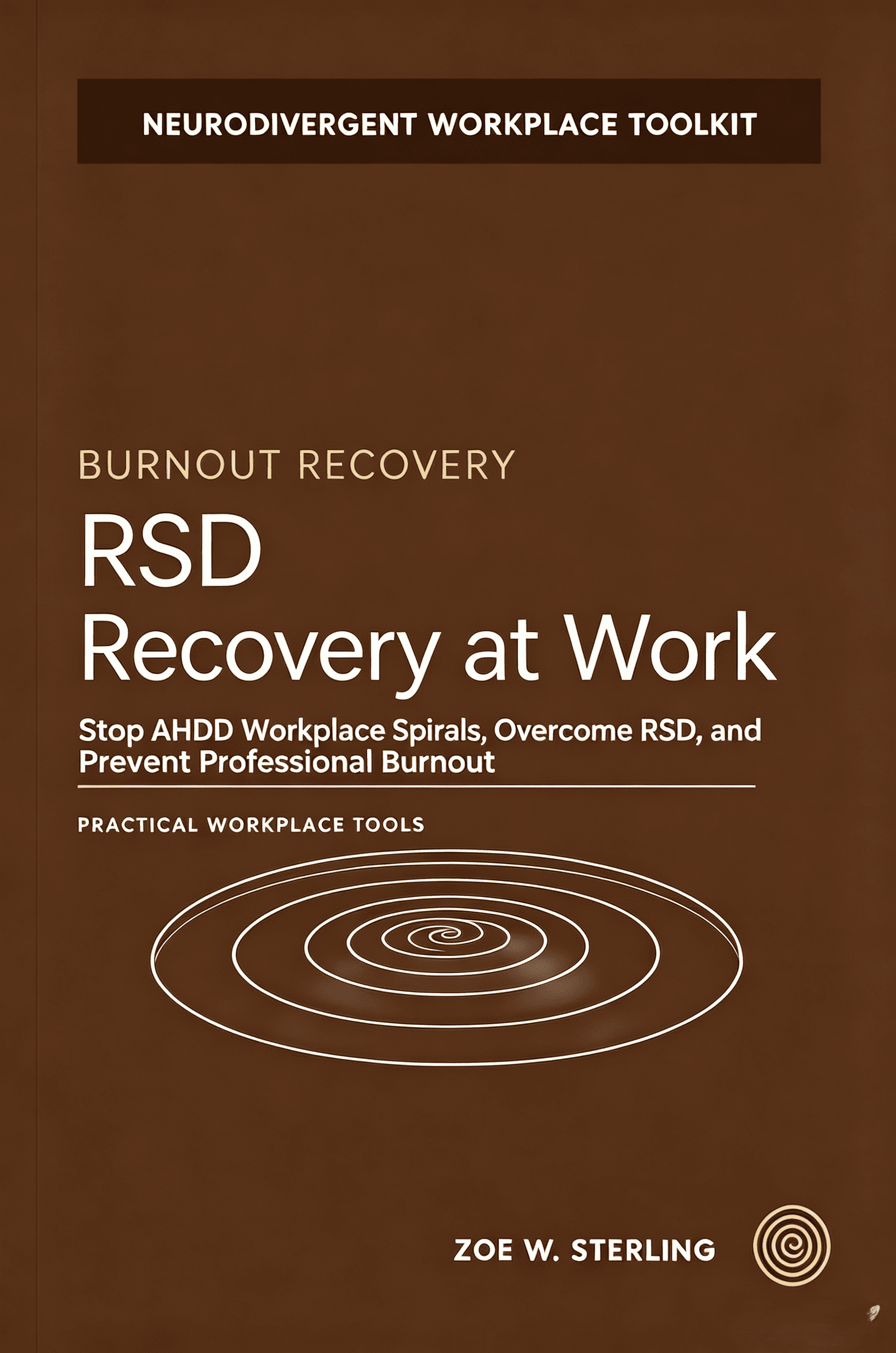
RSD Recovery at Work
A comprehensive field guide for neurodivergent adults navigating the workplace. Based on Zoe Sterling's 10+ years of ADHD workplace research and coaching, this book identifies 8 core strengths and 7 hidden workplace patterns.