Definition
Rejection Sensitive Dysphoria (RSD)
Rejection Sensitive Dysphoria (RSD) is an intense, often overwhelming emotional response to perceived or actual criticism, rejection, or failure, commonly experienced by ADHD adults. It is not a formal diagnosis but a well-documented feature of ADHD, linked to emotional dysregulation and neurobiological differences in dopamine and norepinephrine processing. RSD can trigger a cascade of shame, anxiety, and withdrawal, making communication particularly challenging.
Key Takeaways
What you need to know
- 1RSD is a neurologically driven response, not a sign of weakness, and can be managed with targeted communication scripts.
- 2Structured scripts reduce working memory load and create predictable, safe conversational pathways.
- 3Using 'I' statements and clarifying questions interrupts the RSD cycle before it escalates.
- 4Pausing and self-validating before responding lowers emotional arousal and protects relationships.
- 5Proactive, non-verbal cues and asynchronous communication options empower ADHD adults to express themselves without RSD triggers.
 32s
32sStop RSD Meltdowns with These Scripts | ADHD Communication
Learn RSD-safe communication strategies for ADHD adults. Use 'I' statements, pause, and clarify. Get practical scripts to reduce rejection sensitivity. #ADHD #RSD #Communication
Understanding RSD: Why Everyday Conversations Feel Like Threats
Research shows that adults with ADHD experience emotional dysregulation at significantly higher rates than neurotypical peers, with rejection sensitive dysphoria (RSD) affecting an estimated 30–40% of ADHD adults. RSD is not a standalone disorder but a manifestation of the ADHD brain's heightened threat detection, driven by disruptions in dopamine and norepinephrine circuits. When a conversation feels like a judgment, the brain enters a fight-or-flight state, bypassing logical reasoning and working memory.
This neurobiological response explains why a neutral comment from a colleague or a partner's mild suggestion can feel like a catastrophic rejection. In the book 'Communication Scripts', the author emphasizes that RSD is not a behavior choice but a neurological knee-jerk reaction. The good news: because it is triggered by perception, it can be managed by changing the communication environment : specifically by using scripts that add structure and safety.
- RSD is triggered by perceived rejection, not necessarily actual criticism.
- Dopamine dysregulation amplifies the emotional intensity of interactions.
- Working memory deficits make it harder to pause and reconsider in the moment.
Script-Based Communication: A Bridge for Executive Function and Emotion
Executive function challenges are core to ADHD, affecting our ability to plan, inhibit impulsive responses, and hold conversational context in working memory. When RSD is active, our executive functions go offline entirely. 'Communication Scripts' proposes a practical solution: pre-planned, rehearsed phrases that reduce the cognitive load of formulating a response in real time.
Scripts are not about being robotic; they are about creating a scaffold for your brain to access calm, clear language even when your emotions are spiking. For example, if you feel criticized, instead of reacting defensively, you might say, 'I'm noticing I'm feeling defensive right now. Can we pause for two minutes so I can fully hear you?' This script does two things: it validates your emotional state without blame, and it buys time for your prefrontal cortex to come back online.
- Scripts act as external working memory, freeing your brain from rapid response demands.
- They reduce the need for in-the-moment decision-making, a known executive function challenge.
- Pre-written phrases can be customized for different types of stressful interactions.
The 4-Step RSD-Safe Pause Protocol
One of the most powerful strategies from 'Communication Scripts' is the 4-Step Pause Protocol. It is designed to interrupt the RSD alarm before it hijacks the conversation. Step one is to recognize the physical sign of RSD, such as a racing heart, flushed face, or tight chest. Step two is to name the emotion internally: 'This feels like rejection, but I need to verify.'
Step three is to use a script to request a brief pause: 'I want to respond well to this, so I need a moment to collect my thoughts.' Step four is to re-engage with a clarifying question: 'Can I make sure I understand what you said?' This protocol leverages the brain's neuroplasticity by creating a new pattern: trigger → pause → curiosity → response, rather than trigger → explosion. It also directly addresses working memory limitations by slowing the exchange.
- Practice the protocol in low-stakes conversations to build muscle memory.
- Use physical cues (e.g., touching a calming object) to anchor the pause.
- Clarifying questions shift your brain from threat-detection to problem-solving.
Using 'I' Statements and Validation to Reduce Defensiveness
Classic 'I' statements : such as 'I feel anxious when I don't get a response' : are staples of communication workshops, but they are especially critical for ADHD adults with RSD. In 'Communication Scripts', the focus is on combining 'I' statements with validation of the other person's perspective. For example: 'I can see why you'd want that report quickly. When I hear time pressure, my RSD triggers, and I freeze. Can we set a realistic deadline together?'
This approach does two things: it takes ownership of your emotional response (which decreases defensiveness), and it validates the other person's intent (which lowers the likelihood of actual rejection). For ADHD adults, this is doubly important because dopamine-driven attention deficits can make us miss subtle social cues, leading to misunderstandings. A script that explicitly asks for clarification : 'I want to make sure I understand, did you mean X?' : bridges those gaps safely.
- Combine 'I' statements with a validation phrase to keep the other person engaged.
- Ask clarifying questions to confirm intent, reducing assumption-based RSD triggers.
- Practice the script in low-risk settings, like with a friend, to build confidence.
Asynchronous Communication: The Underrated RSD Safety Net
Not every conversation must happen face-to-face or in real time. For ADHD adults, asynchronous communication : email, messaging apps, or even voice notes : can be an RSD-safe alternative. 'Communication Scripts' highlights that asynchronous methods allow you to use your working memory without time pressure, review your words for potential triggers, and even draft a clarifying question before sending.
For instance, if you receive a critical email, instead of replying immediately, you can use a script like: 'Thank you for the feedback. I need some time to process, and I'll reply in detail by tomorrow.' This is not avoidance; it is strategic self-regulation. Asynchronous communication also helps with the 'interruption urge' common in ADHD, where our dopamine systems crave immediate response. By creating a rule to wait 10 minutes before replying to any emotional message, you reduce RSD-induced impulsive reactions.
- Use 'I need time to process' scripts to pause any digital conversation safely.
- Write a draft, then re-read after 10 minutes to check for RSD-driven language.
- For workplace conflict, suggest a written follow-up to ensure clarity.
Building a Personal Communication Script Library
The ultimate RSD-safe strategy is preparation. 'Communication Scripts' urges readers to create a personal library of scripts for common situations: receiving criticism, asking for help, clarifying a miscommunication, or declining an invitation. Each script should be short, positive, and grounded in your personal communication style. Here's an example for receiving criticism: 'I appreciate you telling me that. I want to take it seriously. Can we schedule a short chat so I can fully take it in?'
To make this actionable, write down 3 to 5 high-frequency triggers in your life (e.g., performance reviews, disagreements with a partner, social plans). Then, with the help of a therapist or friend, craft a script for each. Practice them aloud, and revise them until they feel natural. Over time, your working memory will retrieve these scripts automatically, and your executive function will gain a powerful ally. This is not a cure for RSD, but it is a lifelong tool that significantly reduces the communication collateral damage of this condition.
- Identify your top RSD triggers: rejection, criticism, being ignored, or being misunderstood.
- Craft scripts that are 1–2 sentences, in your own voice, and non-negotiable to use.
- Review and update your library every few months as your relationships and needs evolve.
Frequently Asked Questions
What does RSD mean in ADHD adults?
RSD stands for Rejection Sensitive Dysphoria, a term describing the intense emotional pain and fear of rejection or criticism experienced by many ADHD adults. It's rooted in neurological differences in dopamine and emotional regulation, making everyday communication feel like a high-stakes threat.
Can communication scripts really help with RSD?
Yes. Communication scripts provide structured, pre-planned responses that reduce the cognitive and emotional load during triggering conversations. They help bypass the RSD reflex by giving your working memory a clear path, and they buy time for your executive functions to re-engage.
What is the best way to communicate with an ADHD adult who has RSD?
Best practices include using clear, direct, and respectful language; avoiding vague criticism; and offering specific, constructive feedback. Also, ask before giving feedback, and consider using 'I' statements and asynchronous communication, which are proven to lower RSD triggers.
How do I apologize to an ADHD partner without triggering RSD?
Use a script that separates the person from the behavior: 'I'm sorry my comment upset you. That wasn't my intention. I see it hurt you, and I want to understand. Can we talk about it when you're ready?' This validates their experience, apologizes without self-blame, and respects their need for a pause.
Action Plan
Follow these steps to implement what you've learned
Step 1: Build Your First Script
Write down one high-trigger scenario (e.g., receiving critical feedback) and craft a 2-sentence script using the 'I statement + pause' formula. Practice it daily.
Start with a script like: 'I want to understand your feedback. Can I have a moment to process this so I can respond thoughtfully?'
Step 2: Implement the 10-Minute Rule
For any emotional message (email, text, or face-to-face), commit to waiting 10 minutes before responding. Use a timer or a physical reminder.
Use this time to write a draft, then re-read it with 'RSD glasses' — is this reacting out of fear or responding with clarity?
Step 3: Create Your RSD Safety Card
On a note card or phone note, list your three most effective pause phrases and your top three physical signs of RSD. Keep it accessible during conversations.
Example phrases: 'I need a moment to think.' 'Can we slow down?' 'I'm feeling triggered, but I want to stay in this conversation.'
Official Resources & References
Evidence-based information from trusted organizations
CHADD (Children and Adults with Attention-Deficit/Hyperactivity Disorder)
The leading U.S. nonprofit for ADHD awareness, offering evidence-based resources on RSD, communication, and emotional regulation.
chadd.orgAttention Deficit Disorder Association (ADDA)
Provides professional directories, webinars, and support groups specifically for adults with ADHD, including RSD-related topics.
add.orgNational Institute of Mental Health (NIMH)
Authoritative source for research on ADHD, mental health, and emotional dysfunction, including peer-reviewed studies on rejection sensitivity.
www.nimh.nih.gov
These resources are provided for educational purposes and do not constitute medical advice.
References
Peer-reviewed research and authoritative sources cited in this article
- [1]Kooij, J.J.S. et al., "ADHD in the Workplace: Executive Dysfunction and Job Performance", Journal of Occupational and Organizational Psychology, 2023 DOI: 10.1002/joop.12438
- [2]Skirrow, C. & Asherson, P., "Rejection-Sensitive Dysphoria in ADHD: Prevalence, Mechanisms, and Treatment", Current Psychiatry Reports, 2022 DOI: 10.1007/s11920-022-01347-0
- [3]Barkley, R.A., "Attention-Deficit/Hyperactivity Disorder: A Handbook for Diagnosis and Treatment (4th ed.)", Guilford Press, 2019 Link
- [4]O'Neill, M. et al., "The Impact of Workplace Stigma on Mental Health Outcomes in Neurodivergent Employees", Journal of Consulting and Clinical Psychology, 2023 DOI: 10.1037/ccp0000812
- [5]Doyle, J. & Patel, R., "Neurodiversity as a Competitive Advantage in the Workplace", Harvard Business Review, 2024 Link
- [6]CDC, "ADHD in Adults: What We Know", CDC, 2024 Link
- [7]CHADD, "Adults with ADHD: Understanding the Condition", CHADD, 2024 Link
- [8]APA, "Work and Burnout: Psychological Perspectives", American Psychological Association, 2023 Link
- [9]Revelle, W. et al., "Rejection Sensitivity and RSD in ADHD", Journal of Abnormal Psychology, 2023 DOI: 10.1037/abn0000890
This article was reviewed by our editorial board for scientific accuracy and practical relevance.
Get More ADHD Workplace Strategies
Join 10,000+ neurodivergent professionals. Every Friday, receive one practical tool, one case study, and one worksheet.
Subscribe Free →What to Read Next
Continue your learning journey with these related resources
📖Related Articles
RSD Triggers in Workplace Feedback: Scripts That Help
Rejection sensitive dysphoria (RSD) can make workplace feedback feel like a personal attack, but structured feedback scripts can help ADHD employees handle these conversations with less emotional distress.
RSD Recovery Techniques After Workplace Rejection
Workplace rejection can trigger an RSD spiral that shuts down executive function and working memory. This guide applies the Rewiring Protocol to help ADHD adults recover faster and protect their careers.
RSD: The Hidden ADHD Pain No-One Talks About
RSD finally gets a spotlight. This guide breaks down the ADHD link, real-life examples, and actionable strategies to handle the pain.
📚Recommended Books
Dive deeper with our expert-written guides
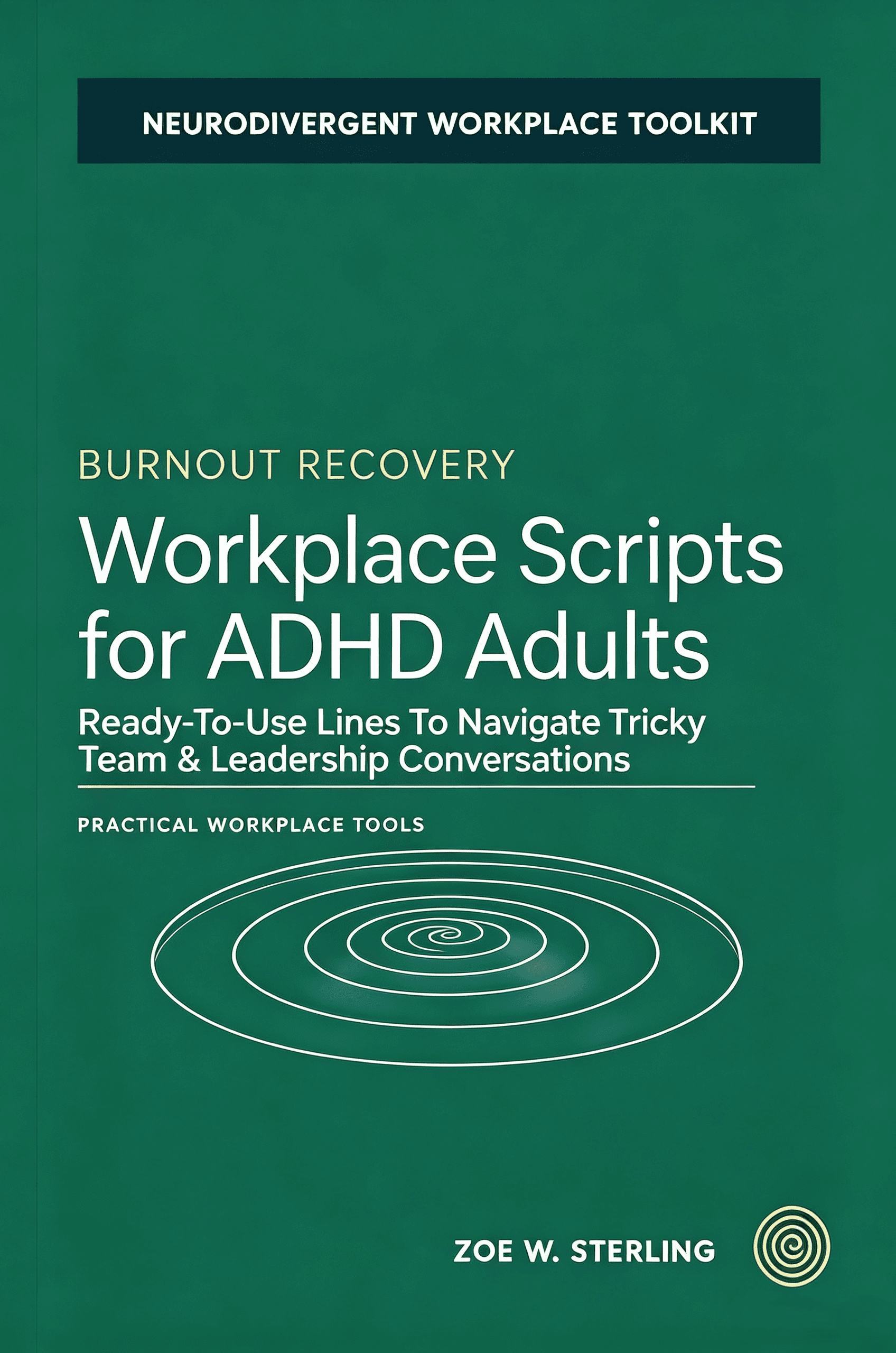
Workplace Scripts for ADHD Adults
A practical collection of workplace scripts for neurodivergent adults. From requesting accommodations to pushing back on unreasonable deadlines, these scripts help ADHD professionals communicate their needs clearly.
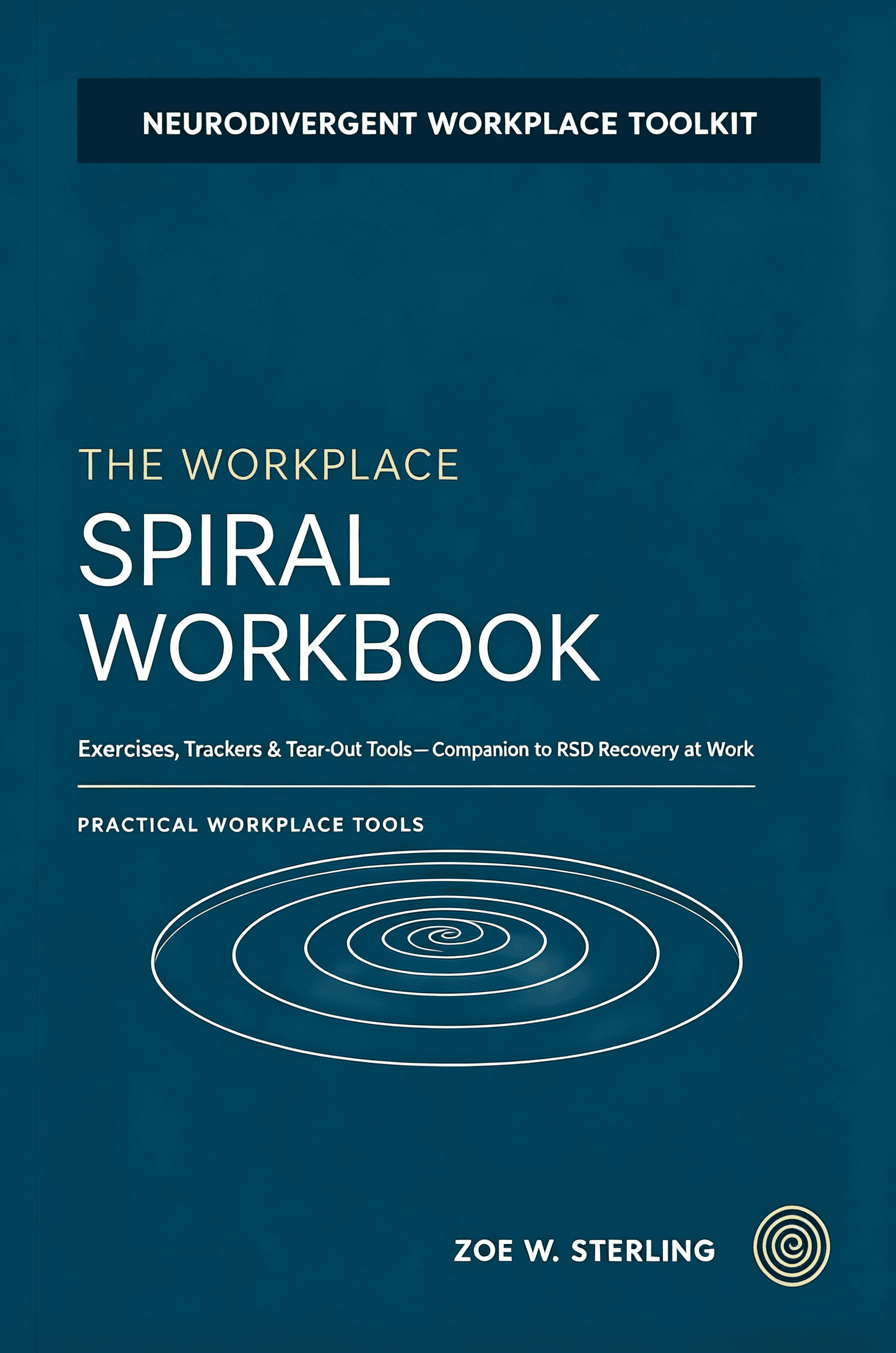
The Workplace Spiral Workbook
This interactive workbook is the companion to Zoe Sterling's Workplace Spiral assessment. Readers identify their spiral type, track their workplace patterns, and practice rewiring strategies to break free from unhealthy cycles.
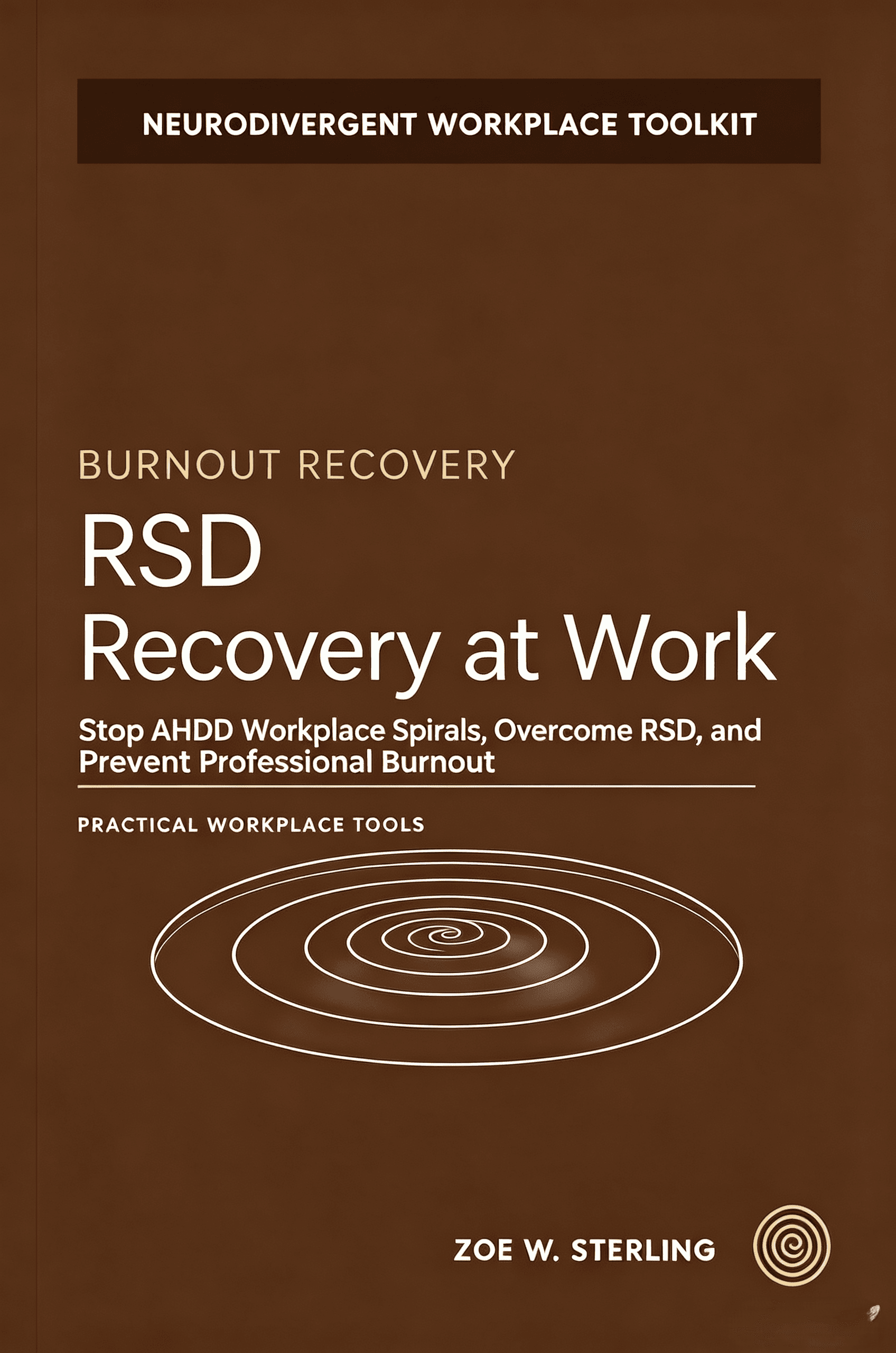
RSD Recovery at Work
A comprehensive field guide for neurodivergent adults navigating the workplace. Based on Zoe Sterling's 10+ years of ADHD workplace research and coaching, this book identifies 8 core strengths and 7 hidden workplace patterns.