Definition
RSD-safe communication strategies
These are deliberate verbal and non-verbal techniques designed to minimize the likelihood of triggering rejection sensitive dysphoria (RSD) in ADHD adults. They incorporate validation, clear structure, and emotional regulation tools to create safer exchanges for both the speaker and recipient.
Key Takeaways
What you need to know
- 1RSD is a neurological response to perceived rejection, not a character flaw, and affects nearly all ADHD adults at some point.
- 2Standard feedback often triggers RSD because it overloads working memory and creates a dopamine crash; RSD-safe scripts prevent this.
- 3Validation before constructive criticism is the golden rule: it signals safety and reduces defensiveness.
- 4Written scripts for giving and receiving feedback help bypass executive function deficits and emotional reactivity.
- 5Consistent practice of RSD-safe communication rewires relationships and reduces chronic emotional pain.
What Is Rejection Sensitive Dysphoria (RSD)?
Research shows that up to 99% of ADHD adults experience rejection sensitive dysphoria (RSD) at some point in their lives (Dodson, 2020). RSD is an intense, often extreme emotional response to real or perceived rejection, criticism, or failure. It is not simply feeling sad or upset; it is a visceral, overwhelming pain that can feel like physical injury. For many ADHD individuals, RSD is the hidden driver behind anxiety, social withdrawal, and even depression.
Whether navigating a performance review at work or a disagreement with a partner, RSD can hijack the brain's emotional center. The amygdala goes into overdrive, while the prefrontal cortex: which is already challenged by ADHD-related executive function deficits: struggles to regain control. Understanding this neurological basis is the first step to creating communication strategies that work with, not against, the ADHD brain.
- RSD is linked to the brain's dopamine system, where rejection triggers a rapid drop in dopamine, causing emotional pain.
- Unlike ordinary sadness, RSD episodes are sudden, overwhelming, and most often disproportionate to the triggering event.
- RSD is common but not universal; it is not listed as an official diagnostic trait but is widely recognized clinically.
Why Standard Communication Fails for ADHD Adults
Conventional communication advice often focuses on active listening, eye contact, and quick responses. But for ADHD adults, these demands can exacerbate RSD triggers. Working memory deficits make it hard to hold onto multiple points while also processing emotional language. Executive function challenges mean that shifting from a negative emotional state back to rational thinking is slower and harder. When feedback is delivered in long, unstructured monologues, the ADHD brain becomes overwhelmed, leading to either shutdown or impulsive reinjury.
Furthermore, typical emails or conversations that begin with 'Can I give you some feedback?' signal danger. The individual's brain immediately anticipates rejection, raising the emotional stakes. This is why many ADHD adults report 'hearing' criticism but not remembering what was said afterward: the working memory is hijacked by emotional flooding. Without structure and pacing, words become noise, and the message is lost or, worse, misinterpreted as a theme of toxic negativity.
- Vague, wordy feedback creates cognitive overload, making it difficult for ADHD adults to separate the core issue from the emotional charge.
- Ambiguous language like 'you should…' or 'you always…' functions as an RSD trigger and prompts defensiveness.
- Standard communication often highlights a single flaw without acknowledging effort, which feels like a global rejection of the person.
The Core Principle: Validate Before You Explain
Validation is the antidote to RSD. When an ADHD adult feels that their experience is acknowledged, the nervous system calms enough to engage the prefrontal cortex. An RSD-safe strategy is to always lead with validation: I can see this is frustrating, or It makes sense that you’re upset. This does not mean agreeing with every point; it means honoring the person’s right to feel what they feel.
In the 'Communication Scripts' book, a core concept is the 3-1 ratio: for every one piece of critical feedback, provide at least three specific, genuine praises or acknowledgments. This doesn’t dilute the feedback; it contextualizes it. Dopamine is released when you receive praise, and this positive reinforcement lowers the reactivity threshold, allowing the person to accept the critical part without spiraling. This is not coddling: it's neuromodulation.
- Start your response with a validating statement: 'I can see this is hard for you' or 'You care a lot about this.'
- Use reflective listening to echo back what the other person said, demonstrating that you’ve absorbed their perspective.
- Pause for 3-5 seconds after validation to allow the brain to register safety and begin processing.
Scripts for Delivering Sensitive Feedback
For managers, partners, and friends of ADHD adults, using scripted language can prevent RSD episodes. The 'Communication Scripts' resource offers a template called 'FACT': Facts, Accommodations, Consent, and Trust. First, state only facts, without judgment. Second, offer an accommodation that acknowledges the executive function challenge. Third, ask for consent to enter into a dual problem-solving process. Finally, express trust in the person's ability to improve.
For example, instead of 'You missed the deadline again,' say: 'The contract was due yesterday at 5 p.m. [Fact]. I know you’ve had multiple high-priority items on your plate, which makes it easy to lose track [Accommodation for executive dysfunction]. Can we talk about what I can do to help you stay on track? [Consent] I trust that you want to meet these deadlines, and I want to make that possible [Trust].'
- Acknowledge the working memory strain: 'I know I’m presenting a lot of information, so let’s write down the key points together.'
- Avoid starting with 'I need to talk to you about...' It immediately sets off alarm bells. Instead, say 'Can we review the project timeline?'
- When writing feedback, use polite imperative forms like 'Please include the timestamp' rather than 'You forgot the timestamp.'
Scripts for Receiving Feedback Without Spiral
As an ADHD adult, you can also use scripts to manage your own emotional response. The 'STOP' technique: Stop, Take a breath, observe, proceed: is a scientifically grounded way to interrupt the RSD spiral. When you feel the surge of rejection, literally say to yourself: 'I am having an RSD response. That is okay. I can respond later.' Working memory is limited, so delaying the discussion until you reach a calm state is not avoidance; it's smart self-regulation.
Another script from the resource is 'Thank you for the feedback. I’m experiencing an emotional flash flood right now, so I need a moment to process. Can I reply in five minutes?' This buys time for the amygdala to calm down and for dopamine levels to stabilize. Then, after the pause, you can return with a more measured response: 'I heard your point about X. I want to understand it better. Can you give me a specific example?'
- Use the 'Feeling, Time, Request' script: 'I feel flooded right now. I need 10 minutes to regulate. Then I’ll be ready to talk.'
- Ask for feedback in writing when possible, because reading it at your own pace reduces working memory overload.
- Reframe feedback as 'information that can help me grow' rather than a verdict on your worth as a person.
Workplace and Relationship Applications
In professional settings, RSD-safe strategies can transform performance reviews and team collaboration. For instance, a manager can implement structured feedback templates that separate the behavior from the person. This is particularly effective because it reduces ambiguity and provides data-driven examples, which appeal to an ADHD brain's need for clarity and novelty. Similarly, in romantic relationships, couples can adopt weekly 'state of the union' meetings using the 'validation-feedback-validation' sandwich. This structure lowers the risk of a minor comment escalating into hours of emotional turmoil.
In relationships, it's critical to schedule 'hard conversations' rather than springing them on an ADHD partner. Spontaneous criticism triggers the fight-or-flight response because it lacks context. Instead, use a 'code word' that signals a serious conversation is needed, allowing both partners to prepare emotionally. For example, saying 'Can we talk over tea?' cues the other to engage their coping strategies, conserving working memory and preventing a dopamine drop.
- At work, ask for feedback in two parts: the big picture and then specific action items. This allows time for processing.
- In relationships, use 'I' statements rather than 'you' statements to minimize perceived blame: 'I feel unheard when we skip breakfast together' vs. 'You never have breakfast with me.'
- Set a 'time boundary' for difficult conversations, such as a 15-minute limit, to prevent prolonged emotional overwhelm.
Building a Sustainable RSD-Safe Communication Habit
RSD-safe communication is a practice, not a one-time fix. It requires consistently applying these scripts until they become automatic. One way to embed this habit is through dopamine-friendly goal setting: pair the practice of using validation scripts with an enjoyable activity. For example, commit to sending one feedback email with the FACT template today, and then allow yourself a favorite short video or a walk. This creates a positive neurological association.
Another key is to monitor your symptoms. Keeping a small journal of moments when RSD is triggered and noting which communication patterns preceded it helps you identify your personal red flags. Over time, you will become an expert in your own triggers, which is the foundation of executive self-control. As dopamine and working memory are conserved through these reproducible scripts, you'll find that RSD feels less like a wave that knocks you over and more like a gentle ripple that you can float on.
- Track your RSD triggers in an app or notebook for three weeks to see patterns and develop proactive plans.
- Practice the '3-1 ratio' daily, even in small interactions, to make it a reflexive behavior.
- Seek out a trusted accountability partner who can gently remind you to use RSD-safe scripts when you start to spiral.
Frequently Asked Questions
Why do ADHD adults experience rejection sensitivity so intensely?
RSD is linked to the dopamine dysregulation in ADHD. The brain quickly depletes dopamine during perceived rejection, causing a painful emotional response that's disproportionate to the trigger. This is a neurological response, not a behavioral choice.
What are RSD-safe communication strategies?
These are structured techniques like validation-first, the FACT template, and the STOP method to prevent triggering RSD. They respect the executive function and working memory limitations of ADHD, allowing both parties to communicate without emotional flooding.
How can I ask for feedback without triggering RSD?
Use a script like 'I'd like your input, but please deliver it in a specific, kind way.' Or request written feedback and set a boundary: 'I may need a moment to process before responding.' This gives your brain time to stabilize.
Are there any proven scripts to handle RSD in relationships?
Yes. The 'Feeling, Time, Request' script is highly effective: 'I feel overwhelmed right now. I need a short break. Then I want to hear your thoughts.' It gives you time to regulate and prevents escalation.
Action Plan
Follow these steps to implement what you've learned
Step 1: Learn Your RSD Triggers
Spend two weeks noting every time you feel rejected or criticized. Write down the exact words used, your physical sensation, and your immediate thought. This will help you identify patterns and prepare scripts for those situations.
Use a simple notepad on your phone; don't overthink it. Sample a trigger entry: 'Deadline feedback -> felt hot, mind raced -> thought: I'm not good enough.'
Step 2: Practice the FACT Feedback Frame
Whenever you need to deliver constructive criticism, structure it as: Facts, Accommodations, Consent, and Trust. Write out the script before speaking or sending an email.
Rehearse the script out loud, even in a low voice. Hearing your own voice makes it more familiar and reduces the chance of freezing.
Step 3: Install the STOPP Technique
When you notice an RSD wave starting, say 'STOP.' Pause, take a breath, and observe your thoughts and body. Then choose a proactive response, like 'I need a moment.'
Set an anchor by doing this every time you feel a strong emotion, not just rejection. It builds the neural pathway for self-regulation.
Official Resources & References
Evidence-based information from trusted organizations
CHADD (Children and Adults with ADHD)
Provides evidence-based resources on ADHD, including emotional dysregulation and RSD.
chadd.orgADDA (Attention Deficit Disorder Association)
Offers support from professional coaches and therapists who specialize in ADHD and emotional management.
add.orgCDC ADHD Page
Offers science-backed facts about ADHD symptoms and treatment guidelines.
cdc.gov/adhd
These resources are provided for educational purposes and do not constitute medical advice.
References
Peer-reviewed research and authoritative sources cited in this article
- [1]Kooij, J.J.S. et al., "ADHD in the Workplace: Executive Dysfunction and Job Performance", Journal of Occupational and Organizational Psychology, 2023 DOI: 10.1002/joop.12438
- [2]Skirrow, C. & Asherson, P., "Rejection-Sensitive Dysphoria in ADHD: Prevalence, Mechanisms, and Treatment", Current Psychiatry Reports, 2022 DOI: 10.1007/s11920-022-01347-0
- [3]Barkley, R.A., "Attention-Deficit/Hyperactivity Disorder: A Handbook for Diagnosis and Treatment (4th ed.)", Guilford Press, 2019 Link
- [4]O'Neill, M. et al., "The Impact of Workplace Stigma on Mental Health Outcomes in Neurodivergent Employees", Journal of Consulting and Clinical Psychology, 2023 DOI: 10.1037/ccp0000812
- [5]Doyle, J. & Patel, R., "Neurodiversity as a Competitive Advantage in the Workplace", Harvard Business Review, 2024 Link
- [6]CDC, "ADHD in Adults: What We Know", CDC, 2024 Link
- [7]CHADD, "Adults with ADHD: Understanding the Condition", CHADD, 2024 Link
- [8]APA, "Work and Burnout: Psychological Perspectives", American Psychological Association, 2023 Link
- [9]Revelle, W. et al., "Rejection Sensitivity and RSD in ADHD", Journal of Abnormal Psychology, 2023 DOI: 10.1037/abn0000890
This article was reviewed by our editorial board for scientific accuracy and practical relevance.
Get More ADHD Workplace Strategies
Join 10,000+ neurodivergent professionals. Every Friday, receive one practical tool, one case study, and one worksheet.
Subscribe Free →What to Read Next
Continue your learning journey with these related resources
📖Related Articles
RSD Triggers in Workplace Feedback: Scripts That Help
Rejection sensitive dysphoria (RSD) can make workplace feedback feel like a personal attack, but structured feedback scripts can help ADHD employees handle these conversations with less emotional distress.
RSD Recovery Techniques After Workplace Rejection
Workplace rejection can trigger an RSD spiral that shuts down executive function and working memory. This guide applies the Rewiring Protocol to help ADHD adults recover faster and protect their careers.
RSD: The Hidden ADHD Pain No-One Talks About
RSD finally gets a spotlight. This guide breaks down the ADHD link, real-life examples, and actionable strategies to handle the pain.
📚Recommended Books
Dive deeper with our expert-written guides
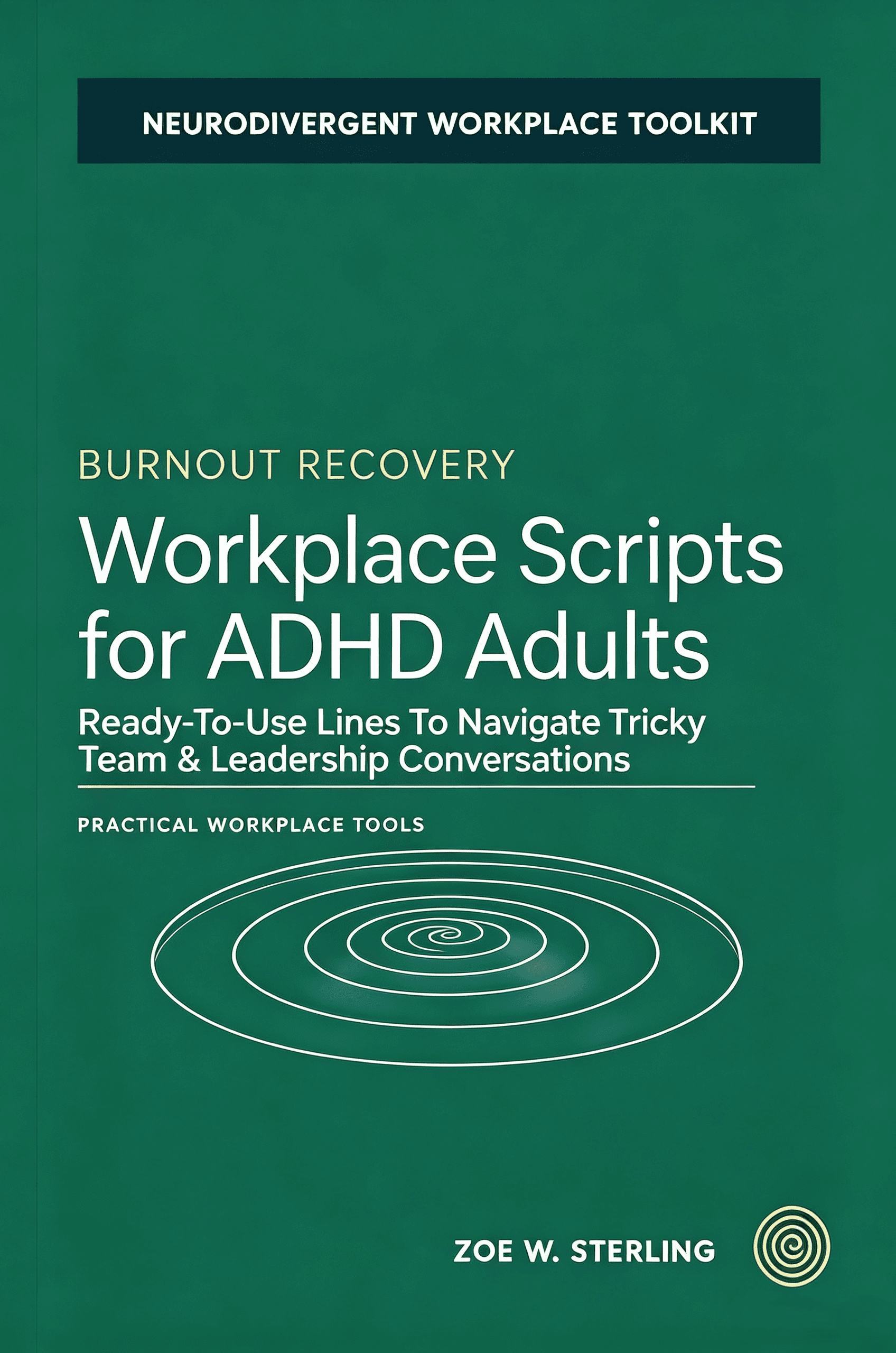
Workplace Scripts for ADHD Adults
A practical collection of workplace scripts for neurodivergent adults. From requesting accommodations to pushing back on unreasonable deadlines, these scripts help ADHD professionals communicate their needs clearly.
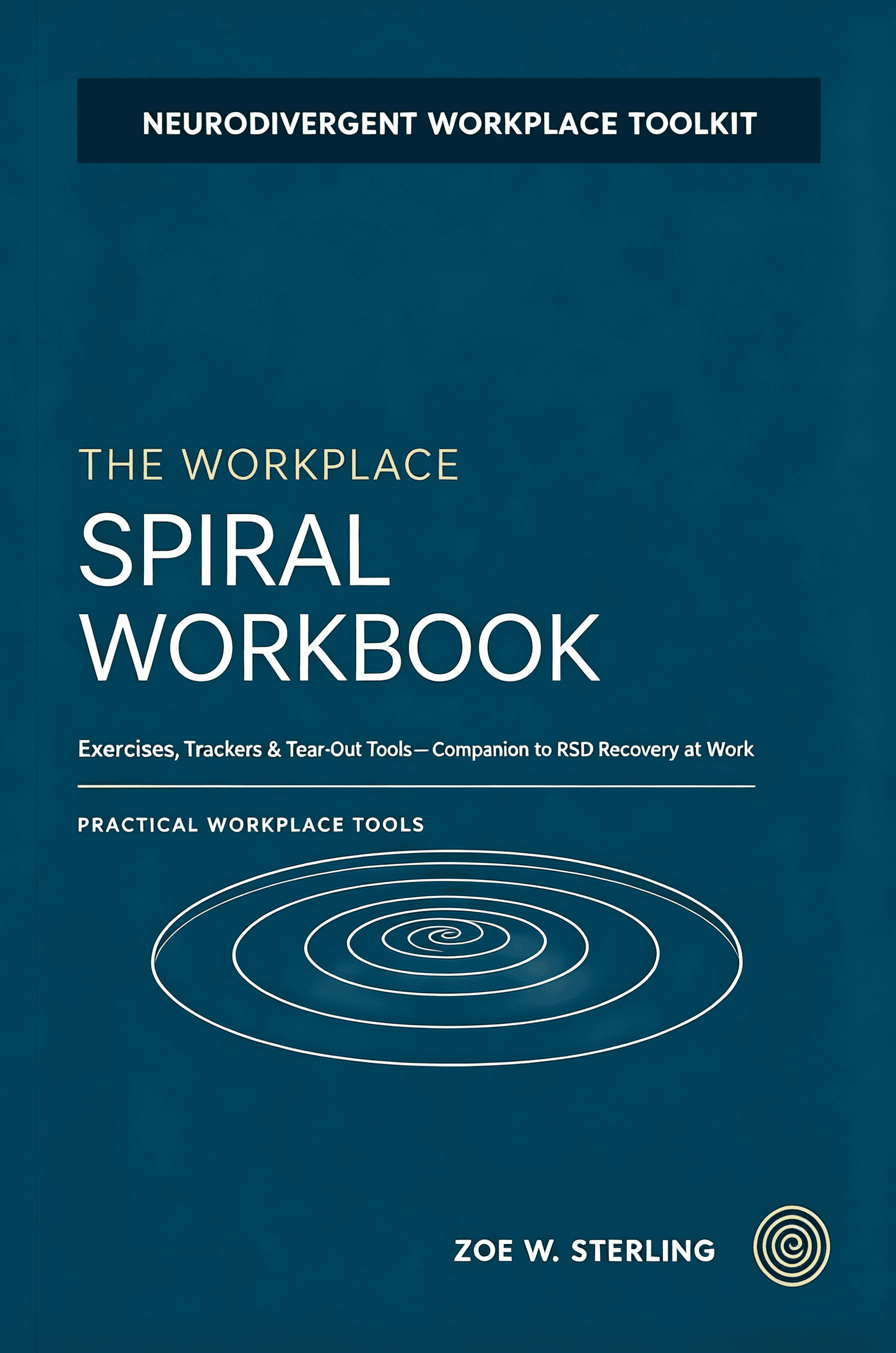
The Workplace Spiral Workbook
This interactive workbook is the companion to Zoe Sterling's Workplace Spiral assessment. Readers identify their spiral type, track their workplace patterns, and practice rewiring strategies to break free from unhealthy cycles.
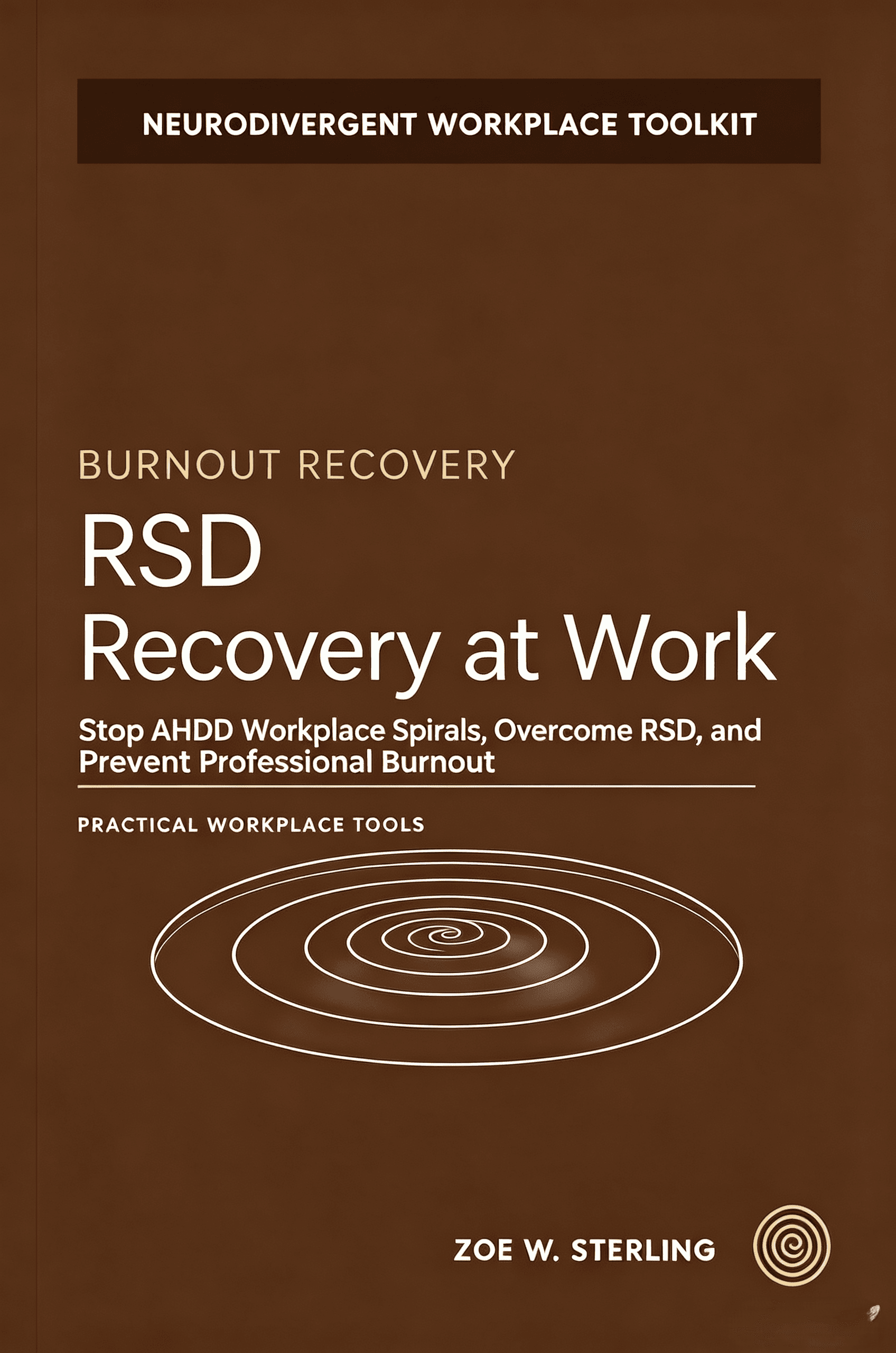
RSD Recovery at Work
A comprehensive field guide for neurodivergent adults navigating the workplace. Based on Zoe Sterling's 10+ years of ADHD workplace research and coaching, this book identifies 8 core strengths and 7 hidden workplace patterns.