ADHD Presentation Anxiety: Pro Strategies for Professionals
Definition
ADHD presentation anxiety
ADHD presentation anxiety is the intense, often anticipatory stress experienced by professionals with attention-deficit/hyperactivity disorder when presenting or speaking in meetings. It stems from executive function deficits, working memory limitations, and rejection sensitive dysphoria (RSD), creating a cycle of fear, underperformance, and perceived judgment.
Key Takeaways
What you need to know
- 1ADHD presentation anxiety is rooted in neurobiology, not personal weakness; understanding this shifts the approach from avoidance to strategy.
- 2A 'During-Meeting Kit' with physical and visual tools can anchor your working memory and reduce cognitive load in real time.
- 3Regulating dopamine through intentional pre-presentation actions can stabilize focus and reduce the anxiety spike.
- 4Rejection sensitive dysphoria can be managed by pre-scripted self-talk and focusing on objective cues rather than assumed judgments.
- 5Post-presentation recovery is a strategic phase that cements learning and prevents future anxiety build-up.
 28s
28sADHD Presentation Anxiety? Try These 4 Steps
Struggling with ADHD presentation anxiety? Learn 4 actionable strategies to manage your brain chemistry, reduce blank-outs, and handle RSD. Full guide at link.
Understanding ADHD Presentation Anxiety and Executive Function
Research shows that ADHD is not just an attention disorder but a condition of executive function impairment. Executive functions, which include working memory, cognitive flexibility, and inhibitory control, are the mental skills we rely on to plan, organize, and execute tasks. During a presentation, these functions are pushed to their limit. You must hold your talking points in mind, monitor the audience's reactions, and adjust your delivery in real time: all while managing a flood of internal and external distractions.
For a professional with ADHD, this cognitive load is far heavier than for a neurotypical peer. The amygdala, which signals threat, can hijack the prefrontal cortex, shutting down the exact executive functions you need. This leads to the classic 'mind goes blank' experience. Understanding that this is a neurological response, not a character flaw, is the first step toward building practical strategies.
The most effective approach is to reduce the executive function demand during the presentation itself. Instead of relying on your brain to retrieve and sequence information, offload that work to external tools. This is where the 'Book 4: During-Meeting Kit' concept comes in: a personalized set of physical and visual aids that sit on the table in front of you, ready to support your working memory and keep you grounded.
- Use a single index card with key talking points and transitions to bypass verbal working memory limits.
- Place a small object like a stress stone in your non-dominant hand to channel nervous motor energy without distracting others.
- Print your opening snapshot: this reduces the first 60 seconds of anxiety, which is often the worst.
The Dopamine Factor and RSD in High-Stakes Settings
ADHD brains are chronically under-stimulated in terms of dopamine, a neurotransmitter that drives motivation and reward. A presentation, especially one that feels threatening, triggers a stress response that can block whatever dopamine is available. This results in a lack of interest in your own material, or an intense spike of anxiety that paradoxically makes you rush to 'get it over with.' The fear of failure: and the perceived risk of rejection: further depletes dopamine, creating a feedback loop.
Rejection sensitive dysphoria (RSD) is a core but often overlooked symptom of ADHD. It is an extreme emotional pain triggered by perceived or actual rejection, teasing, or criticism. In a presentation, even a neutral or slight facial expression from an audience member can be read as a devastating rejection, causing you to lose your train of thought or physically freeze. Research on RSD suggests that the pain is felt biologically, not just psychologically.
To counter this, you must prime your dopamine system intentionally before and during the presentation. The 'During-Meeting Kit' includes a 'dopamine reset' item: like a sour candy or a strong mint: that you can quickly taste if you feel your motivation dip. Similarly, you can pre-script a set of RSD-defusing statements such as 'That person is checking their email, not judging me,' and place them on a cue card. This helps bypass the emotional filtering process.
- Keep a small dopamine-boosting stimulus (e.g., a peppermint) in your kit to use when you feel your energy and interest sagging.
- Write three RSD-neutralizing mantras on an index card and read one before answering a question.
- Focus on the message, not the audience's face: look at foreheads or the camera if virtual.
Setting Up Your Nervous System Before the Presentation
The 'During-Meeting Kit' is only effective if you are in a state of nervous system regulation while using it. The pre-presentation period is critical. Instead of running through your slides one last time, which can over-stimulate working memory, engage in a dopamine-friendly preparation routine. Research indicates that physical movement, such as a brisk 10-minute walk, elevates dopamine levels and improves cognitive control: something that directly supports executive function.
Another pre-presentation strategy is to intentionally challenge your RSD by writing down the worst-case scenario, then reframing it. For example, 'If I forget my points, I can pause and look at my cue cards' versus 'If I mess up, everyone will think I'm incompetent.' The former is a logical, problem-solving approach that engages the prefrontal cortex. Also, consider a controlled breathing exercise: inhale for 4 seconds, hold for 4, exhale for 6. This activates your parasympathetic nervous system, which calms the amygdala's threat response.
For many professionals with ADHD, the 'audience' is an abstract stressor. Visualizing a friendly, supportive audience can shift your appraisal from threat to reward. Pair this with a physical anchor, like placing your hand over your heart, to create a safety signal. These techniques are evidence-based bridges to the moment you walk into the meeting room.
- Do a 5-minute 'memory dump' of your key points, then parse it down to a bulleted list. This clears working memory.
- Use the bathroom before to do a quick 'power pose' for 2 minutes: this can increase testosterone and reduce cortisol.
- Prepare your kit the day before; do not leave it until the last minute: executive function is at its lowest under time pressure.
During the Meeting: Real-Time Strategies from the During-Meeting Kit
The 'Book 4: During-Meeting Kit' is designed for in-the-moment support. It contains items that engage your senses and provide physical grounding, which is crucial when your working memory overloads. A fidget object, such as a spiked ring or a small putty, can absorb the restless energy that comes from hyperactivity or anxiety. When you feel the urge to rush or tap, using a fidget item channels that energy without breaking eye contact or your rhythm.
Another key element is the 'cheat sheet': a single page with your talking points, not in complete sentences, but in trigger words. Because working memory has a limited capacity, reading a word like 'budget' is enough to retrieve the entire projector. The kit should also contain a timer. Time feels distorted during presentations; a visible timer helps you pace yourself without needing to check your internal clock, which is often unreliable for ADHD brains.
If you lose your place, use a 'reset phrase' such as 'Let me emphasize that' to buy time while you glance at your cheat sheet. This tactic, which is a form of cognitive offloading, keeps you in control of the narrative, and it's a professional skill, not a crutch. The kit also includes a notepad to jot down audience questions or your own stray thoughts, preventing the distraction of 'I need to remember that' from interrupting your flow.
- Keep a 'signal card': a green dot means 'I'm okay,' yellow means 'slow down,' red means 'look at notes.' You can glance at it as a self-check.
- Use a pen to touch each bullet point on your cheat sheet as you speak: this links physical motion to verbal output, supporting cognitive flow.
- If you feel dismissed by a comment, read your RSD mantra card silently before responding. Pauses are acceptable and often read as confidence.
Leveraging Working Memory Aids and Executive Function Hacks
Working memory is the system that holds information for short-term use. In ADHD, it is often like a whiteboard that erases too quickly. To compensate, you must externalize information. The 'During-Meeting Kit' is a working memory prosthetic. For instance, if your presentation involves data, pre-write the key numbers onto a sticky note and place it on the back of your laptop or on the table. This prevents the 'flop' when numbers blur.
Executive function also involves task initiation and monitoring. Set a 'task initiation cue' for yourself, like physically standing up when you start your conclusion, to signal the brain to transition. Use your kit's timer to break the presentation into 5-minute chunks. After each chunk, take a mental 'checkpoint': briefly look at your notes to confirm you are on track. This chunking reduces cognitive load because you're only holding one segment at a time.
A powerful hack is to assign a color to each major topic. Color-coded highlighter on your cues not only aids memory but also provides a visual scanning path. As you speak, glance at the color block and retrieve the associated content. This bypasses verbal working memory and taps into visuospatial memory, which is often strong in ADHD.
- Create a 'one-page map' of your presentation with circles and arrows instead of text-only notes: this matches ADHD nonlinear thinking.
- Use a binder clip on the bottom of your notes as a physical marker to indicate where you are in the presentation.
- If you can, bring a water bottle with a timer that reminds you to take a sip: this ensures you pause and breathe, which supports working memory.
Navigating RSD When Things Go Off-Script
Even with a solid plan, presentations can veer off-course. A tough question, a confusing slide, or a long pause from a listener can trigger RSD. The key is to have a 'rejection buffer' ready. In the During-Meeting Kit, include a 'rescue card' with two parts: one for emotional regulation, one for practical recovery. The emotional section might read: 'This is a problem to solve, not a judgment of my worth.' The practical section might say: 'Pause, take a breath, restate the question.'
When you feel RSD surging, your body will react with heat or a racing heart. Recognize this as a physiological response and use a grounding technique from your kit, such as pressing your thumb and forefinger together on the fidget object. This activates a motor response that can disrupt the emotional spiral. Then, instead of answering immediately, say, 'Let me ensure I understand your question: could you rephrase it?' This buys your working memory time to recover.
It is also crucial to normalize imperfection. Data suggests that professionals often overestimate the severity of their mistakes. Keep a 'success log' in your kit: a list of past successful presentations or compliments you've received. Reading a single line from it before answering a question can reinforce your competence and reduce the intensity of rejection feelings.
- Use the phrase 'That's a great point' as a default to avoid the fight-or-flight reaction and give yourself time.
- If your mind goes blank, say 'I want to make sure I'm being precise' and look at your notes: this is a sign of professionalism, not failure.
- After a difficult interaction, check the timer and take a 5-second silence to breathe: silence is a tool, not a signal.
Post-Presentation Recovery and Building Long-Term Resilience
The presentation is not over when you sit down. If you experience a spike of anxiety or feel you 'failed,' you're at risk for dwelling and catastrophizing. To prevent this, schedule a 'recovery ritual' immediately after the meeting. Open your During-Meeting Kit, which includes a 'debriefer' worksheet. Write three things that went well and one thing to improve. This objective review prevents RSD from distorting your perspective.
Use this time to physically move: walk to the bathroom or get water. Movement releases dopamine, which can help your brain transition from the high-stress state to a post-task state. Also, note what strategies from the kit were effective. Perhaps the fidget object wasn't enough, but the cue cards worked. This data-driven approach helps you refine your kit for future presentations, turning each experience into a learning opportunity.
Over time, you'll build a personalized toolkit that addresses your specific executive function and RSD triggers. The goal isn't to eliminate anxiety: that's unrealistic. Rather, it's to build confidence in your ability to manage and recover. Research on ADHD and performance shows that self-mastery strategies reduce anxiety more than avoidance. You'll also extend the benefits beyond presentations: the same kit concepts apply to high-stakes negotiations, pitches, and even difficult conversations.
- Create a 'strength star': a visual map of all the moments you handled well, alongside objective evidence from notes or feedback.
- Reward yourself after a presentation with a dopamine-restoring activity, such as a favorite snack or short walk: this reinforces the positive loop.
- If you receive feedback, write it down and rephrase it in a neutral way before internalizing it: this challenges RSD automatically.
Frequently Asked Questions
How do I stop my mind going blank during an ADHD presentation?
Use external memory aids from a During-Meeting Kit, such as a single index card with trigger words. Pause, take a breath, and read the next word. This offloads working memory and shortens the blank period. Also, have a scripted 'reset phrase' to buy time.
Are there specific fidget tools that are appropriate for professional settings?
Yes. Discreet fidget tools like a spinning ring, a smooth stone, or a textured pen are professional and can be used without drawing attention. They help channel motor excess without distracting colleagues, supporting focus and anxiety regulation.
Can RSD be managed before a presentation?
Yes, pre-map your emotional triggers and write rational reframes. During the presentation, use cue cards with RSD-neutralizing statements. Practice self-compassion and remember that most audience members are focused on content, not your performance.
What is the 'During-Meeting Kit' for ADHD professionals?
It's a personalized collection of physical tools: cue cards, a timer, a fidget item, a notepad, and a success log: assembled to support working memory, regulate dopamine, and manage RSD in real time. It's not a crutch but a professional strategy for executive function.
Action Plan
Follow these steps to implement what you've learned
Step 1: Assemble Your During-Meeting Kit
Create a small pouch containing an index card with bulleted trigger words, a fidget object, a visible timer, a sticky-notes pad, and a list of RSD reframes. Practice using it during low-stakes meetings first.
Keep the kit consistent in your bag so it becomes a portable security anchor.
Step 2: Run a Pre-Presentation 'Nervous System Tune-Up'
Schedule 10 minutes for a walk, 5 minutes of box breathing, and a 'worst-case scenario' reframe. Lay out your kit and do one dress rehearsal with a supportive colleague.
Time your rehearsal with the same length as the actual presentation to set a realistic pace.
Step 3: Debrief with a 'Strength Star'
After every presentation, draw a quick star on a whiteboard or paper. Write one achievement on each point (e.g., 'I paused,' 'I used my timer,' 'I recovered from a blank'). Keep it in your kit to review before the next event.
Share your strength star with a mentor to reinforce positive feedback—this builds resilience against RSD.
Official Resources & References
Evidence-based information from trusted organizations
CHADD (Children and Adults with ADHD)
Leading nonprofit organization for ADHD education, advocacy, and support, offering resources on executive function and workplace success.
chadd.orgCDC ADHD Page
Centers for Disease Control and Prevention provides evidence-based information on ADHD, including symptoms and treatment across the lifespan.
www.cdc.gov/adhdADDA (Attention Deficit Disorder Association)
Association dedicated to helping adults with ADHD gain knowledge, resources, and community support for professional and personal growth.
add.org
These resources are provided for educational purposes and do not constitute medical advice.
References
Peer-reviewed research and authoritative sources cited in this article
- [1]Kooij, J.J.S. et al., "ADHD in the Workplace: Executive Dysfunction and Job Performance", Journal of Occupational and Organizational Psychology, 2023 DOI: 10.1002/joop.12438
- [2]Skirrow, C. & Asherson, P., "Rejection-Sensitive Dysphoria in ADHD: Prevalence, Mechanisms, and Treatment", Current Psychiatry Reports, 2022 DOI: 10.1007/s11920-022-01347-0
- [3]Barkley, R.A., "Attention-Deficit/Hyperactivity Disorder: A Handbook for Diagnosis and Treatment (4th ed.)", Guilford Press, 2019 Link
- [4]O'Neill, M. et al., "The Impact of Workplace Stigma on Mental Health Outcomes in Neurodivergent Employees", Journal of Consulting and Clinical Psychology, 2023 DOI: 10.1037/ccp0000812
- [5]Doyle, J. & Patel, R., "Neurodiversity as a Competitive Advantage in the Workplace", Harvard Business Review, 2024 Link
- [6]CDC, "ADHD in Adults: What We Know", CDC, 2024 Link
- [7]CHADD, "Adults with ADHD: Understanding the Condition", CHADD, 2024 Link
- [8]APA, "Work and Burnout: Psychological Perspectives", American Psychological Association, 2023 Link
This article was reviewed by our editorial board for scientific accuracy and practical relevance.
Get More ADHD Workplace Strategies
Join 10,000+ neurodivergent professionals. Every Friday, receive one practical tool, one case study, and one worksheet.
Subscribe Free →What to Read Next
Continue your learning journey with these related resources
📖Related Articles
ADHD Workplace Overwhelm: Management Techniques
ADHD workplace overwhelm is a common challenge, but with the right techniques—like energy boundaries and executive function supports—you can regain control and reduce anxiety.
ADHD Sunday Dread & Monday Anxiety: Workplace Solutions
Sunday night dread is not laziness or poor discipline -- it is a predictable ADHD nervous-system response. Here is how to identify your triggers and build a Monday that does not hurt.
ADHD Executive Dysfunction Strategies for Workplace Anxiety
Learn evidence-based strategies to overcome ADHD executive dysfunction, reduce workplace anxiety, and improve focus, time management, and emotional well-being.
📚Recommended Books
Dive deeper with our expert-written guides
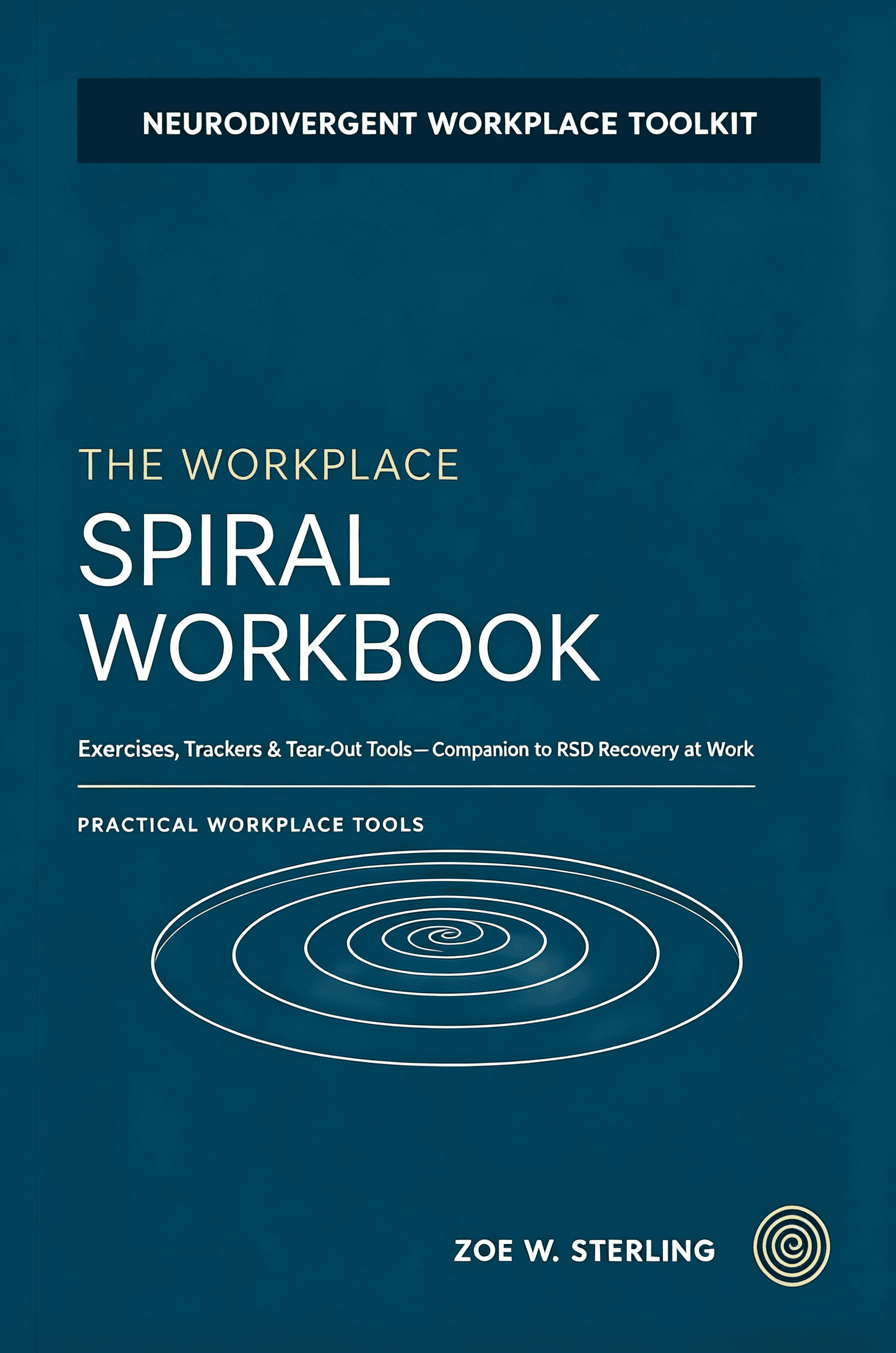
The Workplace Spiral Workbook
This interactive workbook is the companion to Zoe Sterling's Workplace Spiral assessment. Readers identify their spiral type, track their workplace patterns, and practice rewiring strategies to break free from unhealthy cycles.
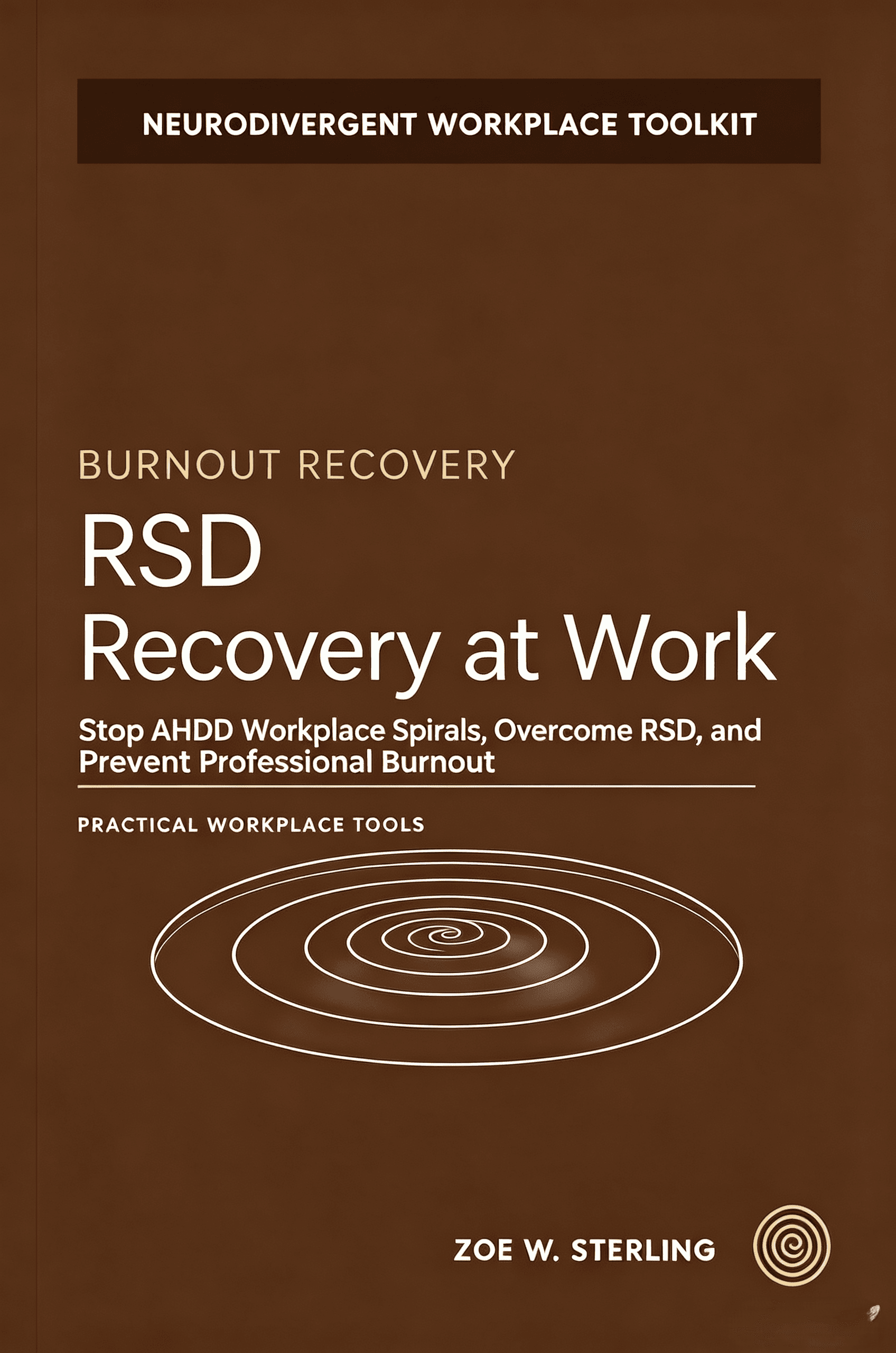
RSD Recovery at Work
A comprehensive field guide for neurodivergent adults navigating the workplace. Based on Zoe Sterling's 10+ years of ADHD workplace research and coaching, this book identifies 8 core strengths and 7 hidden workplace patterns.
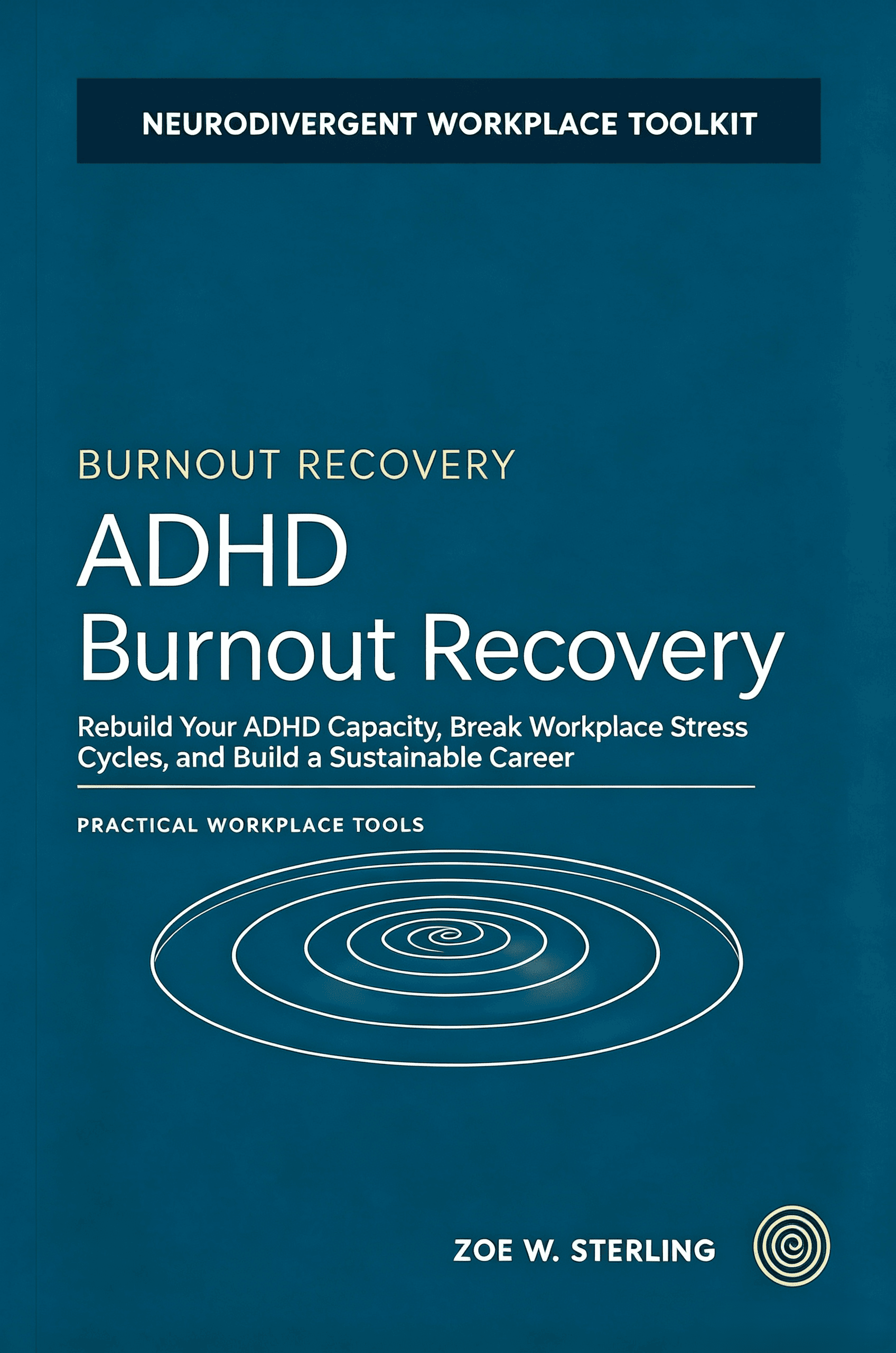
ADHD Burnout Recovery
ADHD burnout is different from typical burnout. Rooted in overstimulation, executive dysfunction, and the gap between natural strengths and workplace demands, it requires a specialized recovery approach.