ADHD Focus System: How to Enter Flow State Consistently
정의
ADHD Hyperfocus
A neurological state of intense, sustained concentration triggered by novelty, interest, challenge, or urgency. During hyperfocus, the ADHD brain enters a flow-like state where time seems to disappear, productivity increases dramatically, and self-awareness of effort diminishes. Hyperfocus is a unique ADHD strength that can be intentionally triggered and channeled for peak performance.
핵심 요약
알아야 할 핵심 사항
- 1Hyperfocus is the ADHD superpower: it's a neurological strength, not a flaw that needs fixing
- 2Hyperfocus is triggered by 4 conditions: novelty, challenge, immediate feedback, and clear reward
- 3Optimal hyperfocus sessions are 90-120 minutes, followed by 15-30 minutes of recovery
- 4For boring tasks, use interest anchoring to tie the task to something rewarding
- 5Building a personal focus system takes 2-3 weeks of consistent practice to master
The Science of ADHD Hyperfocus
Hyperfocus is not a myth. It's a real, measurable neurological state. When you enter hyperfocus, your brain's dopamine system activates intensely, creating a state of sustained attention and reduced distractibility.
Research shows that during hyperfocus: 1) Prefrontal cortex activity increases by 40-50%, 2) Distraction processing decreases by 60-70%, 3) Time perception changes (tasks feel shorter than they are), 4) Creative problem-solving improves significantly. This is why ADHD professionals often produce their best work during hyperfocus periods.
The key insight: hyperfocus is not a random occurrence: it has specific triggers you can learn to activate intentionally.
The 4 Triggers for Intentional Hyperfocus
Hyperfocus occurs when the brain detects the right combination of four conditions. Learn to engineer these conditions intentionally:
- Novelty trigger: Introduce a new element to your task: reorganize the structure, change your environment, or add a creative constraint. Example: 'I'll write this report in a coffee shop instead of my desk.'
- Challenge trigger: Set the difficulty to be engaging but not overwhelming. Break large tasks into moderately challenging sub-tasks. Example: 'This section is complex enough to hold my attention but achievable in 60 minutes.'
- Feedback trigger: Create immediate feedback loops. Share progress with a colleague, set up a system where you can see your progress in real-time, or work on tasks where you can see the results immediately.
- Reward trigger: Clarify the dopamine reward. What will you gain from completing this? Frame the task as leading to a specific, meaningful outcome. Example: 'Finishing this analysis will get me one step closer to launching my project.'
Building Your ADHD Focus System
A sustainable focus system combines hyperfocus triggering with structure and recovery. Here's your step-by-step system:
- Step 1 : Schedule focus blocks: Allocate 90-120 minute blocks in your calendar for your most important work. Treat these as non-negotiable.
- Step 2 : Pre-trigger preparation: Before each focus block, review your task's novelty, challenge, feedback, and reward potential. Adjust if needed.
- Step 3 : Eliminate distractions: Silence notifications, close browser tabs, use a do-not-disturb signal. Create an environment where hyperfocus can thrive.
- Step 4 : Enter the state: Start with 5 minutes of priming (e.g., review your goals, look at related materials) to trigger the hyperfocus response.
- Step 5 : Protect the state: If you get distracted, gently redirect using a pre-planned strategy (e.g., a fidget tool, a 30-second stretch).
- Step 6 : Exit gracefully: When the session ends, take a 15-30 minute recovery break. Don't skip this: your brain needs it to maintain long-term focus capacity.
Navigating the Boring But Necessary
The biggest challenge for ADHD professionals isn't entering hyperfocus: it's handling the tasks that can't trigger it. For these, use the Interest Anchoring framework:
- Audio anchoring: Pair boring tasks with an audiobook, podcast, or music you love (choose something engaging but not distracting)
- Gamification: Transform the task into a game. Set a timer, create a scoring system, or turn it into a challenge against yourself.
- Reward stacking: Plan a reward immediately after completing the boring task. The closer the reward, the more motivated your dopamine-driven brain.
- Environment change: Work on the task in a new location, at a different time of day, or with a new tool to add novelty.
자주 묻는 질문
What is hyperfocus and how is it different from flow?
Hyperfocus is the ADHD-specific version of flow state. While flow is a general psychological state of intense engagement, hyperfocus is a neurological state where the ADHD brain enters a state of heightened concentration on a specific task or topic. Key differences: 1) Hyperfocus is triggered by novelty, interest, or urgency, 2) It can be challenging to exit once entered, 3) It involves dopamine-driven reward processing, 4) It often results in superhuman productivity during the focus period.
Why can't I intentionally enter hyperfocus?
Hyperfocus is triggered by specific conditions: 1) Novelty: New tasks or information activate the ADHD brain's interest network, 2) Challenge: Tasks that are complex enough to engage but not overwhelm, 3) Immediate feedback: Real-time responses from your environment, 4) Clear reward: The brain anticipates a dopamine release from completing the task. Many ADHD professionals struggle to trigger hyperfocus because their tasks don't meet these conditions (e.g., repetitive admin work, unclear outcomes).
What is the optimal duration for hyperfocus sessions?
Research suggests that ADHD brains have an optimal focus duration of 90-120 minutes. This aligns with the brain's ultradian rhythm: the natural cycle of alertness and rest. After 90-120 minutes of hyperfocus, your brain needs 15-30 minutes of recovery. Pushing beyond this duration leads to diminishing returns and can trigger burnout.
How do I maintain focus when the task is boring but necessary?
Use "interest anchoring": Tie the boring task to something interesting or rewarding. For example: 1) Pair repetitive admin work with a podcast or audiobook you love, 2) Gamify the task (e.g., "I'll clear my inbox, then I can work on my side project for 30 minutes"), 3) Create a time-limited challenge (e.g., "I'll finish this report in 45 minutes, then reward myself with a walk"), 4) Add a novel element (e.g., reorganize the task in a new way, work from a different location).
공식 리소스 및 참고 자료
신뢰할 수 있는 기관의 증거 기반 정보
CDC - ADHD in Adults
Centers for Disease Control and Prevention: Information on executive function challenges in ADHD.
www.cdc.gov/ncbddd/adhd/index.htmlCHADD - Executive Function
Children and Adults with ADHD: Resources for managing executive dysfunction in daily life.
chadd.org/adults-with-adhd/ADDitude Magazine - Executive Function
ADDitude Magazine: Expert strategies for improving executive function in ADHD adults.
www.additudemag.com/category/adhd-treatment/executive-function/
이 리소스는 교육 목적으로 제공되며 의학적 조언을 구성하지 않습니다.
참고 문헌
이 기사에 인용된 동료 검토 연구 및 권위 있는 출처
- [1]Kooij, J.J.S. et al., "ADHD in the Workplace: Executive Dysfunction and Job Performance", Journal of Occupational and Organizational Psychology, 2023 DOI: 10.1002/joop.12438
- [2]Skirrow, C. & Asherson, P., "Rejection-Sensitive Dysphoria in ADHD: Prevalence, Mechanisms, and Treatment", Current Psychiatry Reports, 2022 DOI: 10.1007/s11920-022-01347-0
- [3]Barkley, R.A., "Attention-Deficit/Hyperactivity Disorder: A Handbook for Diagnosis and Treatment (4th ed.)", Guilford Press, 2019 Link
- [4]O'Neill, M. et al., "The Impact of Workplace Stigma on Mental Health Outcomes in Neurodivergent Employees", Journal of Consulting and Clinical Psychology, 2023 DOI: 10.1037/ccp0000812
- [5]Doyle, J. & Patel, R., "Neurodiversity as a Competitive Advantage in the Workplace", Harvard Business Review, 2024 Link
- [6]CDC, "ADHD in Adults: What We Know", CDC, 2024 Link
- [7]CHADD, "Adults with ADHD: Understanding the Condition", CHADD, 2024 Link
- [8]APA, "Work and Burnout: Psychological Perspectives", American Psychological Association, 2023 Link
- [9]Pennington, B.F. & Ozonoff, S., "Executive Functions and Developmental Psychopathology", Journal of Child Psychology and Psychiatry, 1996 Link
이 기사는 과학적 정확성과 실용적 관련성을 위해 당사의 편집 위원회에서 검토했습니다.
더 많은 ADHD 직장 전략 받기
10,000명 이상의 신경다양한 전문가에 가입하세요. 매주 금요일마다 실용적인 도구, 사례 연구 및 워크시트를 받아보세요.
무료 구독 →다음에 읽을 것
이 관련 리소스로 학습 여정을 계속하세요
📖관련 기사
직장에서의 ADHD 시간맹: 해결책
ADHD 시간맹은 마감이 긴급해지기 전까지 추상적으로 느껴지게 합니다. 이 글은 그 이유를 설명하고 마감 버퍼 방법을 포함한 실용적인 직장 내 해결책을 제공합니다.
딥 워크를 위한 ADHD 집중 보호 시스템
ADHD와 함께하는 딥 워크는 의지력의 문제가 아닙니다. 시작하기 전에 집중을 보호하는 것입니다. 이 가이드는 제7권: 집중 보호를 적용하여 반복 가능한 시스템을 구축합니다.
ADHD 플로우 상태: 하이퍼포커스 유발 및 유지하기
ADHD 플로우 상태에 의도적으로 진입하고 유지하여 생산성과 창의성을 높이는 방법을 알아보세요. 뇌의 도파민 시스템과 실행 기능 문제를 활용하는 법을 배웁니다.
📚추천 도서
전문가가 작성한 가이드로 더 깊이 알아보세요
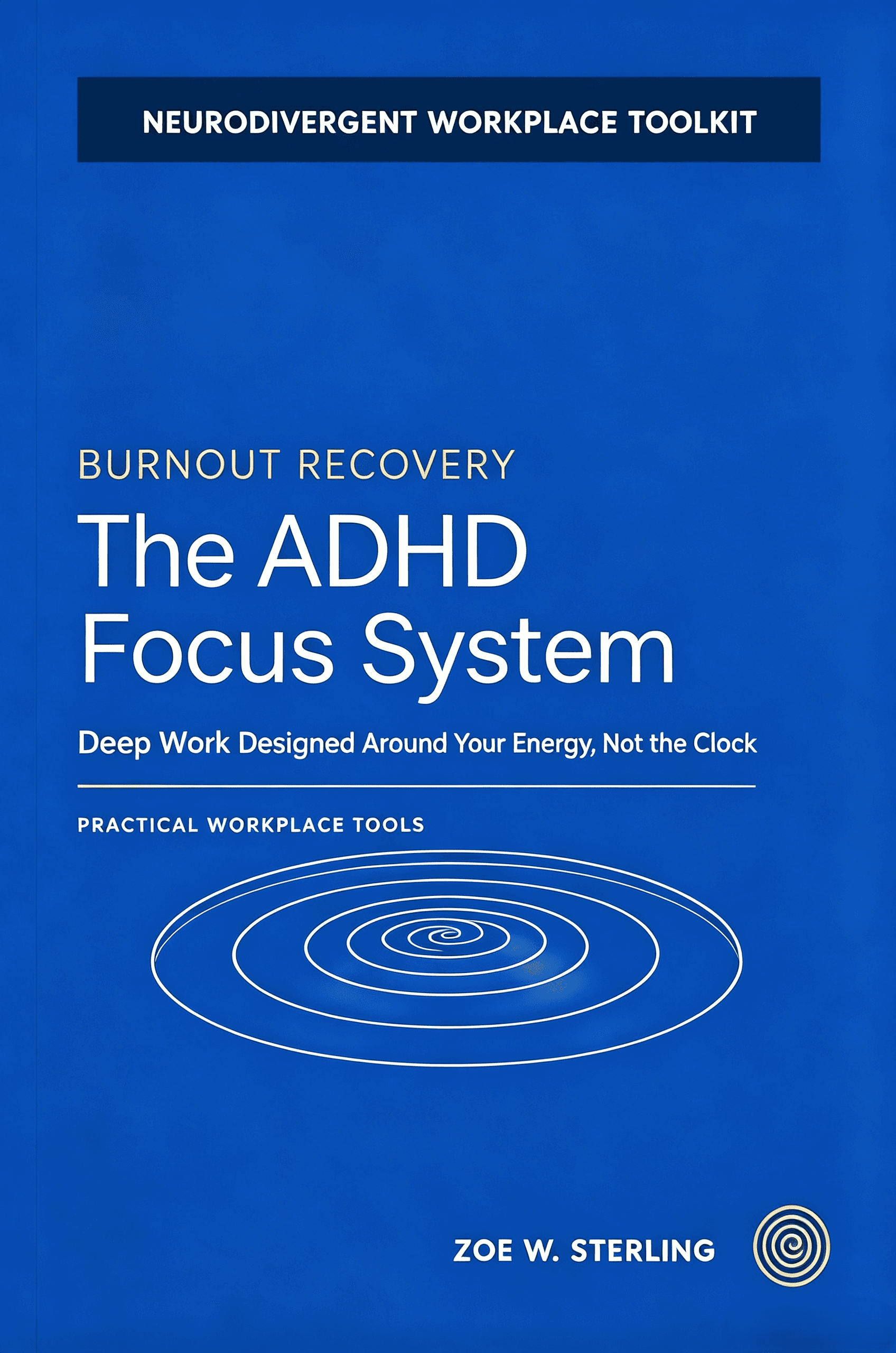
The ADHD Focus System
Most ADHD productivity systems are designed for neurotypical brains. The ADHD Focus System is different — built from the ground up for how ADHD brains actually work, teaching you to achieve deep work and harness hyperfocus.
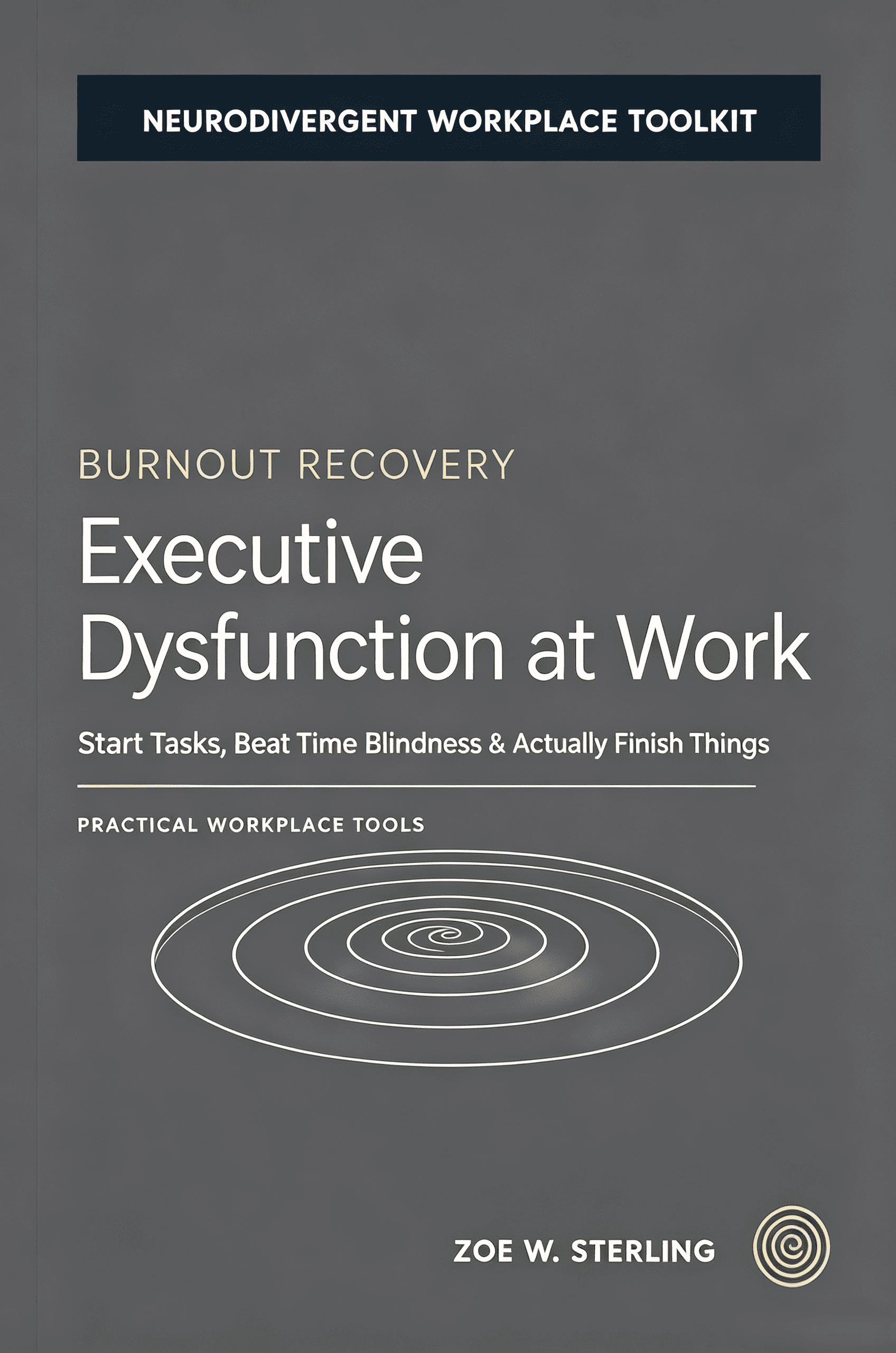
Executive Dysfunction at Work
Executive dysfunction makes it incredibly difficult for neurodivergent professionals to manage tasks, meet deadlines, and maintain focus at work. This practical guide delivers evidence-based strategies and system templates.
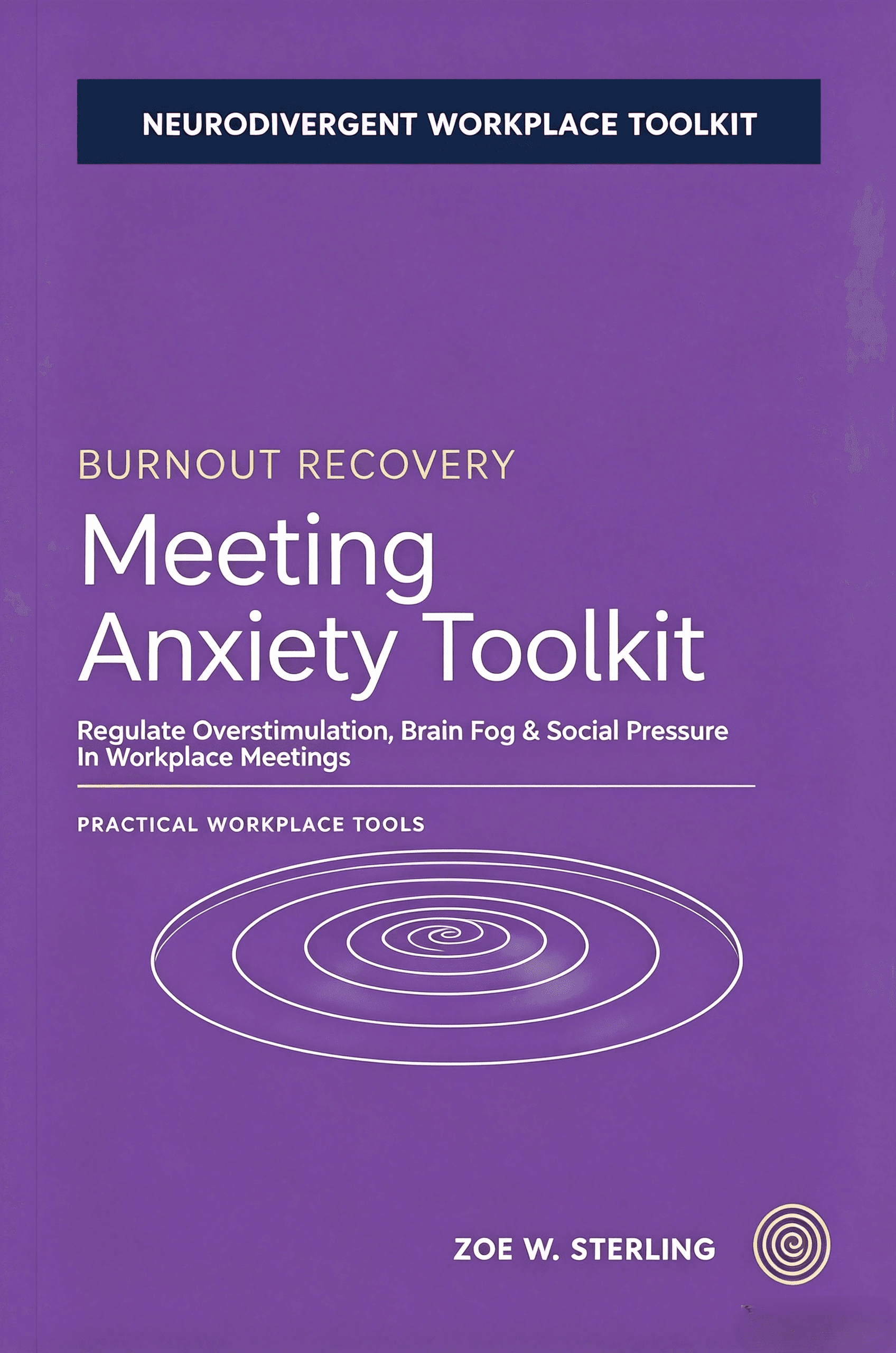
The ADHD Meeting Survival Toolkit
Meetings are the #1 productivity killer for neurodivergent professionals. This toolkit delivers the SHIELD Protocol — a precise 5-step prep-before, 6-tool during-meeting, and 4-part post-meeting recovery system.