定義
Workplace Boundary for ADHD
A clear, communicated guideline that protects an ADHD professional's energy, focus, and mental health. Boundaries define what you will and won't do, when you're available, and how you can best support the team. For ADHD professionals, boundaries are not optional—they are essential for preventing burnout and sustaining peak performance.
核心要點
你需要了解的要点
- 1ADHD professionals struggle with boundaries due to RSD, people-pleasing, and executive dysfunction
- 2The RSV framework (Relate, Support, Value) helps you say no without triggering RSD
- 3Boundaries protect your most limited resource: energy, not time
- 4Written boundaries (email, shared doc) are more effective than verbal agreements
- 5Consistency matters more than perfection: your boundaries will strengthen over time
Why Boundaries Are Critical for ADHD Professionals
If you have ADHD, you have a limited energy budget each day. Every time you say yes when you mean no, you're drawing down that budget without replenishing it. Over time, this creates a deficit that leads to burnout.
ADHD professionals face unique challenges with boundary-setting: 1) RSD makes saying no feel like rejecting the other person, 2) People-pleasing becomes a compensation strategy for feeling 'inadequate,' 3) Executive dysfunction makes it hard to prioritize requests effectively. Understanding these barriers is the first step to overcoming them.
The cost of poor boundaries is significant: chronic burnout, resentment, reduced productivity, and damaged relationships. The cost of good boundaries is minimal: a brief uncomfortable conversation followed by sustained energy and focus.
The RSV Framework: Saying No Without RSD
The RSV framework is designed specifically for ADHD professionals who struggle with the RSD trigger of saying no. It reframes the conversation from rejection to collaboration:
- Relate: Start with empathy. "I understand this project is a priority and I want to make sure we do it right."
- Support: Offer an alternative or a path forward. "Instead of taking this on now, let me suggest we break it into two phases: I can handle Phase 1 this week, and we can schedule Phase 2 for next week when I have more bandwidth."
- Value: Connect your boundary to team success. "My goal is to make sure I can give this the attention it deserves and produce work that reflects well on the whole team."
6 Types of Workplace Boundaries Every ADHD Professional Needs
These six boundaries address the most common energy drains for ADHD professionals:
- Time boundaries: Define your working hours and communicate when you're available vs. in deep focus mode
- Meeting boundaries: Set limits on meeting frequency, duration, and purpose. Request async alternatives when possible
- Communication boundaries: Specify preferred communication channels and response times (e.g., 'Email for non-urgent, chat for quick questions, phone only for emergencies')
- Task boundaries: Clarify what tasks are in vs. out of your scope. Learn to say 'That's outside my current responsibilities, but I can connect you with the right person.'
- Feedback boundaries: Request written feedback first, one issue at a time, and a 24-hour window for processing
- Energy boundaries: Protect your recovery time: no work after hours, no weekend responses, minimum 30-minute buffer between meetings
Maintaining Boundaries When People Push Back
Even with clear boundaries, some people will push back. Here's how to handle common scenarios:
- The urgent request: 'I understand this feels urgent. Let me check my priorities and get back to you in 15 minutes with a realistic timeline.'
- The guilt trip: 'I appreciate that you're counting on me. Let's talk about what I can commit to without sacrificing my other responsibilities.'
- The boundary violation: 'I noticed this request came in after our agreed response time. Let me suggest we set up a better system for future urgent items.'
- The pushback from a manager: 'I want to be transparent about my capacity. Here's what I'm currently working on, and here's what I'd need to shift to take this on.'
常見問題
Why do ADHD professionals struggle with boundaries?
ADHD professionals struggle with boundaries for three main reasons: 1) RSD (Rejection-Sensitive Dysphoria): Saying no can trigger fear of disappointing others, 2) People-pleasing tendency: Many ADHD professionals develop over-helping as a compensation strategy for feeling 'not good enough,' 3) Difficulty prioritizing: Executive dysfunction makes it hard to distinguish between urgent and important requests, leading to overcommitment.
What are the signs I need stronger boundaries?
Key signs: 1) You're constantly overloaded and feel like you're running on empty, 2) You say yes to requests and then feel resentful, 3) You have trouble saying no even to low-priority requests, 4) You're always the one people come to for help, 5) Your personal life suffers because work always takes priority, 6) You experience burnout symptoms (fatigue, irritability, reduced productivity).
How do I say no without triggering RSD?
Use the "RSV" framework (Relate, Support, Value): 1) Relate: "I understand this is important and I want to help." 2) Support: "Let me suggest an alternative approach that might work better." 3) Value: "Your success matters to me, and I want to make sure I can give this my best attention when I're available." This frames the "no" as a commitment to quality, not a rejection.
How do I maintain boundaries once I've set them?
Consistency is key. Strategies: 1) Put boundaries in writing (email, shared doc) so they're not just verbal, 2) Use calendar blocking to visually represent your availability, 3) Have pre-planned responses for common boundary violations, 4) Check in monthly to assess if your boundaries are holding, 5) Address violations immediately and respectfully (don't let them accumulate).
官方資源與參考資料
來自可信組織的循證資訊
CHADD - Workplace Communication
Children and Adults with ADHD: Resources for improving workplace communication skills.
chadd.org/adults-with-adhd/ADA.gov - Reasonable Accommodations
Americans with Disabilities Act: Your rights to communication-related workplace accommodations.
www.ada.gov/reasonable-accommodations/JAN - Workplace Accommodations
Job Accommodation Network: Free, expert guidance on workplace accommodations for ADHD.
askjan.org/
這些資源僅供教育目的提供,不構成醫療建議。
参考文献
本文引用的同行评审研究与权威来源
- [1]Kooij, J.J.S. et al., "ADHD in the Workplace: Executive Dysfunction and Job Performance", Journal of Occupational and Organizational Psychology, 2023 DOI: 10.1002/joop.12438
- [2]Skirrow, C. & Asherson, P., "Rejection-Sensitive Dysphoria in ADHD: Prevalence, Mechanisms, and Treatment", Current Psychiatry Reports, 2022 DOI: 10.1007/s11920-022-01347-0
- [3]Barkley, R.A., "Attention-Deficit/Hyperactivity Disorder: A Handbook for Diagnosis and Treatment (4th ed.)", Guilford Press, 2019 Link
- [4]O'Neill, M. et al., "The Impact of Workplace Stigma on Mental Health Outcomes in Neurodivergent Employees", Journal of Consulting and Clinical Psychology, 2023 DOI: 10.1037/ccp0000812
- [5]Doyle, J. & Patel, R., "Neurodiversity as a Competitive Advantage in the Workplace", Harvard Business Review, 2024 Link
- [6]CDC, "ADHD in Adults: What We Know", CDC, 2024 Link
- [7]CHADD, "Adults with ADHD: Understanding the Condition", CHADD, 2024 Link
- [8]APA, "Work and Burnout: Psychological Perspectives", American Psychological Association, 2023 Link
- [9]Pennebaker, J.W., "Opening Up: The Healing Power of Expressing Emotions", Guilford Press, 1997 Link
本文由我們的編輯委員會審閱,以確保科學準確性與實用性。
獲取更多 ADHD 職場策略
加入超過 10,000 位神經多樣性專業人士。每週五收到一個實用工具、一個案例研究和一個工作紙。
免費訂閱 →下一步閱讀
繼續您的學習之旅
📖相關文章
職場中的ADHD過度解釋:簡潔溝通
職場中的ADHD過度解釋通常源於執行功能差異、工作記憶缺口和拒絕敏感焦慮症——而非缺乏專業素養。本指南提供具體的腳本和框架,幫助你簡潔溝通,同時不掩蓋你的神經多樣性優勢。
ADHD 職場自我倡導腳本:助你成功
透過以證據為基礎、專為真實對話設計的自我倡導腳本,將你的 ADHD 挑戰轉化為清晰、自信的職場請求。
ADHD 會前準備協議:保持專注的 5 個步驟
學習一個實用、以證據為基礎的 5 步驟會前協議,專為 ADHD 大腦設計,以改善執行功能和溝通。
📚推薦書籍
深入閱讀我們專家撰寫的指南
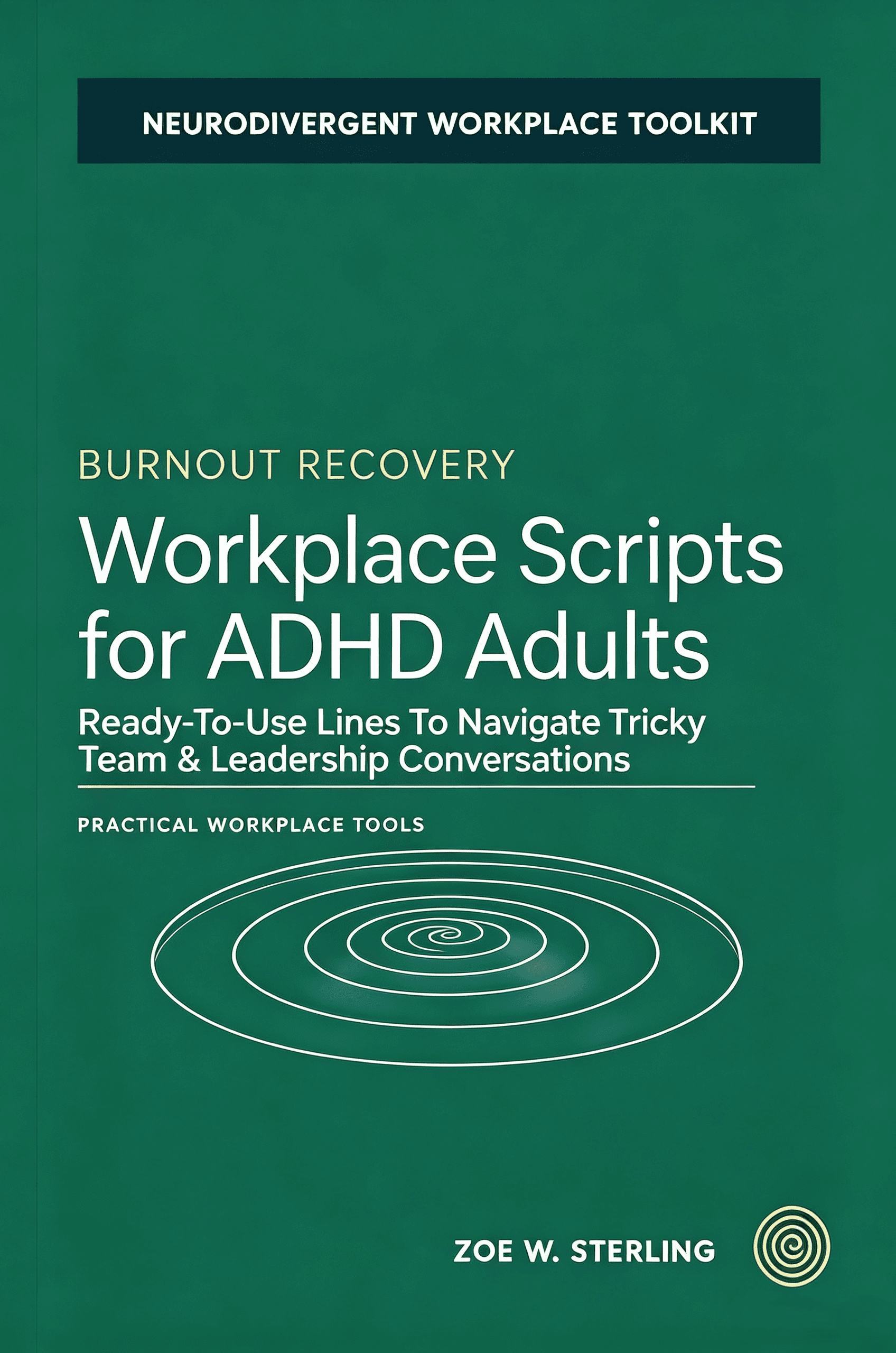
Workplace Scripts for ADHD Adults
A practical collection of workplace scripts for neurodivergent adults. From requesting accommodations to pushing back on unreasonable deadlines, these scripts help ADHD professionals communicate their needs clearly.
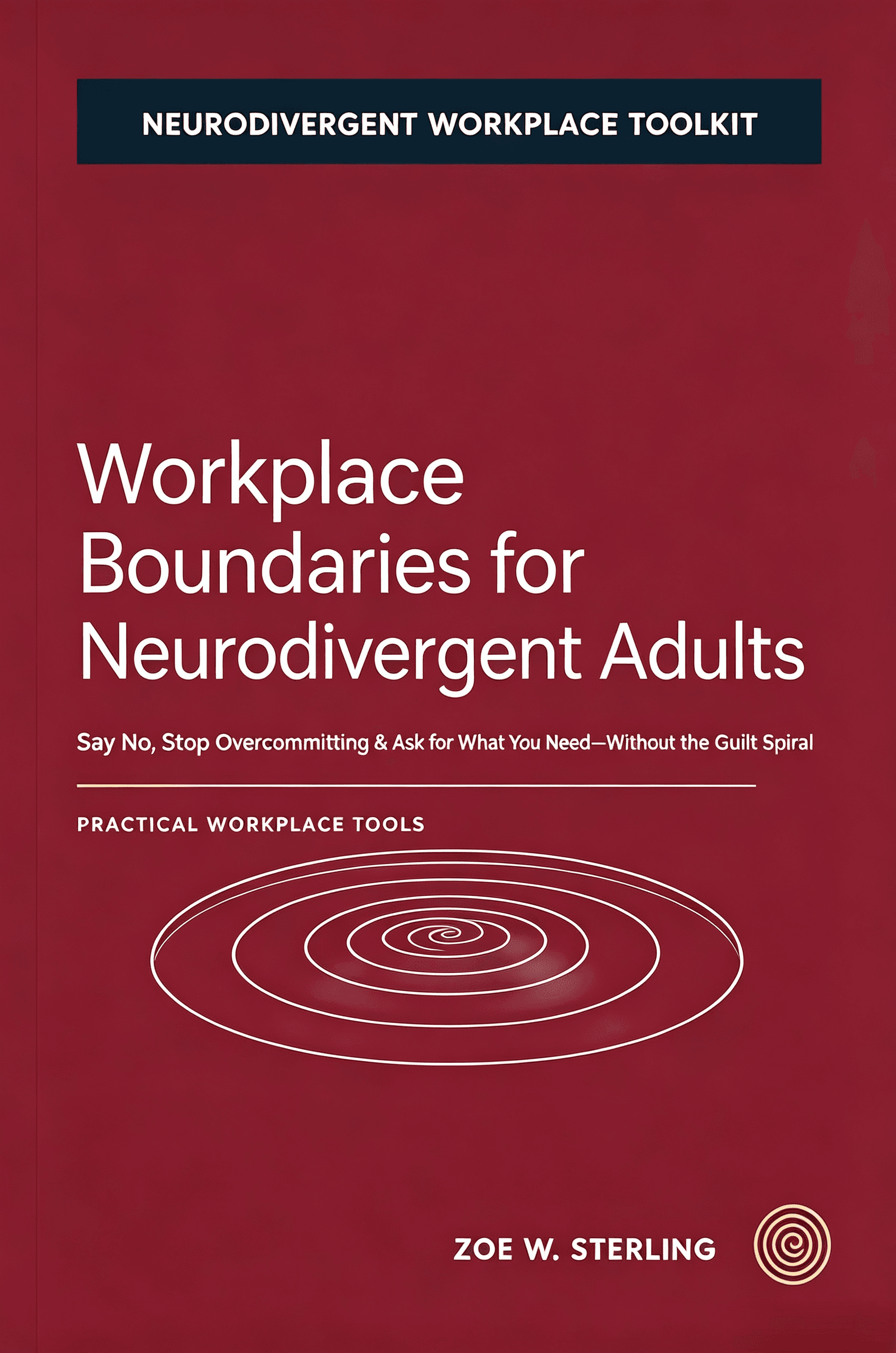
Workplace Boundaries for Neurodivergent Adults
Setting boundaries is critical for all professionals, but especially for neurodivergent adults who are more susceptible to overstimulation, RSD triggers, and energy depletion. This book provides practical strategies and scripts.
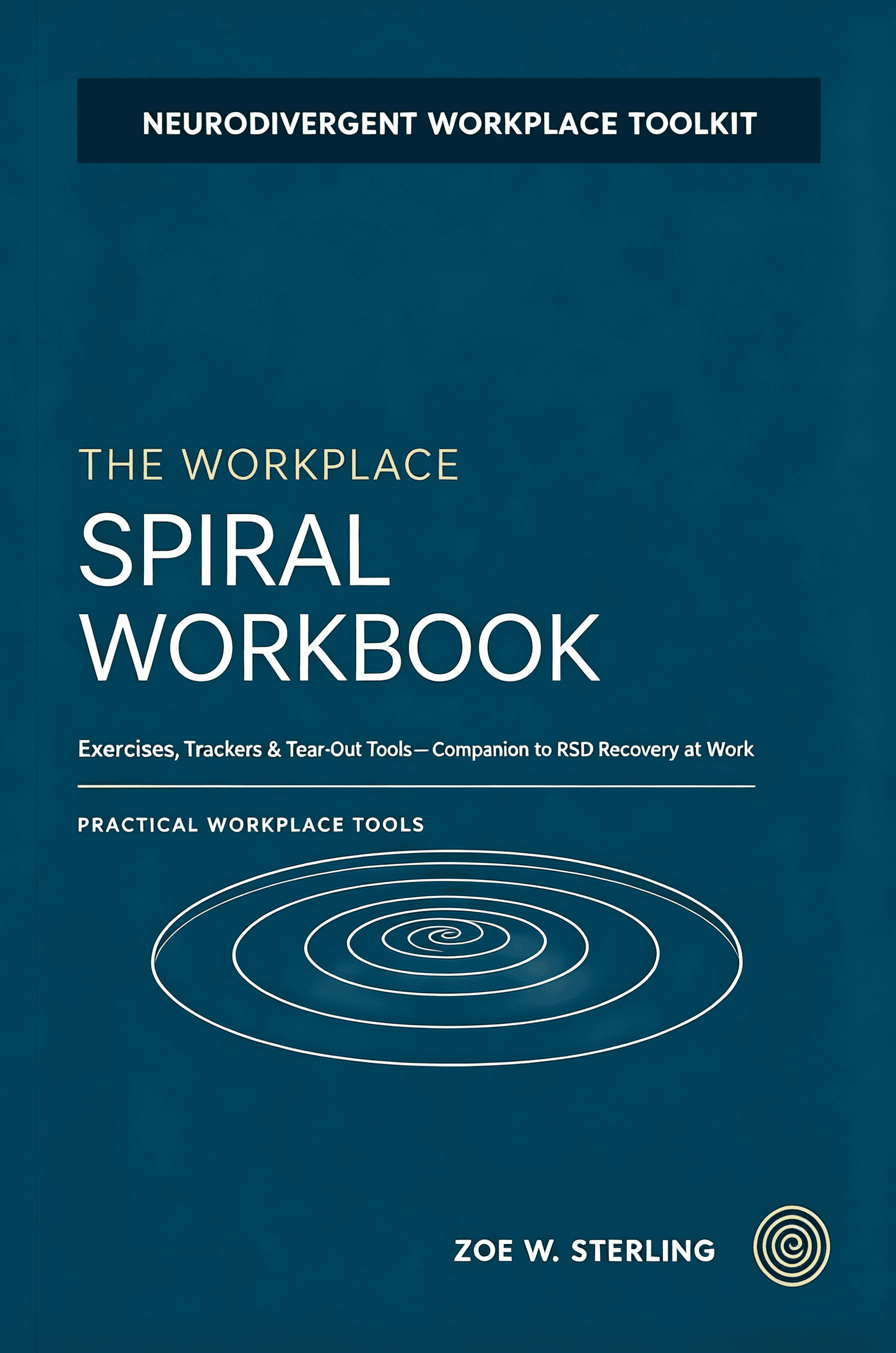
The Workplace Spiral Workbook
This interactive workbook is the companion to Zoe Sterling's Workplace Spiral assessment. Readers identify their spiral type, track their workplace patterns, and practice rewiring strategies to break free from unhealthy cycles.