Definition
12-week ADHD burnout recovery protocol
A structured, evidence-informed recovery framework for adults with ADHD who are experiencing burnout. It combines cognitive behavioral approaches, executive function rehabilitation, dopamine management, and progressive energy restoration across three 4-week phases: stabilize, restore, and rebuild.
Key Takeaways
Was Sie wissen müssen
- 1ADHD burnout is a distinct neurological state driven by chronic executive function overload and dopamine depletion: not a personal failure.
- 2Recovery requires a phased protocol: first stabilizing your nervous system, then restoring energy and routines, and finally rebuilding sustainable executive function.
- 3A 12-week timeframe is effective because it allows for neuroplastic change, habit formation, and gradual dopamine re-regulation without overwhelming your working memory.
 38s
38s12-Week ADHD Burnout Recovery Protocol That Works
Struggling with ADHD burnout? This 12-week protocol rebuilds executive function and dopamine. Watch now for actionable steps. Full guide at link.
What is ADHD Burnout and Why Standard Advice Fails
Research shows that adults with ADHD experience burnout at significantly higher rates than the general population, largely because their baseline effort for everyday tasks is higher. Burnout in ADHD is not just exhaustion: it is a neurobiological crash where dopamine reserves are depleted, and the executive function system (which regulates planning, focus, inhibition, and task initiation) becomes severely impaired. Standard burnout advice like "take a vacation" or "practice self-care" often fails because it does not address ADHD-specific mechanisms like reward insufficiency, RSD (rejection sensitive dysphoria), and working memory overload.
A professional, evidence-based approach recognizes that ADHD burnout is multifaceted. The 12-week ADHD burnout recovery protocol, detailed in Book 2 of the ADHD Self-Care series, is designed around this reality. It does not ask you to white-knuckle your way to wellness; instead, it guides you through a structured, three-phase process that respects your neurobiology, rebuilds your cognitive resources, and gradually reintroduces responsibilities without triggering relapse.
This protocol is not generic advice dressed in ADHD terminology. It operationalizes proven cognitive-behavioral and executive function coaching techniques into a week-by-week plan. You will learn to map your personal energy patterns, ration dopamine-expensive tasks, and rewire your self-talk around RSD-driven perfectionism. The result is a systematic exit from burnout: one that leaves you with tools you will use for life.
- Standard burnout advice overlooks ADHD-specific dopamine and executive function deficits.
- ADHD burnout is a clinical syndrome, not a motivational failure.
- The 12-week protocol is neuroplasticity-friendly and built on phased behavioral activation.
The Three-Phase Architecture of the 12-Week Protocol
Book 2's 12-week protocol is elegantly structured into three 4-week phases: Stabilize, Restore, and Rebuild. Each phase has a clear therapeutic objective, and together they mirror the arc of successful ADHD burnout recovery. The Stabilize phase focuses on halting the downward spiral by addressing sleep, stress triggers, and the acute symptoms of dopamine depletion. You'll implement what I call 'baseline guards': non-negotiable routines for meals, sleep, and medication timing that prevent further energy leakage.
The Restore phase shifts to active recovery. This is where you begin rebuilding dopamine through graduated physical activity, creative expression, and low-stakes social connection: all timed to your circadian rhythm. You also start practicing 'single-tasking' with a timer, which is a direct attack on working memory overload. The final Rebuild phase is about sustainable reintegration. You re-enter work and relationships with a new 'executive scaffolding' system: external visual planners, body-doubling commitments, and checkpoints that reduce the cognitive load of decision-making.
What makes this protocol uniquely ADHD-friendly is its built-in flexibility. Each week includes a 'slip factor': a pre-planned 20% buffer for days when RSD or executive dysfunction hijack your best intentions. Too many recovery programs fail because they are rigid and evoke shame when you deviate. The 12-week protocol expects variability and provides explicit strategies to get back on track without losing the whole week.
- Stabilize: Reduce unexpected load and establish non-negotiable baseline habits.
- Restore: Regenerate dopamine through graded activities and attention training.
- Rebuild: Design executive function supports for real-world responsibilities.
Week-by-Week Map: Executive Function Training and Working Memory Repair
In the first two weeks, the protocol is almost behaviorally minimalist. You will log your tasks, but not change them. This 'observation with no judgment' is critical because it bypasses the shame loop that keeps RSD active. You will identify which tasks are 'dopamine orphans': tasks with no immediate reward: and which trigger working memory failures because they have too many steps. By week 3, you begin 'dopamine scheduling': you pair high-drive activities (like social media or intense hobbies) with low-drive responsibilities, but not during the same time block. Instead, you leverage the anticipation of the reward to carry you through the chore.
Weeks 5 to 8 introduce the 'executive function workout.' Each day, you choose one mental muscle: flexible thinking, working memory, or inhibitory control. For example, on working memory days, you use a 'brain dump' sheet for every task, then transfer to a master spreadsheet only in the evening. This reduces the pressure on your prefrontal cortex by using external memory. On inhibitory control days, you practice a 5-minute 'STOP' ritual before any high-impulse activity: this is shown to increase self-efficacy without triggering the all-or-nothing perfectionism that leads to burnout.
Weeks 9 to 12 are about integration. You will run a 'small-change pilot' in a real area of your life, whether that's a part-time work schedule, shared home responsibilities, or a personal project. The protocol asks you to document not just outcomes but your emotional reactions: especially RSD flares when you make mistakes. This reflection turns setbacks into data. By the end of week 12, you should have a personalized 'burnout prevention blueprint' that lists your early warning signs, your non-negotiables, and your dopamine replenishment activities.
- Week 1-2: Observe and log without self-judgment to deactivate shame.
- Week 3-4: Implement dopamine scheduling and energy peaks mapping.
- Week 5-8: Daily executive function drills focused on working memory and inhibition.
- Week 9-12: Real-world integration with RSD-aware self-review and blueprint creation.
Dopamine and Motivation: Rewiring Your Reward System Without Exhaustion
ADHD burnout is deeply tied to a dysregulated dopamine reward system. The 12-week protocol addresses this through a technique called 'dopamine micro-coupling.' Instead of trying to eliminate high-dopamine activities (which often causes immediate rebellion and relapse), you systematically pair one 'low drive' task with one 'high drive' sensory trigger: but only for 5 to 10 minutes. For instance, you might allow yourself a favorite podcast only while folding laundry. This is not a bribe; it is a conscious neurological bridge that creates new reward associations.
Another core concept is 'reward lag.' People with ADHD thrive on immediate feedback, but real-world recovery requires delayed gratification. The protocol teaches you to create artificial checkpoints: after 15 minutes of focused work, you check off a tiny visual badge on a sticky note. This triggers a small but consistent dopamine release. By week 8, you'll have trained your brain to tolerate longer lag times because you trust that the reward will come. This directly counteracts the sense of futility that makes burnout in ADHD feel permanent.
Crucially, the protocol warns against 'dopamine fasting' during the Stabilize phase. Cold-turkey removal of stimulating activities can cause a rebound crash and worsen RSD. Instead, you learn to buffer your dopamine demand: you reduce the number of high-intensity choices per day, but you do not eliminate pleasurable inputs. This is a far more sustainable and empathetic scientific approach for ADHD recovery.
- Use micro-coupling to connect low-drive tasks to high-dopamine sensory triggers.
- Build reward lag tolerance with visual micro-checkpoints.
- Avoid dopamine fasting; instead, buffer stimulation intensity and quantity.
Navigating RSD, Shame, and Executive Function Relapses
In the 12-week protocol, rejection sensitive dysphoria is recognized not as a personality flaw but as a neurological hyperreactivity that directly sabotages recovery. When a relapse happens: say, you miss a week of routines: RSD will whisper that you are hopeless. The protocol offers a counter-ritual called 'The Debrief.' Within 24 hours of any setback, you write down three facts and one interpretation. The facts are objective, neutral data. The interpretation is your emotional story. This separation weakens the shame response and prevents catastrophic thinking from derailing the entire 12 weeks.
Executive function lapses are normalized as 'resets,' not returns to square one. Because working memory alone is often overwhelmed by complex multi-step tasks, the protocol recommends physical checklists that are laminated or clearly posted. It also introduces the 'two-minute entry point': if a task feels huge, you commit to only two minutes. This bypasses the executive function paralysis and creates momentum. Empirical studies of implementation intentions suggest such 'if-then' plans can double the odds of following through: which is why the protocol embeds them into every weekly checkpoint.
Between weeks 8 and 12, you will intentionally practice making small mistakes in safe environments: like an error in a low-priority email or a forgotten non-essential meeting. This is not masochistic; it is an exposure exercise that trains your brain to tolerate imperfection without a full RSD meltdown. Over time, you become more resilient to the everyday triggers that often precipitate another burnout spiral.
- Implement 'The Debrief' to separate facts from shame-laden interpretations.
- Use 'two-minute entry points' to overcome executive function paralysis.
- Practice intentional small mistakes to desensitize RSD responses.
Sustaining Results: From 12-Week Recovery to Lifelong Prevention
The final two weeks of the protocol and the period immediately after are the highest risk for relapse. Knowing this, the 12-week plan ends with a 'maintenance taper': you repeat the first week's protocols but at 70% intensity, to prove that you can sustain your gains without full cognitive effort. This taper consolidates habits into the basal ganglia, moving them from effortful executive control to automatic routines.
You are also asked to create a 'Personal Operating Manual.' This is a one-page document that includes your personal early warning signs (e.g., irritable toward colleagues, unable to remember appointments), your 'dopamine lunchbox' (five quick, legal activities that restore your focus), and your communication scripts for setting boundaries when you feel overwhelmed. This manual is your take-home tool, and the protocol recommends reviewing it every Sunday for 10 minutes.
Finally, the protocol emphasizes the importance of 'recovery ripple effects': as you heal your own nervous system, you will naturally make better decisions about work, relationships, and health. It is not about perfection; it is about creating an environment where executive function is supported and dopamine is sensibly managed. When that environment remains intact, the 12-week protocol becomes not just a rescue plan but a lifelong operating system for flourishing with ADHD.
- Use a maintenance taper to consolidate habits at reduced intensity.
- Create a one-page Personal Operating Manual with warning signs and scripts.
- Review your blueprint weekly to prevent silent burnout recurrence.
Frequently Asked Questions
Is a 12-week ADHD burnout recovery protocol realistic for someone with severe fatigue?
Yes, because the protocol is intentionally phased. Weeks 1-4 focus exclusively on stabilizing sleep, nutrition, and stress: not on 'productive' rehabilitation. The intensity increases gradually, and every week includes a 20% buffer for high-fatigue days, so you never fall irreparably behind.
How does this protocol address ADHD-specific dopamine and RSD challenges?
It integrates dopamine scheduling and micro-coupling to gently rebuild reward pathways without triggering RSD. The protocol also includes explicit anti-shame tools like 'The Debrief' and exposure exercises that help your nervous system tolerate mistakes without collapsing into self-blame.
Can I use this 12-week protocol while taking ADHD medication?
Absolutely. In fact, Book 2 suggests that medication can be an anchor during the Stabilize phase. The protocol encourages you to work with your prescriber to ensure your medication timing supports: not undermines: your sleep, appetite, and energy cycles during each phase.
What if I miss a week or more of the 12-week ADHD burnout recovery protocol?
The protocol's design accounts for this. If you miss less than two consecutive weeks, you simply slide back to where you left off with the next week's 'slip factor' buffer. If you miss longer, you return to the previous phase's first week, because your nervous system likely needs that stabilization again.
Handlungsplan
Folgen Sie diesen Schritten, um das Gelernte umzusetzen
Schritt 1: Map Your Energy and Dopamine Landscape
For the first two weeks, keep a simple daily log of your energy, focus, mood, and task completion. Note which activities feel 'heavy' (require executive function) and which feel effortless. Do this without judgment.
Use time-stamped sticky notes instead of an app if working memory is a barrier—physical records are easier to review.
Schritt 2: Design Your Baseline Guards
Pick three non-negotiable habits to anchor your day: a fixed wake time, a 10-minute morning light exposure, and a regular dinner time. These stabilize your circadian system and dopamine fluctuations.
Start with just one of these for the first week. Over-committing is a common ADHD burnout relapse trigger.
Schritt 3: Practice Dopamine Micro-Coupling
Identify one low-drive task you avoid and one high-reward sensory trigger (a song, podcast, favorite tea). Allow yourself the trigger for 5-10 minutes only while starting the task.
The effect is stronger if you choose a different trigger each day for the first week to prevent habituation.
Schritt 4: Build Your Personal Operating Manual
After week 10, write a one-page sheet with your burnout warning signs, three behavioral scripts for saying no, and five low-effort dopamine-replenishing activities. Keep it visible.
Review it every Sunday evening. Think of it as your 'owner's manual' that helps other people understand your needs too.
Offizielle Ressourcen & Referenzen
Evidenzbasierte Informationen von vertrauenswürdigen Organisationen
CDC - ADHD in Adults
Official public health guidance on ADHD prevalence, diagnosis, and treatment in adults, including supportive strategies.
www.cdc.gov/ncbddd/adhd/index.htmlCHADD (Children and Adults with ADHD)
The leading nonprofit providing science-based information, advocacy, and support for ADHD adults and families.
chadd.org/National Institute of Mental Health (NIMH) - ADHD
Trusted research summaries on ADHD symptoms, treatments, and ongoing clinical trials.
www.nimh.nih.gov/health/topics/attention-deficit-hyperactivity-disorder-adhd
Diese Ressourcen dienen Bildungszwecken und stellen keine medizinische Beratung dar.
Referenzen
Peer-reviewed Forschung und autoritative Quellen, auf die in diesem Artikel verwiesen wird
- [1]Kooij, J.J.S. et al., "ADHD in the Workplace: Executive Dysfunction and Job Performance", Journal of Occupational and Organizational Psychology, 2023 DOI: 10.1002/joop.12438
- [2]Skirrow, C. & Asherson, P., "Rejection-Sensitive Dysphoria in ADHD: Prevalence, Mechanisms, and Treatment", Current Psychiatry Reports, 2022 DOI: 10.1007/s11920-022-01347-0
- [3]Barkley, R.A., "Attention-Deficit/Hyperactivity Disorder: A Handbook for Diagnosis and Treatment (4th ed.)", Guilford Press, 2019 Link
- [4]O'Neill, M. et al., "The Impact of Workplace Stigma on Mental Health Outcomes in Neurodivergent Employees", Journal of Consulting and Clinical Psychology, 2023 DOI: 10.1037/ccp0000812
- [5]Doyle, J. & Patel, R., "Neurodiversity as a Competitive Advantage in the Workplace", Harvard Business Review, 2024 Link
- [6]CDC, "ADHD in Adults: What We Know", CDC, 2024 Link
- [7]CHADD, "Adults with ADHD: Understanding the Condition", CHADD, 2024 Link
- [8]APA, "Work and Burnout: Psychological Perspectives", American Psychological Association, 2023 Link
- [9]Maslach, C. & Jackson, S.E., "The Measurement of Experienced Burnout", Journal of Occupational Behaviour, 1981 Link
- [10]Selye, H., "Stress and Disease", Science, 1955 Link
Dieser Artikel wurde von unserem Redaktionsbeirat auf wissenschaftliche Genauigkeit und praktische Relevanz geprüft.
Get More ADHD Workplace Strategies
Join 10,000+ neurodivergent professionals. Every Friday, receive one practical tool, one case study, and one worksheet.
Subscribe Free →Weiterlesen
Setzen Sie Ihre Lernreise mit diesen verwandten Ressourcen fort
📖Ähnliche Artikel
ADHD Burnout Recognition Framework: 5 Stages
ADHD burnout is a chronic state of executive and emotional exhaustion. This five-stage recognition framework helps you spot it early and respond with targeted strategies.
ADHD-Shutdown bei der Arbeit: Ursachen & Erholung
ADHD-Shutdown bei der Arbeit ist mehr als nur Überforderung – es ist eine neurologische Stressreaktion, die auf Defiziten der exekutiven Funktionen und Dopamin-Dysregulation beruht. Entdecken Sie die 5 Phasen und wie Sie sich erholen können.
12-Wochen-ADHS-Burnout-Erholungsprotokoll: Ein Fahrplan
ADHS-Burnout kann sich wie eine Sackgasse anfühlen, aber dieses 12-Wochen-Erholungsprotokoll bietet einen strukturierten, neurowissenschaftlich fundierten Weg, um Gleichgewicht, Motivation und Wohlbefinden wiederherzustellen.
📚Empfohlene Bücher
Tauchen Sie tiefer in unsere Expertenführer ein
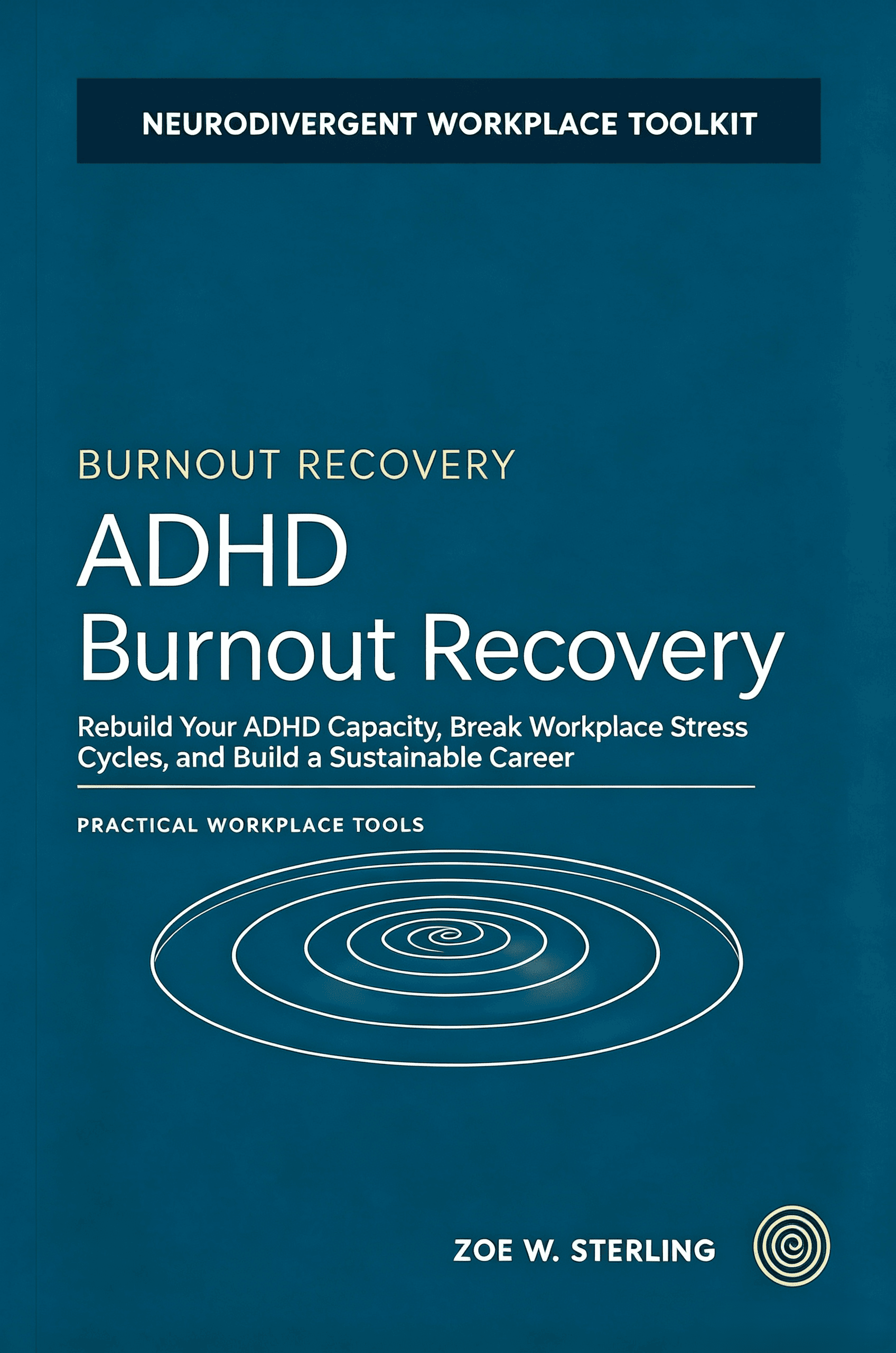
ADHD Burnout Recovery
ADHD burnout is different from typical burnout. Rooted in overstimulation, executive dysfunction, and the gap between natural strengths and workplace demands, it requires a specialized recovery approach.
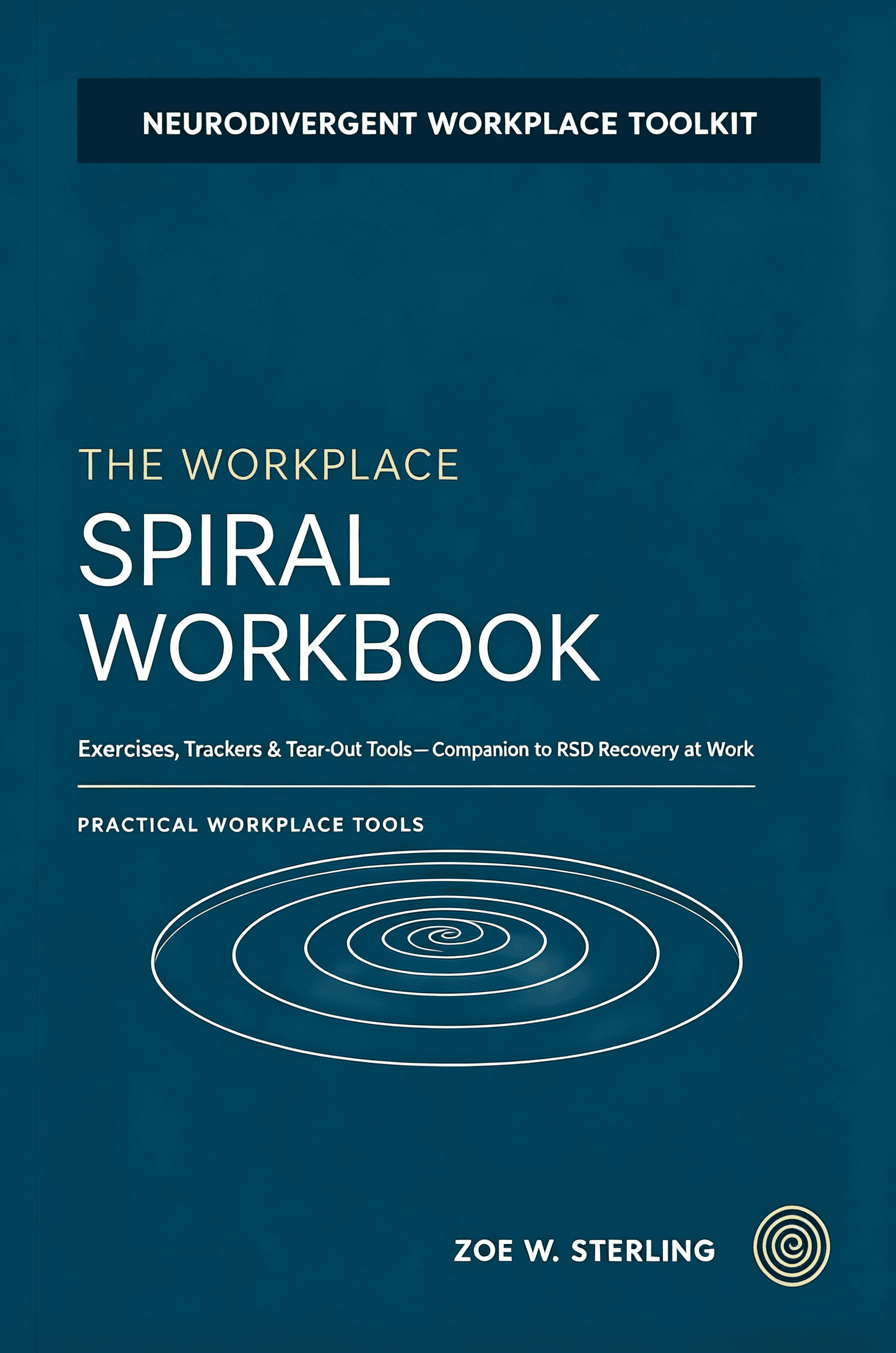
The Workplace Spiral Workbook
This interactive workbook is the companion to Zoe Sterling's Workplace Spiral assessment. Readers identify their spiral type, track their workplace patterns, and practice rewiring strategies to break free from unhealthy cycles.
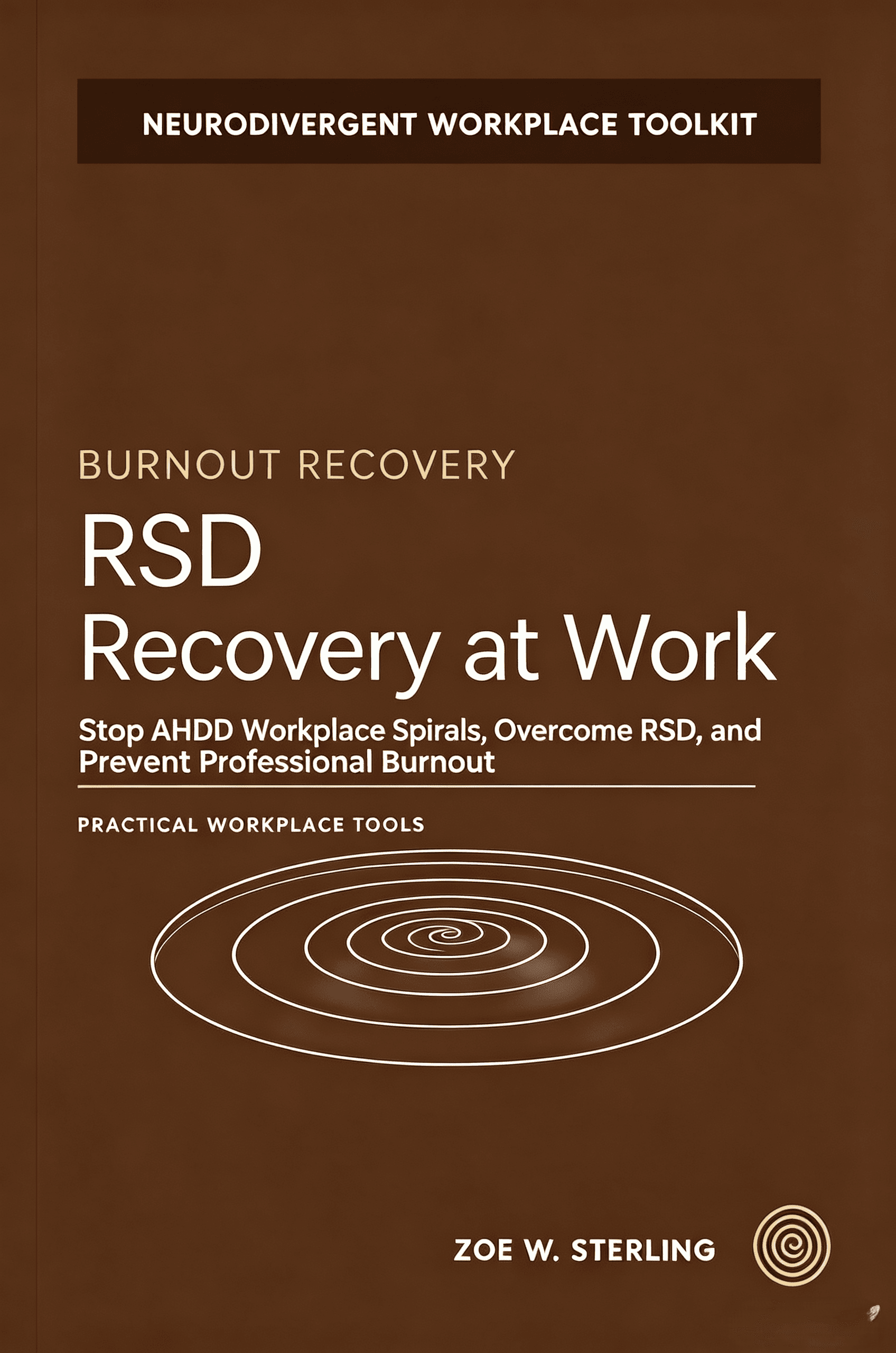
RSD Recovery at Work
A comprehensive field guide for neurodivergent adults navigating the workplace. Based on Zoe Sterling's 10+ years of ADHD workplace research and coaching, this book identifies 8 core strengths and 7 hidden workplace patterns.