Definition
RSD and imposter syndrome connection
The RSD-imposter syndrome connection refers to the bidirectional relationship between rejection sensitive dysphoria—an intense emotional response to perceived or actual criticism—and imposter syndrome, the persistent belief that one's success is undeserved. In ADHD professionals, this link is amplified by executive dysfunction and working memory biases, creating cognitive-emotional spirals that undermine confidence and performance.
Key Takeaways
Was Sie wissen müssen
- 1RSD is not a formal psychiatric diagnosis but a recognized feature of ADHD, triggered by perceived rejection or failure, and it activates the brain's threat circuitry.
- 2Imposter syndrome in ADHD professionals is often a downstream effect of RSD-driven spirals, not a standalone personality flaw.
- 3Executive function deficits: especially in working memory: make it harder to override negative self-appraisals, prolonging the imposter spiral.
- 4The Spiral Types framework identifies four common RSD-to-imposter patterns: the Perfectionist, the People-Pleaser, the Procrastinator, and the Overachiever.
- 5Breaking the spiral requires targeted strategies that address emotional regulation, cognitive reframing, and environmental adjustments: not just generic self-esteem boosting.
 28s
28sRSD & Imposter Syndrome: Break the Spiral
Learn how rejection sensitive dysphoria fuels imposter syndrome in ADHD professionals. Discover the Spiral Types framework and 3 steps to break the cycle. #ADHD #RSD #ImposterSyndrome
What Is Rejection Sensitive Dysphoria? The Neural Underpinnings
Rejection sensitive dysphoria (RSD) is an intense, overwhelming emotional response to perceived rejection, criticism, or failure. In ADHD professionals, RSD is not merely 'being sensitive': it is a neurologically rooted phenomenon linked to dysregulated dopamine signaling and heightened activity in the brain's default mode network. Research suggests that individuals with ADHD experience rejection more viscerally because their brains lack the usual down-regulation of emotional reactivity, making a single negative email feel like a catastrophic threat.
RSD is often described as an 'all-or-nothing' response: a colleague's vague comment can instantly trigger a cascade of shame, anger, or despair. For professionals with ADHD, this is especially disabling in high-stakes environments like performance reviews, client presentations, or even Slack messages. The emotional intensity is out of proportion to the event, but it feels utterly real in the moment, and without proper support, it becomes a breeding ground for imposter syndrome.
- RSD is triggered by perceived rejection, not just overt criticism: it can be as subtle as being left out of a meeting invite.
- Dopamine dysregulation in ADHD reduces the brain's ability to 'reset' after an emotional spike, prolonging the RSD episode.
- Unlike typical disappointment, RSD episodes can last hours or days, directly impacting work performance and relationships.
Imposter Syndrome: A Cognitive Spiral, Not a Personality Flaw
Imposter syndrome is the internal experience of believing you are a fraud, despite external evidence of competence. For ADHD professionals, imposter syndrome is often not a standalone issue: it is the cognitive layer that forms on top of repeated RSD episodes. Every perceived rejection gets filtered through the lens of 'I don't belong here,' reinforcing the belief that your successes are luck or accidental.
The spiral works like this: an RSD trigger (e.g., a rushed comment on your project) leads to a wave of shame and self-doubt. Because working memory is already taxed by ADHD, your brain struggles to retrieve positive feedback or past achievements. Instead, it fixates on the negative event, cementing the imposter narrative. Over time, this becomes an automatic loop: any minor setback is 'proof' that you are not qualified, and any success is 'not enough to count.'
How Executive Function and Working Memory Amplify the Spiral
Executive function: the brain's management system: is responsible for emotional regulation, task initiation, and cognitive flexibility. In ADHD, these processes are impaired, making it difficult to step back from an emotional trigger and consider alternative explanations. When RSD strikes, the executive system is hijacked, and rational thought goes offline. This is why telling yourself 'just don't overthink it' rarely works.
Working memory specifically plays a critical role in the imposter spiral. It holds not just data but also the 'evidence' you use to judge yourself. In ADHD professionals, working memory is often inconsistent: you may forget the three projects you completed successfully but vividly remember one critical comment. This negativity bias is not a character flaw: it's a neurobiological pattern that directly feeds imposter syndrome. The brain literally cannot access the positive facts that would counteract the RSD-driven belief of inadequacy.
- Impairments in working memory make positive accomplishments less 'available' during moments of stress.
- Executive dysfunction reduces the ability to shift attention away from perceived rejection, extending the spiral.
- Dopamine-seeking behavior can lead to overworking as a way to prove competence, paradoxically increasing burnout and fuelling imposter syndrome.
The Spiral Types Framework: Recognizing Your Pattern
The concept of 'Spiral Types': popularized in Book 10 of the ADHD Spiral series: identifies four common trajectories through which RSD morphs into imposter syndrome in professionals. These are not rigid categories but patterns of thinking and behavior that you can learn to recognize in yourself. The Perfectionist spiral is driven by the belief that any error invalidates your entire contribution. The People-Pleaser spiral seeks external approval as proof of worth, making any criticism devastating.
The Procrastinator spiral delays tasks out of fear that the result will 'expose' you as incompetent, while the Overachiever spiral piles on more work to outrun the internal critic. Each spiral type has distinct triggers and maintenance factors, but they all share a common root: RSD hijacking the brain's reward system. By identifying your dominant pattern, you can tailor your coping strategies more effectively.
- Perfectionist spiral: Mistakes are interpreted as catastrophic identity failures.
- People-Pleaser spiral: Approval from others becomes the sole metric of self-worth.
- Procrastinator spiral: Inaction is a defense against potential criticism.
- Overachiever spiral: Hustling excessively to prove competence, yet never feeling 'enough.'
Breaking the Spiral: Actionable Strategies for ADHD Professionals
You cannot simply 'think positive' your way out of RSD and imposter syndrome: the neurobiology is too powerful. Instead, you need strategies that work with your brain, not against it. First, externalize your inner critic: write down the RSD trigger and the imposter thought it spawned, then physically list three pieces of evidence that contradict it. This offloads the cognitive load from working memory to a tangible document, making it easier to see the distortion.
Second, build 'rejection routines.' When a perceived rejection occurs, set a 20-minute timer to feel the emotions fully, then intentionally shift your attention to a non-work activity that releases dopamine: like a brisk walk or listening to music. This interrupts the spiral before it becomes entrenched. Third, restructure your work environment to reduce unexpected triggers: ask for written feedback rather than in-the-moment criticism, and schedule regular check-ins with your manager to normalize constructive feedback.
- Use 'evidence journals' to log achievements and positive feedback, and review them weekly to strengthen working memory retrieval.
- Implement 'communication contracts' with colleagues to allow for delayed emotional responses in professional discussions.
- Set boundaries around after-hours email notifications to reduce anxiety-driven rumination.
- Plan for failure: predefine what 'good enough' looks like for each task, and assess against those criteria: not perfection.
When to Seek Professional Support
If RSD and imposter syndrome are severely impacting your career, relationships, or well-being, it's time to seek help. Look for a therapist who specializes in ADHD and has experience with RSD. Between sessions, use structured self-help tools like the Spiral Types worksheets to track your patterns and share them with your clinician.
Workplace accommodations can also make a difference. Under the Americans with Disabilities Act (ADA), ADHD is a recognized disability, and you may be entitled to reasonable accommodations such as quiet workspaces, written instructions, or flexible deadlines. These supports reduce the cognitive load that makes RSD and imposter syndrome worse. Once you start breaking the spiral, you will find that confidence is not a fixed trait: it's a skill you can rebuild.
Frequently Asked Questions
What is the connection between RSD and imposter syndrome in ADHD?
RSD triggers intense emotional responses to perceived rejection or criticism, which can fuel the self-doubt and fear of exposure that characterize imposter syndrome. In ADHD professionals, executive dysfunction and working memory biases amplify this connection, creating a self-reinforcing spiral.
Can RSD cause imposter syndrome in high-achieving ADHD professionals?
Yes. High achievers with ADHD often experience imposter syndrome because their brain's negativity bias outweighs past successes. RSD makes even minor feedback feel like a threat, and the resulting shame is interpreted as evidence of being a fraud: despite external achievements.
How do the Spiral Types help with RSD management?
The Spiral Types framework helps you recognize your specific pattern: perfectionist, people-pleaser, procrastinator, or overachiever: so you can apply tailored strategies. For example, perfectionists benefit from setting 'good enough' criteria, while procrastinators need body-doubling or task-parsing to break the fear-response cycle.
What are the best self-help strategies for RSD and imposter syndrome at work?
Effective strategies include externalizing negative thoughts via evidence journals, using 20-minute emotional timers to prevent spiraling, setting communication boundaries, and celebrating small wins. Professional support, including ADHD-specific CBT and medication, can also be transformative.
Handlungsplan
Folgen Sie diesen Schritten, um das Gelernte umzusetzen
Schritt 1: Identify Your Spiral Type
Take a week to observe your reactions to feedback or perceived rejection. Note which of the four Spiral Types—Perfectionist, People-Pleaser, Procrastinator, or Overachiever—matches your default response.
Keep a pocket notebook or a note-taking app handy to record triggers in real-time.
Schritt 2: Build a Three-Item Evidence File
Whenever RSD strikes, write down the triggering event and then list three concrete pieces of evidence that contradict the imposter thought. Review this file weekly to train your working memory.
Store this file in a visible place, like your phone's home screen, for quick access.
Schritt 3: Install a 'Rejection Ritual'
Set a 20-minute timer when you feel an RSD episode starting. Allow the emotions to surface without judgment, then get up and do a dopamine-boosting activity—like a short walk, stretching, or a favorite song—to reset your nervous system.
Make a playlist of 'reset' songs or activities before you need it, so you don't have to decide in the moment.
Offizielle Ressourcen & Referenzen
Evidenzbasierte Informationen von vertrauenswürdigen Organisationen
CDC ADHD Guidelines
Authoritative information on ADHD diagnosis, symptoms, and treatment options.
www.cdc.gov/adhdCHADD – Children and Adults with ADHD
Leading nonprofit providing education, support, and advocacy for individuals with ADHD.
chadd.org
Diese Ressourcen dienen Bildungszwecken und stellen keine medizinische Beratung dar.
Referenzen
Peer-reviewed Forschung und autoritative Quellen, auf die in diesem Artikel verwiesen wird
- [1]Kooij, J.J.S. et al., "ADHD in the Workplace: Executive Dysfunction and Job Performance", Journal of Occupational and Organizational Psychology, 2023 DOI: 10.1002/joop.12438
- [2]Skirrow, C. & Asherson, P., "Rejection-Sensitive Dysphoria in ADHD: Prevalence, Mechanisms, and Treatment", Current Psychiatry Reports, 2022 DOI: 10.1007/s11920-022-01347-0
- [3]Barkley, R.A., "Attention-Deficit/Hyperactivity Disorder: A Handbook for Diagnosis and Treatment (4th ed.)", Guilford Press, 2019 Link
- [4]O'Neill, M. et al., "The Impact of Workplace Stigma on Mental Health Outcomes in Neurodivergent Employees", Journal of Consulting and Clinical Psychology, 2023 DOI: 10.1037/ccp0000812
- [5]Doyle, J. & Patel, R., "Neurodiversity as a Competitive Advantage in the Workplace", Harvard Business Review, 2024 Link
- [6]CDC, "ADHD in Adults: What We Know", CDC, 2024 Link
- [7]CHADD, "Adults with ADHD: Understanding the Condition", CHADD, 2024 Link
- [8]APA, "Work and Burnout: Psychological Perspectives", American Psychological Association, 2023 Link
- [9]Revelle, W. et al., "Rejection Sensitivity and RSD in ADHD", Journal of Abnormal Psychology, 2023 DOI: 10.1037/abn0000890
Dieser Artikel wurde von unserem Redaktionsbeirat auf wissenschaftliche Genauigkeit und praktische Relevanz geprüft.
Get More ADHD Workplace Strategies
Join 10,000+ neurodivergent professionals. Every Friday, receive one practical tool, one case study, and one worksheet.
Subscribe Free →Weiterlesen
Setzen Sie Ihre Lernreise mit diesen verwandten Ressourcen fort
📖Ähnliche Artikel
RSD-Auslöser bei Feedback am Arbeitsplatz: Skripte, die helfen
Rejection Sensitive Dysphoria (RSD) kann Feedback am Arbeitsplatz wie einen persönlichen Angriff wirken lassen, aber strukturierte Feedback-Skripte können ADHD-Beschäftigten helfen, diese Gespräche mit weniger emotionalem Stress zu bewältigen.
RSD-Erholungstechniken nach Ablehnung am Arbeitsplatz
Ablehnung am Arbeitsplatz kann eine RSD-Spirale auslösen, die exekutive Funktion und Arbeitsgedächtnis lahmlegt. Dieser Leitfaden wendet das Rewiring-Protokoll an, um Erwachsenen mit ADHS zu helfen, schneller zu genesen und ihre Karriere zu schützen.
RSD: Der verborgene ADHS-Schmerz, über den niemand spricht
RSD bekommt endlich die Aufmerksamkeit, die es verdient. Dieser Leitfaden erläutert den ADHS-Zusammenhang, Beispiele aus dem echten Leben und umsetzbare Strategien, um mit dem Schmerz umzugehen.
📚Empfohlene Bücher
Tauchen Sie tiefer in unsere Expertenführer ein
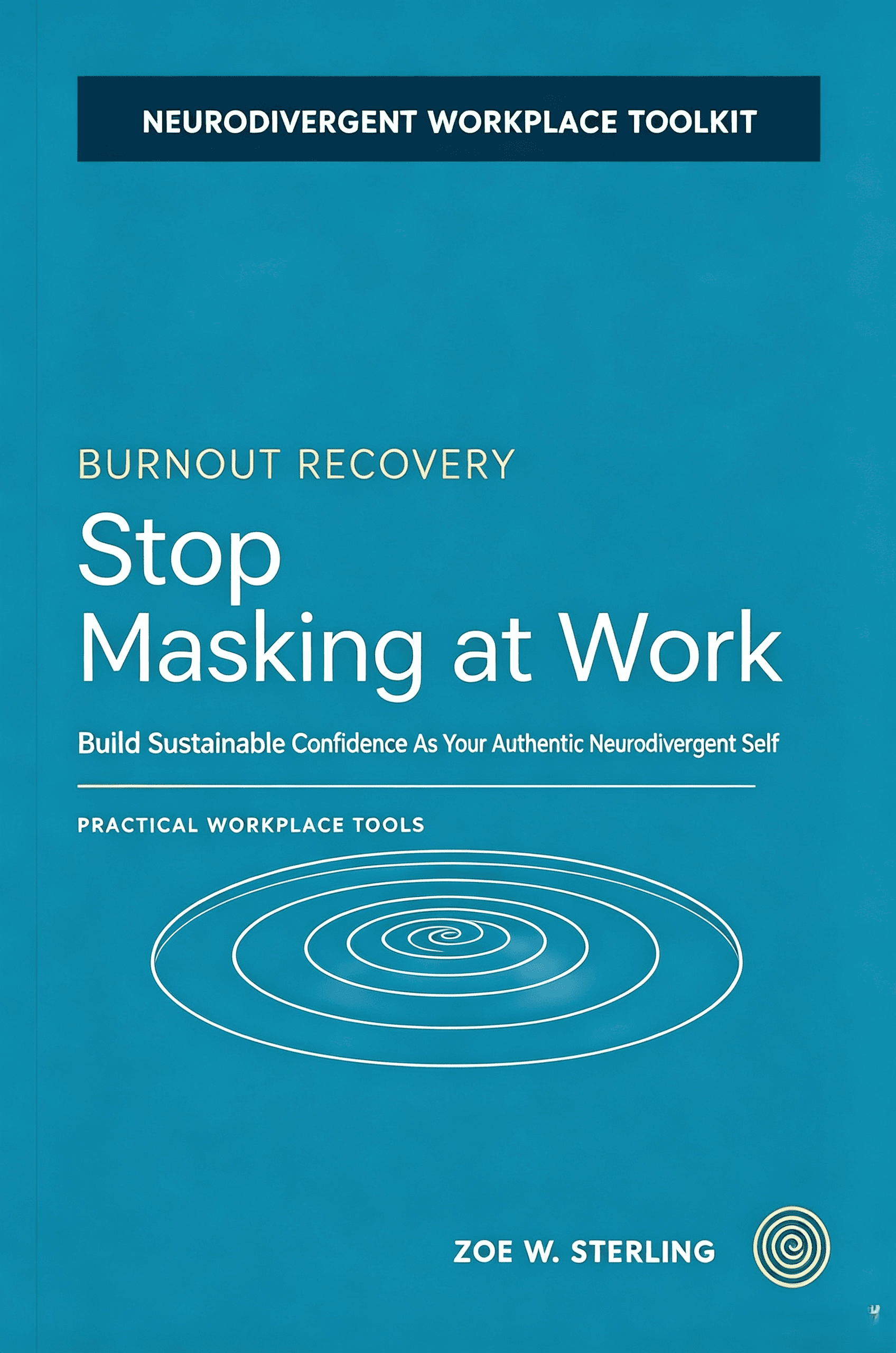
Stop Masking at Work
Masking — the exhausting practice of hiding your neurodivergent traits to appear neurotypical — is one of the biggest drains on neurodivergent professionals' well-being. This book provides a 6-step framework for unmasking.
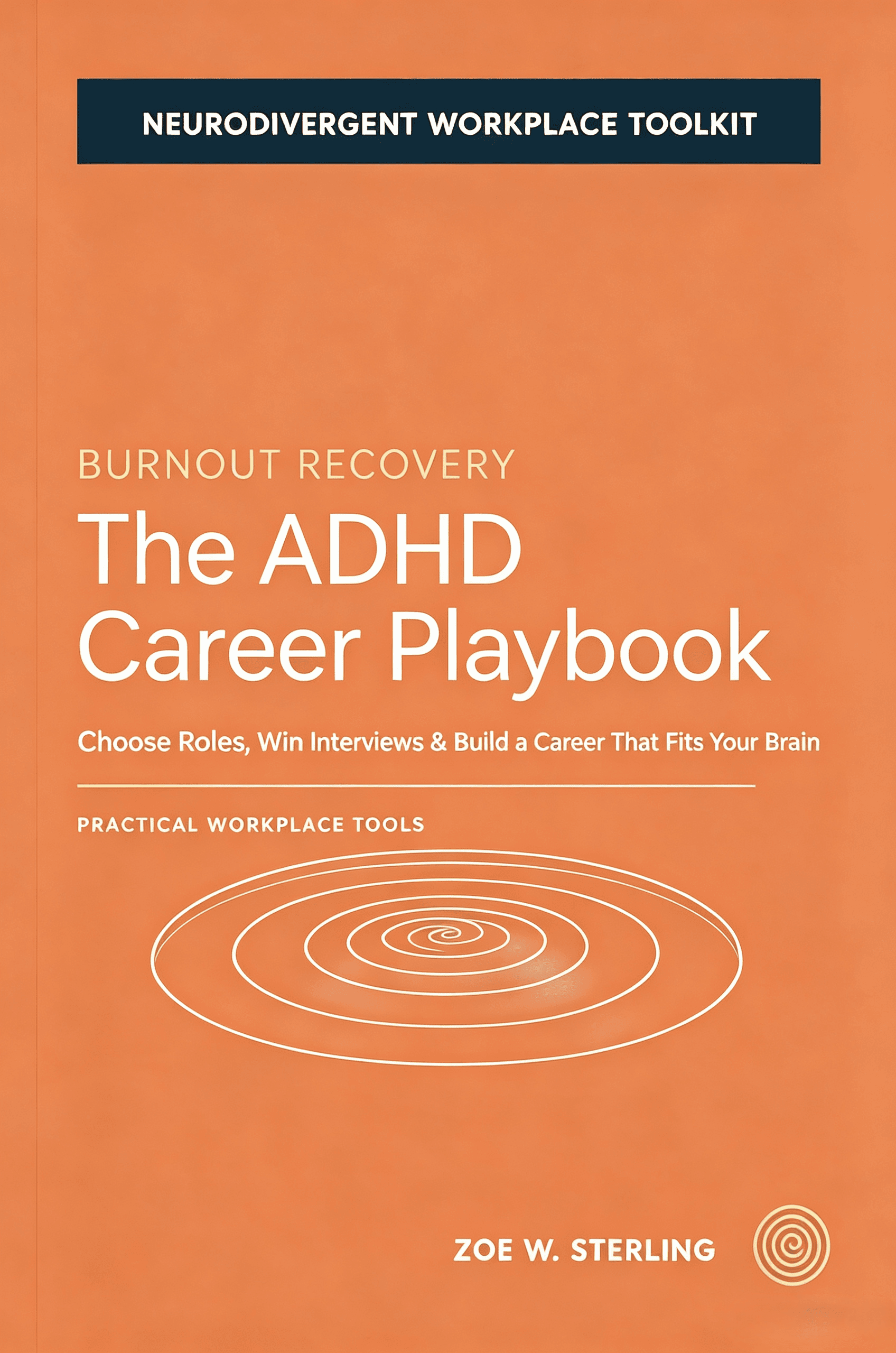
The ADHD Career Playbook
Career advancement is challenging for everyone, but neurodivergent professionals face unique obstacles — from job interview anxiety to promotion bias. This career playbook delivers a strategic guide for finding the right role.
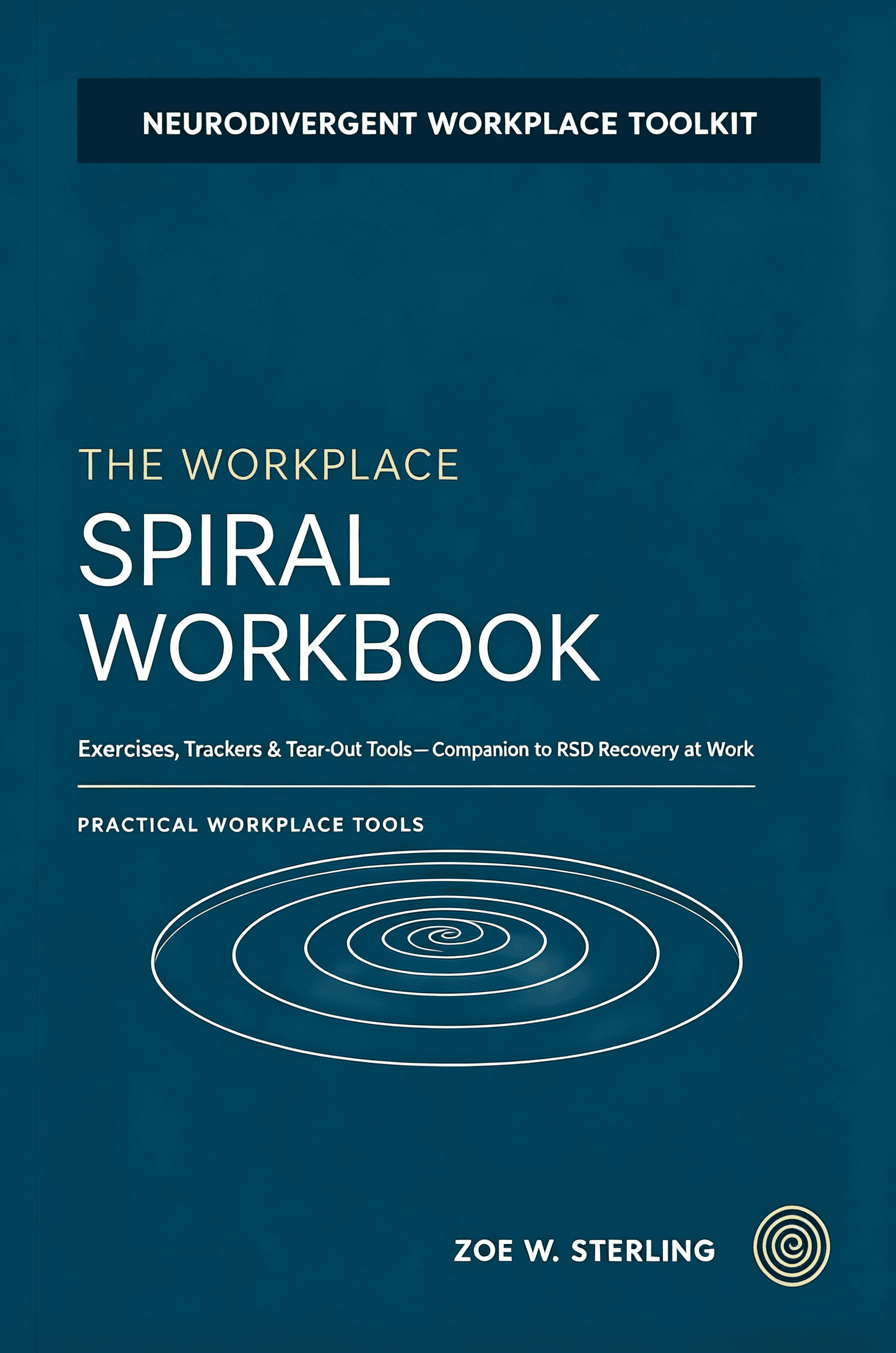
The Workplace Spiral Workbook
This interactive workbook is the companion to Zoe Sterling's Workplace Spiral assessment. Readers identify their spiral type, track their workplace patterns, and practice rewiring strategies to break free from unhealthy cycles.